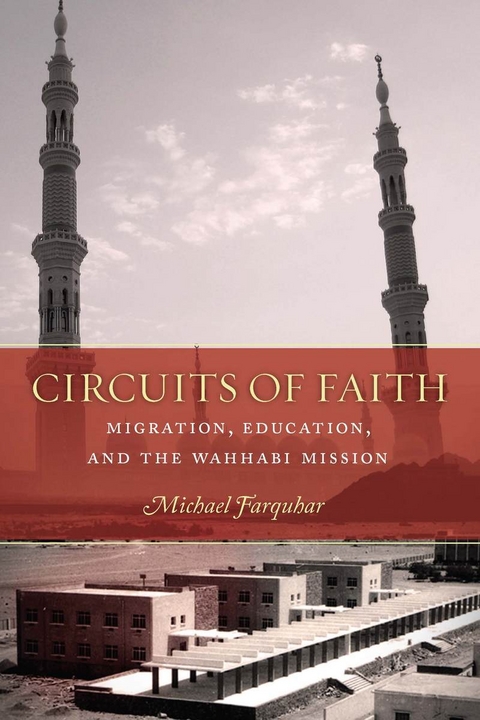
Circuits of Faith (eBook)
288 Seiten
Stanford University Press (Verlag)
9781503600270 (ISBN)
The Islamic University of Medina was established by the Saudi state in 1961 to provide religious instruction primarily to foreign students. Students would come to Medina for religious education and were then expected to act as missionaries, promoting an understanding of Islam in line with the core tenets of Wahhabism. By the early 2000s, more than 11,000 young men from across the globe had graduated from the Islamic University. Circuits of Faith offers the first examination of the Islamic University and considers the efforts undertaken by Saudi actors and institutions to exert religious influence far beyond the kingdom's borders. Michael Farquhar draws on Arabic sources, including biographical materials, memoirs, syllabi, and back issues of the Islamic University journal, as well as interviews with former staff and students, to explore the institution's history and faculty, the content and style of instruction, and the trajectories and experiences of its students. Countering typical assumptions, Farquhar argues that the project undertaken through the Islamic University amounts to something more complex than just the one-way "e;export"e; of Wahhabism. Through transnational networks of students and faculty, this Saudi state-funded religious mission also relies upon, and has in turn been influenced by, far-reaching circulations of persons and ideas.
Michael Farquhar is Lecturer in Middle East Politics at King's College London.
Contents and AbstractsIntroduction chapter abstractThis chapter introduces the question of Saudi "religious expansion" – that is, the various processes by which Saudi actors are said to have exerted increasing religious influence beyond the kingdom's borders in the course of the twentieth century – and it situates the Islamic University of Medina as a key institution in relation to such dynamics. It establishes the contours of the Salafi and Wahhabi traditions, before setting out the historiographical framework employed throughout the remainder of the book. The latter is grounded in a particular conception of a transnational religious economy, comprising flows – both within and across borders – of material capital, spiritual capital, religious migrants and social technologies. The chapter ends with a brief overview of the historical narrative and arguments that run through the book.1Transformations in the Late Ottoman Hijaz chapter abstractThis chapter develops an account of education in mosques, madrasas and Sufi lodges in the Hijaz in the Ottoman period which hosted scholars and students from across the Islamic world. It shows that education in these settings was supported by a variety of cross-border flows of material capital, that methods of instruction were largely personalized and informal, and that these arrangements fostered a religious economy marked by considerable diversity. However, from the end of the nineteenth century, new social technologies brought by religious migrants and imperial officials contributed to the spread of increasingly rationalized, bureaucratized modes of pedagogy. The chapter argues that these new practices paved the way for private and particularly state actors to exercise more sustained control over the distribution, exchange and translation of material and spiritual capital in religious educational settings.2Wahhabi Expansion in Saudi-Occupied Mecca chapter abstractThis chapter explores the use of education as a tool for expanding Wahhabi influence in the Hijaz, in the period immediately following its occupation by the Saudis in the 1920s. This project was fraught with tensions, occurring as it did in the context of a process of state-building within an occupied territory with its own religious traditions quite different from those of the Wahhabi heartlands of Najd. The chapter argues that this period saw the consolidation of numerous strategies – including not only material investment but also cultural appropriation, hegemonic modification of religious discourse, and the recruitment of migrants from across the Middle East to lend legitimacy to Wahhabi proselytizing – which would later become central to the role of education in expanding Saudi religious influence beyond the Peninsula. These arguments are illustrated with reference to the content and styles of teaching that developed in the Saudi Scholastic Institute in Mecca.3National Politics and Global Mission chapter abstractThis chapter traces the genesis and institutional evolution of the Islamic University of Medina from the time of its founding in 1961 and over the decades that followed. It maps the history of this key Wahhabi missionary project onto Cold War geopolitics, maneuvering between the Saudi royals and the Wahhabi establishment, efforts to bolster narratives of dynastic and national legitimacy, and shifts in the international oil economy. In doing so, it emphasizes the extent to which the transactions in material and spiritual capital which would occur on the IUM campus were influenced by Saudi politics and integrated with the kingdom's own political economy.4Migration and the Forging of a Scholarly Community chapter abstractThis chapter explores the role of large numbers of non-Saudi staff members at the Islamic University of Medina (IUM) from the early 1960s to the 1980s, and considers the part that they played in the remaking of Wahhabi religious authority. It argues that until the mid-twentieth century, the relatively parochial and insular nature of the Wahhabi scholarly milieu meant that Wahhabi scholars lacked the kinds of symbolic resources that would be required to launch such an ambitious missionary project. It then traces the trajectories that brought migrants from across the Middle East, Africa, South Asia and beyond to work at the IUM. It argues that, by bringing diversified reserves of spiritual capital – including qualifications acquired in venerable centers of learning like al-Azhar – these migrants lent legitimacy to the new effort to extend the Wahhabi mission to broad audiences beyond the kingdom's borders.5Rethinking Religious Instruction chapter abstractThis chapter considers the styles of pedagogy which took shape at the Islamic University of Medina from the time of its founding. It argues that the university was viewed by many of those involved as a response to imperial intrusions in the cultural sphere in the colonized parts of the Islamic world in which a large proportion of them had been born and raised. At the same time, rather than engaging in an effort to shore up what had come to be seen as traditional modes of religious schooling, they instead sought to actively appropriate social technologies of education whose own genealogies traced back to European metropoles and to rework them in the name of what was understood to consist in a project of cultural resistance.6A Wahhabi Corpus in Motion chapter abstractThis chapter considers the content of teaching at the Islamic University of Medina, from the time of its founding and over the decades that followed. While IUM syllabuses were from the start strongly influenced by Wahhabi norms, the bodies of knowledge that were to be transmitted to its students underwent certain subtle shifts over time. These shifts in many ways map onto, and no doubt in part reflect, the broader evolution of the Wahhabi tradition in the second half of the twentieth century. However, the chapter highlights evidence that they also related to the university's status as a node within a transnational religious economy and its engagement in far-reaching struggles to steer the course of the Islamic tradition.7Leaving Medina chapter abstractThis chapter explores the role of the Islamic University of Medina's non-Saudi students, as religious migrants, bearers of spiritual capital accumulated on its campus and mediators of its Wahhabi-influenced message. It considers their experiences in Medina and their trajectories after graduation. It argues that agency exercised by these students, as well as efforts by an array of religious authorities and lay actors around the world to contest their authority to speak in the name of Islam, have contributed to determining the ways in which the impact of the IUM project has played out in diverse locations. This suggests that, while Saudi religious and political elites may be able to exert religious influence abroad through the IUM, that influence does not necessarily constitute control.Conclusion chapter abstractThis chapter revisits the arguments that run throughout the book and considers their broader implications in regard to debates about Saudi "religious expansion", the evolution of the Wahhabi tradition within the kingdom's borders, and the rise of Salafism in locations around the world in the last decades of the twentieth century.
| Erscheint lt. Verlag | 16.11.2016 |
|---|---|
| Reihe/Serie | Stanford Studies in Middle Eastern and Islamic Societies and Cultures | Stanford Studies in Middle Eastern and Islamic Societies and Cultures |
| Sprache | englisch |
| Themenwelt | Geisteswissenschaften ► Religion / Theologie ► Islam |
| Sozialwissenschaften ► Soziologie ► Spezielle Soziologien | |
| Schlagworte | Islamic Education • Migration • Religious Economies • Salafism • Saudi Arabia • spiritual capital • transnational history • transnationalism • transnational religion • Wahhabism |
| ISBN-13 | 9781503600270 / 9781503600270 |
| Informationen gemäß Produktsicherheitsverordnung (GPSR) | |
| Haben Sie eine Frage zum Produkt? |
 EPUB (Adobe DRM)
Kopierschutz: Adobe-DRM
Adobe-DRM ist ein Kopierschutz, der das eBook vor Mißbrauch schützen soll. Dabei wird das eBook bereits beim Download auf Ihre persönliche Adobe-ID autorisiert. Lesen können Sie das eBook dann nur auf den Geräten, welche ebenfalls auf Ihre Adobe-ID registriert sind.
Details zum Adobe-DRM
Dateiformat: EPUB (Electronic Publication)
EPUB ist ein offener Standard für eBooks und eignet sich besonders zur Darstellung von Belletristik und Sachbüchern. Der Fließtext wird dynamisch an die Display- und Schriftgröße angepasst. Auch für mobile Lesegeräte ist EPUB daher gut geeignet.
Systemvoraussetzungen:
PC/Mac: Mit einem PC oder Mac können Sie dieses eBook lesen. Sie benötigen eine
eReader: Dieses eBook kann mit (fast) allen eBook-Readern gelesen werden. Mit dem amazon-Kindle ist es aber nicht kompatibel.
Smartphone/Tablet: Egal ob Apple oder Android, dieses eBook können Sie lesen. Sie benötigen eine
Geräteliste und zusätzliche Hinweise
Buying eBooks from abroad
For tax law reasons we can sell eBooks just within Germany and Switzerland. Regrettably we cannot fulfill eBook-orders from other countries.
aus dem Bereich