Confessions of the Shtetl (eBook)
360 Seiten
Stanford University Press (Verlag)
9781503600249 (ISBN)
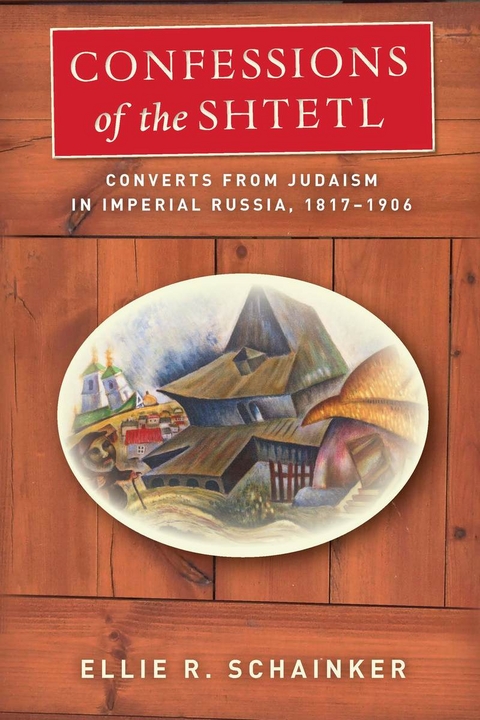
Over the course of the nineteenth century, some 84,500 Jews in imperial Russia converted to Christianity. Confessions of the Shtetl explores the day-to-day world of these people, including the social, geographic, religious, and economic links among converts, Christians, and Jews. The book narrates converts' tales of love, desperation, and fear, tracing the uneasy contest between religious choice and collective Jewish identity in tsarist Russia. Rather than viewing the shtetl as the foundation myth for modern Jewish nationhood, this work reveals the shtetl's history of conversions and communal engagement with converts, which ultimately yielded a cultural hybridity that both challenged and fueled visions of Jewish separatism. Drawing on extensive research with conversion files in imperial Russian archives, in addition to the mass press, novels, and memoirs, Ellie R. Schainker offers a sociocultural history of religious toleration and Jewish life that sees baptism not as the fundamental departure from Jewishness or the Jewish community, but as a conversion that marked the start of a complicated experiment with new forms of identity and belonging. Ultimately, she argues that the Jewish encounter with imperial Russia did not revolve around coercion and ghettoization but was a genuinely religious drama with a diverse, attractive, and aggressive Christianity.
Ellie R. Schainker is the Arthur Blank Family Foundation Assistant Professor of History and Jewish Studies at Emory University.
Contents and AbstractsIntroduction: Converts and Confessions chapter abstractThematically, the introduction first probes the role of the Russian government in managing religious diversity and toleration, and thus the relationship between mission and empire with regard to the Jews. Second, it explores the day-to-day world of converts from Judaism in imperial Russia, including the social, geographic, religious, and economic links among converts, Christians, and Jews. This exploration of daily life is attuned to convert motivations and post-baptism trajectories, and perhaps more significantly, it focuses on everyday relations of trust and attraction between Jews and their neighbors in the imperial Russian borderlands. Finally, the introduction examines the challenges of constructing, transgressing, and maintaining ethno-confessional boundaries by casting the convert as a boundary-crosser who exposes and thus renders violable the borders of faith, community, and nationhood.1The Genesis of Confessional Choice chapter abstractChapter 1 charts the institutionalization of confessional difference in the Russian Empire, from Tsar Alexander I and the genesis of confessional choice for Jews in 1817, to freedom of conscience measures instituted by Tsar Nicholas II in the wake of the 1905 revolution, which allowed Jewish converts to all tolerated confessions to legally reclaim their ancestral faith. The chapter uses the 1820 conversion to Catholicism of Moshe Schneerson, scion to the Chabad Hasidic dynasty, to illustrate the conditions in pre-reform imperial Russia (1817-1855) that shaped the conversion landscape for Jews. The tsarist state's missionary impulse was tempered by religious toleration and the empire's increasing patronage and sponsorship of a variety of Christian and non-Christian religions. The Schneerson case also highlights how contemporary Jews actively engaged with the problem of Jewish conversion and leveraged their confessional status to vie with the state for control over apostasy and communal belonging.2The Missionizing Marketplace chapter abstractChapter 2 uses the story of the convert from Judaism turned missionary Alexander Alekseev to highlight the overall reactive missionary policy of the state and the Orthodox Church with regard to Jews. The chapter analyzes self-appointed convert missionaries, their struggles with the strict translation politics of the Holy Synod, and how many leveraged foreign, non-Orthodox investments in proselytizing Jews to access Hebrew and Yiddish publications of scriptures. The intellectual and literary biographies of individual convert missionaries further illuminate how toleration and multiconfessionalism created ambivalence about proselytizing Jews, and how everyday Jewish encounters with Christianity were mediated by a range of religious groups beyond just the Russian Orthodox Church. These convert cum missionary stories are instructive for thinking about how converts navigated the multiconfessional landscape and were acutely aware of the marketplace of religion for Jews in a confessional state.3Shtetls, Taverns, and Baptism chapter abstractChapter 3 explores the social dynamics of religious toleration and the confessional state from below by examining the spaces of Jewish conversion. The chapter presents a range of conversion narratives which locate interfaith encounters at the local tavern as the springboard for migrating to a different confessional community. It analyzes daily social interactions among Jewish and neighboring Polish, Lithuanian, Belorussian, and Ukrainian communities, and how these encounters nurtured intimate knowledge of other confessional lifestyles, facilitated interfaith relationships, and provided access to the personnel and institutions of other faiths. By taking a geographical approach, the chapter presents the western provincial towns and villages of imperial Russia as interreligious zones wherein conversion was predicated on interconfessional networks, sociability, and a personal familiarity with Christianity via its adherents. In exploring forms of encounter, the chapter highlights the role of the local godparent—often local elites or civil/military personnel—in facilitating confessional transfers.4From Vodka to Violence chapter abstractChapter 4 analyzes narratives of Jewish violence against converts as another aspect of the provincial social threads of conversion. Here, the local spaces of conversion are important for the proximity of baptisms to the controlling gaze of Jewish family and community and the vulnerability of convert relapse into a Jewish milieu. Conversion as a form of boundary crossing raised anxieties about close interfaith living and became a flashpoint for negotiating the local politics of confessional coexistence and religious toleration. In these stories of violence in response to conversions, confessional feuds became family affairs—complete with familial contestation and the breakdown of the imperial, patriarchal family through conversion. The chapter offers a view of Jewish politics, shaped through empire and the confessional state, and the ways Jews worked through state documentary practices to alternatively endorse and resist conversion, and even mimic the previously violent, coercive practices of the state towards converts.5Relapsed Converts and Tales of Marranism chapter abstractChapter 5 analyzes narratives of relapsed converts and their multiple cultural fluencies using legal cases of converts suspected of illegally relapsing back to Judaism before 1905 and petitions for relapse after the legalization of apostasy in 1905. Imperial sponsorship of Russian Orthodoxy combined with the criminality of Orthodox deviance until 1905 created an environment in which Jewish converts often lived in the interstices of communal and confessional life, defying clear religious categorization. Relapsed converts and their tales of marranism, or secret Jewish practice, called into question the confessional state's strategy of mapping identity and community onto confessional ascription— especially in the wake of the cantonist episode when legal and chosen religious identities were often at odds. As church and state officials grappled with these difficulties, relapsed converts and their defenders tried to inscribe their cultural mobility into imperial law through freedom of conscience measures.6Jewish-Christian Sects in Southern Russia chapter abstractChapter 6 charts the proliferation of Jewish-Christian sects in southern Russia in the 1880s and the confessional journeys of their leaders and adherents who were in conversation with contemporary sectarian and revolutionary political movements. These sects provided a forum for a cross-cultural conversation in the public press on Jewish and Russian fears of conversion, cultural hybridity, and trespassing the boundaries of imperial confessions. The liminal space occupied by the sects highlighted the tension between tolerated confession and personal faith in the empire, and the question of where converts and schismatics communally belonged.Epilogue: Converts on the Cultural Map chapter abstractThe epilogue summarizes how the phenomenon of Russian Jewish conversion, though marginal in number, left an outsized imprint on the cultural map of East European Jews who grappled with questions of Jewish identity and the role of religion in the increasingly powerful Jewish secular nationalist ideologies of the late nineteenth and early twentieth centuries. The epilogue explores evolving Jewish attitudes towards baptism, interfaith sociability, and cultural mobility in the late-imperial period, and it puts conversions from Judaism in imperial Russia in conversation with conversions from Judaism in the modern period more broadly. Finally, the epilogue looks ahead to the inter-revolutionary period (1906-1917) and the Soviet period when conversions from Judaism accelerated, accompanied by a growing ethnic conception of Jewish identity whereby national Jewishness found explicit harmony with Christian religious adherence.
| Erscheint lt. Verlag | 16.11.2016 |
|---|---|
| Reihe/Serie | Stanford Studies in Jewish History and Culture | Stanford Studies in Jewish History and Culture |
| Zusatzinfo | 6 figures, 1 table, 1 map |
| Sprache | englisch |
| Themenwelt | Geisteswissenschaften ► Geschichte ► Regional- / Ländergeschichte |
| Geschichte ► Teilgebiete der Geschichte ► Kulturgeschichte | |
| Geisteswissenschaften ► Religion / Theologie ► Judentum | |
| Sozialwissenschaften ► Soziologie ► Spezielle Soziologien | |
| Schlagworte | Baptism • confessional state • Conversion • Imperial Russia • Jewish Identity • Jews • Pale of Jewish Settlement • Religious toleration • russian orthodoxy • Shtetl |
| ISBN-13 | 9781503600249 / 9781503600249 |
| Informationen gemäß Produktsicherheitsverordnung (GPSR) | |
| Haben Sie eine Frage zum Produkt? |
 EPUB (Adobe DRM)
Kopierschutz: Adobe-DRM
Adobe-DRM ist ein Kopierschutz, der das eBook vor Mißbrauch schützen soll. Dabei wird das eBook bereits beim Download auf Ihre persönliche Adobe-ID autorisiert. Lesen können Sie das eBook dann nur auf den Geräten, welche ebenfalls auf Ihre Adobe-ID registriert sind.
Details zum Adobe-DRM
Dateiformat: EPUB (Electronic Publication)
EPUB ist ein offener Standard für eBooks und eignet sich besonders zur Darstellung von Belletristik und Sachbüchern. Der Fließtext wird dynamisch an die Display- und Schriftgröße angepasst. Auch für mobile Lesegeräte ist EPUB daher gut geeignet.
Systemvoraussetzungen:
PC/Mac: Mit einem PC oder Mac können Sie dieses eBook lesen. Sie benötigen eine
eReader: Dieses eBook kann mit (fast) allen eBook-Readern gelesen werden. Mit dem amazon-Kindle ist es aber nicht kompatibel.
Smartphone/Tablet: Egal ob Apple oder Android, dieses eBook können Sie lesen. Sie benötigen eine
Geräteliste und zusätzliche Hinweise
Buying eBooks from abroad
For tax law reasons we can sell eBooks just within Germany and Switzerland. Regrettably we cannot fulfill eBook-orders from other countries.
aus dem Bereich