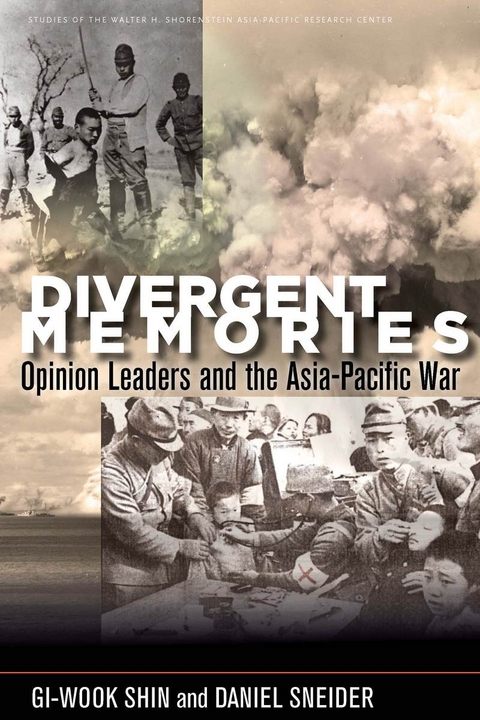
Divergent Memories (eBook)
376 Seiten
Stanford University Press (Verlag)
978-0-8047-9972-0 (ISBN)
Gi-Wook Shin is the Tong Yang, Korea Foundation, Korea Stanford Alumni Chair of Korean Studies; Professor of Sociology; Director of the Shorenstein Asia-Pacific Research Center; and Director of the Korea Program at Stanford University. Daniel Sneider is the Associate Director for Research of the Shorenstein Asia-Pacific Research Center at Stanford University, and, with Gi-Wook Shin, is Co-Director of the Divided Memories and Reconciliation Project.
Contents and Abstracts1Historical Memory, National Identity, and International Relations chapter abstractThis chapter introduces the entire volume, beginning with the ongoing importance of wartime history issues in shaping relations among the former combatants and their failure to achieve postwar reconciliation. The source of that failure, the book argues, is the existence of divergent memories of the past, shaped to serve the needs of national identity, and contested not only between nations but also within them. This book explains how China, Japan, South Korea and the United States all have formed very different memories of the war, each one having a focus on the past that differs from the others. This volume explores the role of elites in shaping historical memory, based on in-depth interviews with key elite opinion makers in China, Japan, South Korea and the United States.2Fashioning a Patriotic Narrative in Contemporary China chapter abstractThis chapter presents the formation of a patriotic narrative about the wartime past in China, explaining how the Chinese communist party leadership has shifted from a narrative that emphasized the civil war struggle against the rival Nationalists to a narrative of patriotic unity against foreign invaders, embodied in the resistance to Japanese aggression. The introductory section takes the reader to two national museums, one in Beijing focused on the resistance to Japan and one in Nanjing devoted to the massacre carried out by Japan in 1937, an emotional presentation of Chinese victimization. The introduction is followed by profiles of five opinion leaders – a historian who led dialogues with Japan, a journalist who fought to revise the Communist account of the war, the authoritative historian of the Sino-Japanese war, a prominent nationalist blogger, and a civil society activist against Japanese war crimes.3Confronting Collaboration in Korea chapter abstractThis chapter explores the formation of Korean understanding of their experience of Japanese colonial rule and the wartime period. But underneath are fault lines over the issue of Korean collaboration with the Japanese Empire and whether Japan contributed to Korea's own development. The five profiles explore different aspects of memory formation – a leftwing novelist whose fiercely nationalist epics excoriate collaboration, a prominent official involved in dialogue with Japan who also retains painful memories of a childhood under Japanese rule, a civil rights lawyer turned politician who fought for compensation from Japan for victims, a scholar who is attacked for arguing that Japan left some positive legacy, and an activist who fought on behalf of Korean women dragooned into sexual servitude by the Japanese.4Multiple Memories of War in Postwar Japan chapter abstractThis chapter explores the multiple wartime memories formed in Japan – the progressive narrative of Japanese militarism, the pacifist narrative of Japan as both aggressor and victim, and the conservative nationalist narrative that believes Japan fought a just war and denies criminality. These three views have been contending since 1945, with no consensus formed, beyond a sense of victimization. The section profiles five opinion leaders – a nationalist journalist who defends Japan's war record and agitates against China and Korea, a civil rights lawyer who fights for Korean, Chinese and Japanese victims of the war, a film maker who made a powerful film on the fire bombings, a diplomat and grandson of a convicted war criminal who seeks reconciliation, a prominent conservative newspaper publisher who still holds the Emperor responsible for the war.5The Uncomfortable War: the Pacific War in American memory chapter abstractThis chapter explores the place of the war in the Pacific in American historical memory. In contrast to the morality tale of the war in Europe against Nazi Germany, the war in the Pacific remains an uncomfortable war for many Americans. Overlain with racial overtones, it began with defeat, at Pearl Harbor and in the Philippines, was brutally fought, and ended with the morally ambiguous decision to drop the atomic bomb on two Japanese cities. The section profiles five Americans – a Chinese-American writer who brought the Nanjing massacre to public memory, a historian who chronicled the racial nature of the war, a Japanese-American politician who fought for justice for interned Japanese, a military historian who experienced the war as a boy, and a former POW forced laborer who still fights for compensation and recognition.6Japanese Colonial Rule, Forced Labor, and Comfort Women chapter abstractThis chapter looks at the diverse memories formed regarding the legacy of Japanese colonial rule and wartime administration, particularly the mobilization and use of forced labor by the Japanese Empire. The most egregious case of forced labor remains that of the so-called "comfort women," women who were recruited, often coercively, in Japan and in its colonies (Korea, Taiwan) and occupied lands (China, the Dutch East Indies, the Philippines) to servitude in brothels organized by the Japanese Imperial Army. The chapter explores the unresolved demands for compensation for the forced laborers, millions of who worked in Japanese mines and factories, and for the women. Whether these women were forced into sexual servitude or were willing prostitutes, as Japanese conservatives contend, remains a source of sharp tension, particularly between Japan and Korea.7The Sino-Japanese War and Japanese War Crimes chapter abstractThis chapter is devoted to the Sino Japanese war, a largely forgotten battlefield of the Second World War that caused more casualties than any other arena. Historical memory regarding this war is widely contentious, with disagreements that begin with the question of when the war began (with the seizure of Manchuria in 1931 or the widening of war in 1937), continue with debate over why Japan went to war with China and what were its goals and extend to divisions over whether China's resistance to Japan had any decisive impact on the outcome of the war. Not least, there remain sharp divisions, especially between Chinese and Japanese, but also within Japan, over the nature of Japanese war crimes in China, particularly the scale and character of the mass killings in Nanjing in 1937, and whether it was a singular moment in the war.8The War in the Pacific chapter abstractThis chapter is devoted to the Sino Japanese war, a largely forgotten battlefield of the Second World War that caused more casualties than any other arena. Historical memory regarding this war is widely contentious, with disagreements that begin with the question of when the war began (with the seizure of Manchuria in 1931 or the widening of war in 1937), continue with debate over why Japan went to war with China and what were its goals and extend to divisions over whether China's resistance to Japan had any decisive impact on the outcome of the war. Not least, there remain sharp divisions, especially between Chinese and Japanese, but also within Japan, over the nature of Japanese war crimes in China, particularly the scale and character of the mass killings in Nanjing in 1937, and whether it was a singular moment in the war.9The Atomic Bombings of Japan chapter abstractThis chapter looks at perhaps the most charged issue of the war, particularly for Japanese and Americans – the decision to drop atomic weapons on Japan. The bombings are key to Japan's formation of a victim consciousness in its historical memory, allowing Japan to avoid its own criminality and responsibility. Americans remain deeply torn about the decision – any suggestion at an official level that the use was not fully justified remains politically taboo and rejected by most Americans. The question of whether the President of the U.S. should visit the bombing sites, a step that some believe could aid reconciliation, and encourage Japan to reconcile with China and Korea, remains hotly debated. The chapter recounts however that Korean and Chinese opinion leaders almost universally approve the bombing and reject any notion of American apology.10The United States and Postwar Settlements chapter abstractThis chapter looks at the still highly contentious issue of the postwar settlement orchestrated by the United States and the failure of that settlement, embodied mainly in the San Francisco Peace Treaty, to settle claims for individual and state compensation for the victims of Japanese colonial rule and wartime aggression. Compensation issues are closely tied to the broader question of apology and the sense that Japanese leaders have used the postwar settlement as means to argue that it is no longer necessary for Japan to take public or legal responsibility for its war crimes. This chapter examines the decision of the U.S. not to bring the Japanese Emperor to trial, or to hold him personally accountable in any manner, for his leadership during the war, arguing that he was a figurehead and needed to secure the calm occupation of Japan.11Toward Historical Reconciliation in the Asia-Pacific chapter abstractThe conclusion of the book explains why the process of reconciliation among the wartime combatants in the Asia-Pacific has been so limited, especially compared to Europe. It suggests that the failure to reconcile is a major source of ongoing conflict and tension in the region, particularly between Japan and its neighbors. The chapter looks at efforts at reconciliation – apology, litigation, civil action, joint history commissions – and their limitations. Democracy, the conclusion argues, has made reconciliation more difficult, allowing public opinion in favor of historical redress to have more impact on the actions of governments, including China. It argues that a comparative understanding of the divergence in historical memory is a necessary foundation for reconciliation.
| Erscheint lt. Verlag | 7.9.2016 |
|---|---|
| Reihe/Serie | Studies of the Walter H. Shorenstein Asia-Pacific Research Center |
| Studies of the Walter H. Shorenstein Asia-Pacific Research Center | Studies of the Walter H. Shorenstein Asia-Pacific Research Center |
| Zusatzinfo | 24 halftones, 1 map |
| Sprache | englisch |
| Themenwelt | Geschichte ► Allgemeine Geschichte ► 1918 bis 1945 |
| Geisteswissenschaften ► Geschichte ► Regional- / Ländergeschichte | |
| Geschichte ► Teilgebiete der Geschichte ► Militärgeschichte | |
| Sozialwissenschaften ► Soziologie | |
| Schlagworte | Cognition • Cognitive Science of Religion • dual processing • Gods • human brain/mind • Human Evolution • mental modularity • Natural selection • religious ideas |
| ISBN-10 | 0-8047-9972-5 / 0804799725 |
| ISBN-13 | 978-0-8047-9972-0 / 9780804799720 |
| Informationen gemäß Produktsicherheitsverordnung (GPSR) | |
| Haben Sie eine Frage zum Produkt? |
 EPUB (Adobe DRM)
Kopierschutz: Adobe-DRM
Adobe-DRM ist ein Kopierschutz, der das eBook vor Mißbrauch schützen soll. Dabei wird das eBook bereits beim Download auf Ihre persönliche Adobe-ID autorisiert. Lesen können Sie das eBook dann nur auf den Geräten, welche ebenfalls auf Ihre Adobe-ID registriert sind.
Details zum Adobe-DRM
Dateiformat: EPUB (Electronic Publication)
EPUB ist ein offener Standard für eBooks und eignet sich besonders zur Darstellung von Belletristik und Sachbüchern. Der Fließtext wird dynamisch an die Display- und Schriftgröße angepasst. Auch für mobile Lesegeräte ist EPUB daher gut geeignet.
Systemvoraussetzungen:
PC/Mac: Mit einem PC oder Mac können Sie dieses eBook lesen. Sie benötigen eine
eReader: Dieses eBook kann mit (fast) allen eBook-Readern gelesen werden. Mit dem amazon-Kindle ist es aber nicht kompatibel.
Smartphone/Tablet: Egal ob Apple oder Android, dieses eBook können Sie lesen. Sie benötigen eine
Geräteliste und zusätzliche Hinweise
Buying eBooks from abroad
For tax law reasons we can sell eBooks just within Germany and Switzerland. Regrettably we cannot fulfill eBook-orders from other countries.
aus dem Bereich