


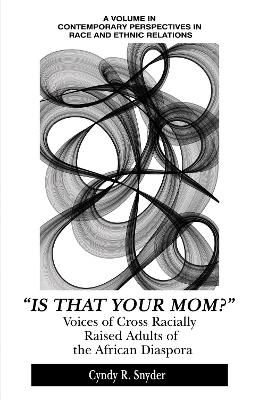
"Is That Your Mom?"
Voices of Cross Racially Raised Adults of The African Diaspora
Seiten
2017
Information Age Publishing (Verlag)
978-1-68123-849-4 (ISBN)
Information Age Publishing (Verlag)
978-1-68123-849-4 (ISBN)
This book explores the complexities of cross-racial families, centering the voices of Black individuals raised by White parents. It highlights their experiences with racism, parental efforts in racial socialization and coping strategies. The book offers insight for educators and parents to support resilience in racially hostile environments.
While White parents raising Black children has become increasingly salient in the last 20-30 years, the experience of those who grow up in these cross-racial families is much more complicated. Indeed, much of the adoption studies literature has privileged White parent voices, further silencing crossracially raised Black-identified children. “Is That Your Mom?” challenges the dominant narrative that love trumps race (and racism) in family dynamics, and reasserts the need for critical voices of those most impacted by being cross-racially raised: the very people who face extreme racism that is both similar to, and uniquely different from, that faced by people of color more broadly.
“Is That Your Mom?” centers the voices of Cross Racially Raised individuals of the African Diaspora to illustrate that racial socialization is a process in which individuals have agency in their racial development. In this book, Cross Racially Raised adults, both those who were adopted and those who were raised in cross-racial birth families, share their stories regarding experiences with racism in the following three ways: (1) encounters with racism within and beyond educational settings, (2) perceptions of parents or guardians’ efforts toward racial socialization, and (3) strategies used to navigate racially hostile environments (which sometimes are the families themselves). The voices of the individuals in this book illuminate a deeper conceptual understanding of how racial socialization practices are linked with one’s ability to cope with racism and ways of addressing racism, particularly among those families that contradict monoracial assumptions of racial socialization processes. The book concludes with a discussion of how schools, educators, and parents can help Cross Racially Raised children and youth develop skills necessary to cope and remain resilient in the face of racism, particularly if the immediate family is not offering those supports.
While White parents raising Black children has become increasingly salient in the last 20-30 years, the experience of those who grow up in these cross-racial families is much more complicated. Indeed, much of the adoption studies literature has privileged White parent voices, further silencing crossracially raised Black-identified children. “Is That Your Mom?” challenges the dominant narrative that love trumps race (and racism) in family dynamics, and reasserts the need for critical voices of those most impacted by being cross-racially raised: the very people who face extreme racism that is both similar to, and uniquely different from, that faced by people of color more broadly.
“Is That Your Mom?” centers the voices of Cross Racially Raised individuals of the African Diaspora to illustrate that racial socialization is a process in which individuals have agency in their racial development. In this book, Cross Racially Raised adults, both those who were adopted and those who were raised in cross-racial birth families, share their stories regarding experiences with racism in the following three ways: (1) encounters with racism within and beyond educational settings, (2) perceptions of parents or guardians’ efforts toward racial socialization, and (3) strategies used to navigate racially hostile environments (which sometimes are the families themselves). The voices of the individuals in this book illuminate a deeper conceptual understanding of how racial socialization practices are linked with one’s ability to cope with racism and ways of addressing racism, particularly among those families that contradict monoracial assumptions of racial socialization processes. The book concludes with a discussion of how schools, educators, and parents can help Cross Racially Raised children and youth develop skills necessary to cope and remain resilient in the face of racism, particularly if the immediate family is not offering those supports.
Cyndy R. Snyder, University of Washington, School of Medicine, Department of Family Medicine, Seattle, WA
Acknowledgments.
Chapter 1. Learning to be Cross Racially Raised in a Racist World.
Chapter 2. Mommy, He Called Me the N-Word: Encountering Racism in School and Everyday Contexts.
Chapter 3. Who's Talkin’ ’Bout Race and Who's Not: Colorblind and Race-Conscious Approaches to Racial Socialization.
Chapter 4. Finding Our Way: Strategies for Coping With and Responding to Racism.
Chapter 5. Developing Racial Competency Within America's Racial Divide.
References.
Appendix.
About the Author.
| Erscheinungsdatum | 09.06.2017 |
|---|---|
| Reihe/Serie | Contemporary Perspectives in Race and Ethnic Relations |
| Sprache | englisch |
| Maße | 156 x 234 mm |
| Gewicht | 162 g |
| Themenwelt | Sozialwissenschaften ► Ethnologie |
| Sozialwissenschaften ► Soziologie | |
| ISBN-10 | 1-68123-849-7 / 1681238497 |
| ISBN-13 | 978-1-68123-849-4 / 9781681238494 |
| Zustand | Neuware |
| Informationen gemäß Produktsicherheitsverordnung (GPSR) | |
| Haben Sie eine Frage zum Produkt? |
Mehr entdecken
aus dem Bereich

aus dem Bereich
Prolegomena zu einer Geschichte der Magie
Buch | Hardcover (2025)
Matthes & Seitz Berlin (Verlag)
CHF 53,20
Buch | Hardcover (2021)
Konstanz University Press (Verlag)
CHF 39,20
ethnographische Texte
Buch | Hardcover (2025)
Konstanz University Press (Verlag)
CHF 36,40


