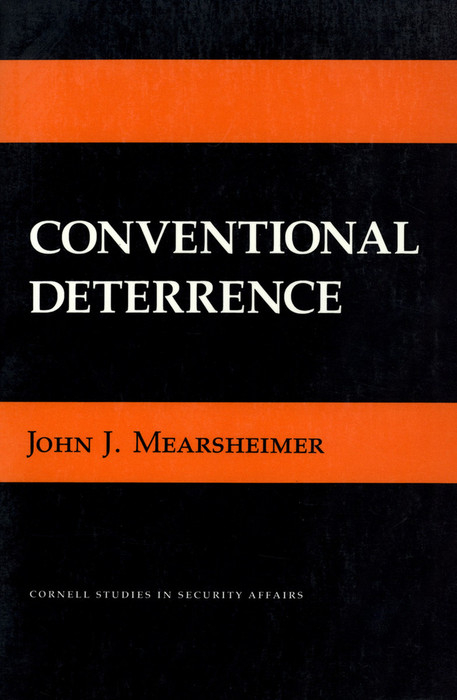
Conventional Deterrence (eBook)
296 Seiten
Cornell University Press (Verlag)
978-1-5017-1326-2 (ISBN)
Conventional Deterrence is a book about the origins of war. Why do nations faced with the prospect of large-scale conventional war opt for or against an offensive strategy? John J. Mearsheimer examines a number of crises that led to major conventional wars to explain why deterrence failed.
John J. Mearsheimer is R. Wendell Harrison Distinguished Service Professor of Political Science at the University of Chicago. He is the author of many books, includingWhy Leaders Lie: The Truth about Lying in International Politics
Conventional Deterrence is a book about the origins of war. Why do nations faced with the prospect of large-scale conventional war opt for or against an offensive strategy? John J. Mearsheimer examines a number of crises that led to major conventional wars to explain why deterrence failed. He focuses first on Allied and German decision making in the years 1939-1940, analyzing why the Allies did not strike first against Germany after declaring war and, conversely, why the Germans did attack the West. Turning to the Middle East, he examines the differences in Israeli and Egyptian strategic doctrines prior to the start of the major conventional conflicts in that region. Mearsheimer then critically assays the relative strengths and weaknesses of NATO and the Warsaw Pact to determine the prospects for conventional deterrence in any future crisis. He is also concerned with examining such relatively technical issues as the impact of precision-guided munitions (PGM) on conventional deterrence and the debate over maneuver versus attrition warfare. Mearsheimer pays considerable attention to questions of military strategy and tactics. Challenging the claim that conventional detrrence is largely a function of the numerical balance of forces, he also takes issue with the school of thought that ascribes deterrence failures to the dominance of offensive weaponry. In addition to examining the military consideration underlying deterrence, he also analyzes the interaction between those military factors and the broader political considerations that move a nation to war.
| Erscheint lt. Verlag | 21.8.1985 |
|---|---|
| Sprache | englisch |
| Themenwelt | Schulbuch / Wörterbuch ► Lexikon / Chroniken |
| Geschichte ► Teilgebiete der Geschichte ► Militärgeschichte | |
| Sozialwissenschaften ► Politik / Verwaltung ► Europäische / Internationale Politik | |
| Sozialwissenschaften ► Politik / Verwaltung ► Politische Theorie | |
| Sozialwissenschaften ► Politik / Verwaltung ► Staat / Verwaltung | |
| ISBN-10 | 1-5017-1326-4 / 1501713264 |
| ISBN-13 | 978-1-5017-1326-2 / 9781501713262 |
| Informationen gemäß Produktsicherheitsverordnung (GPSR) | |
| Haben Sie eine Frage zum Produkt? |
 PDF (Adobe DRM)
Kopierschutz: Adobe-DRM
Adobe-DRM ist ein Kopierschutz, der das eBook vor Mißbrauch schützen soll. Dabei wird das eBook bereits beim Download auf Ihre persönliche Adobe-ID autorisiert. Lesen können Sie das eBook dann nur auf den Geräten, welche ebenfalls auf Ihre Adobe-ID registriert sind.
Details zum Adobe-DRM
Dateiformat: PDF (Portable Document Format)
Mit einem festen Seitenlayout eignet sich die PDF besonders für Fachbücher mit Spalten, Tabellen und Abbildungen. Eine PDF kann auf fast allen Geräten angezeigt werden, ist aber für kleine Displays (Smartphone, eReader) nur eingeschränkt geeignet.
Systemvoraussetzungen:
PC/Mac: Mit einem PC oder Mac können Sie dieses eBook lesen. Sie benötigen eine
eReader: Dieses eBook kann mit (fast) allen eBook-Readern gelesen werden. Mit dem amazon-Kindle ist es aber nicht kompatibel.
Smartphone/Tablet: Egal ob Apple oder Android, dieses eBook können Sie lesen. Sie benötigen eine
Geräteliste und zusätzliche Hinweise
Buying eBooks from abroad
For tax law reasons we can sell eBooks just within Germany and Switzerland. Regrettably we cannot fulfill eBook-orders from other countries.
aus dem Bereich