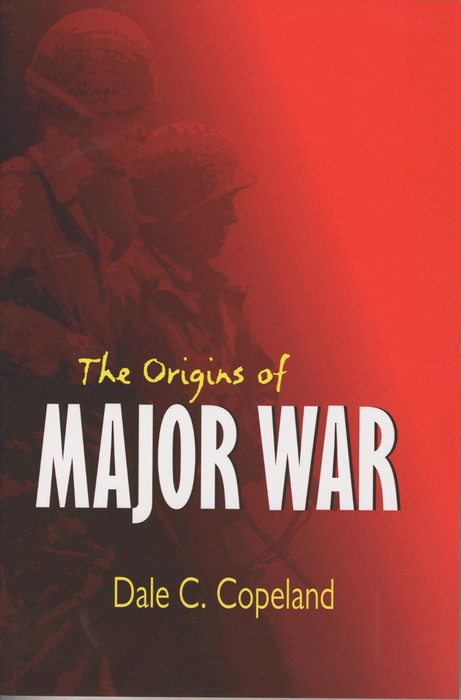
Origins of Major War (eBook)
336 Seiten
Cornell University Press (Verlag)
978-0-8014-6705-9 (ISBN)
One of the most important questions of human existence is what drives nations to war-especially massive, system-threatening war. Much military history focuses on the who, when, and where of war. In this riveting book, Dale C. Copeland brings attention to bear on why governments make decisions that lead to, sustain, and intensify conflicts.Copeland presents detailed historical narratives of several twentieth-century cases, including World War I, World War II, and the Cold War. He highlights instigating factors that transcend individual personalities, styles of government, geography, and historical context to reveal remarkable consistency across several major wars usually considered dissimilar. The result is a series of challenges to established interpretive positions and provocative new readings of the causes of conflict.Classical realists and neorealists claim that dominant powers initiate war. Hegemonic stability realists believe that wars are most often started by rising states. Copeland offers an approach stronger in explanatory power and predictive capacity than these three brands of realism: he examines not only the power resources but the shifting power differentials of states. He specifies more precisely the conditions under which state decline leads to conflict, drawing empirical support from the critical cases of the twentieth century as well as major wars spanning from ancient Greece to the Napoleonic Wars.
Dale C. Copeland is Associate Professor of International Relations in the Woodrow Wilson Department of Politics at the University of Virginia.
One of the most important questions of human existence is what drives nations to war-especially massive, system-threatening war. Much military history focuses on the who, when, and where of war. In this riveting book, Dale C. Copeland brings attention to bear on why governments make decisions that lead to, sustain, and intensify conflicts.Copeland presents detailed historical narratives of several twentieth-century cases, including World War I, World War II, and the Cold War. He highlights instigating factors that transcend individual personalities, styles of government, geography, and historical context to reveal remarkable consistency across several major wars usually considered dissimilar. The result is a series of challenges to established interpretive positions and provocative new readings of the causes of conflict.Classical realists and neorealists claim that dominant powers initiate war. Hegemonic stability realists believe that wars are most often started by rising states. Copeland offers an approach stronger in explanatory power and predictive capacity than these three brands of realism: he examines not only the power resources but the shifting power differentials of states. He specifies more precisely the conditions under which state decline leads to conflict, drawing empirical support from the critical cases of the twentieth century as well as major wars spanning from ancient Greece to the Napoleonic Wars.
| Erscheint lt. Verlag | 21.2.2013 |
|---|---|
| Sprache | englisch |
| Themenwelt | Geschichte ► Teilgebiete der Geschichte ► Militärgeschichte |
| Sozialwissenschaften ► Politik / Verwaltung ► Europäische / Internationale Politik | |
| Sozialwissenschaften ► Politik / Verwaltung ► Politische Theorie | |
| ISBN-10 | 0-8014-6705-5 / 0801467055 |
| ISBN-13 | 978-0-8014-6705-9 / 9780801467059 |
| Informationen gemäß Produktsicherheitsverordnung (GPSR) | |
| Haben Sie eine Frage zum Produkt? |
 PDF (Adobe DRM)
Kopierschutz: Adobe-DRM
Adobe-DRM ist ein Kopierschutz, der das eBook vor Mißbrauch schützen soll. Dabei wird das eBook bereits beim Download auf Ihre persönliche Adobe-ID autorisiert. Lesen können Sie das eBook dann nur auf den Geräten, welche ebenfalls auf Ihre Adobe-ID registriert sind.
Details zum Adobe-DRM
Dateiformat: PDF (Portable Document Format)
Mit einem festen Seitenlayout eignet sich die PDF besonders für Fachbücher mit Spalten, Tabellen und Abbildungen. Eine PDF kann auf fast allen Geräten angezeigt werden, ist aber für kleine Displays (Smartphone, eReader) nur eingeschränkt geeignet.
Systemvoraussetzungen:
PC/Mac: Mit einem PC oder Mac können Sie dieses eBook lesen. Sie benötigen eine
eReader: Dieses eBook kann mit (fast) allen eBook-Readern gelesen werden. Mit dem amazon-Kindle ist es aber nicht kompatibel.
Smartphone/Tablet: Egal ob Apple oder Android, dieses eBook können Sie lesen. Sie benötigen eine
Geräteliste und zusätzliche Hinweise
Buying eBooks from abroad
For tax law reasons we can sell eBooks just within Germany and Switzerland. Regrettably we cannot fulfill eBook-orders from other countries.
aus dem Bereich