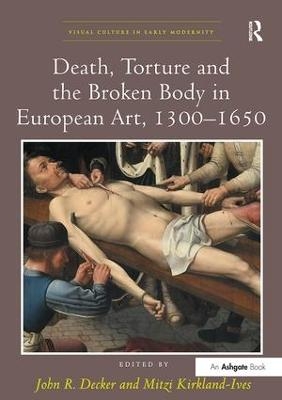
Death, Torture and the Broken Body in European Art, 1300–1650
Routledge (Verlag)
978-1-138-30741-4 (ISBN)
John R. Decker is Associate Professor of Art History at Georgia State University, USA, and author of The Technology of Salvation and the Art of Geertgen tot Sint Jans (Ashgate, 2009). Mitzi Kirkland-Ives is Associate Professor of Art and Design at Missouri State University, USA.
Contents: Introduction: Spectacular unmaking: creative destruction, destructive creativity, John R. Decker. Part 1 Holy Violence, the Creation of Martyrs: Guido da Siena and the four modes of violence, Assaf Pinkus; The suffering Christ and visual mnemonics in Netherlandish devotions, Mitzi Kirkland-Ives; A chopped-off head on a golden plate: Jan Mostaert’s Head of Saint John the Baptist on a Plate Surrounded by Angels, Soetkin Vanhauwaert; Reviving martyrdom: interpretations of the catacombs in Cesare Baronio’s patronage, Kelley Magill; The authorizations of torture: John Bale writing Anne Askew, Natalia Khomenko. Part 2 Social Violence, the Creation of Civic Identities: Killing and dying at The Death of Decius Mus, Renzo Baldasso; Dracula, the Turks and the rhetoric of impaling in 15th- and 16th-century Germany, Heather Madar; Execution by image: visual spectacularism and iconoclasm in late medieval and early modern Europe, Allie Terry-Fritsch; A shameful spectacle: Claes Jansz. Visscher’s 1623 news prints of executed Dutch ‘Arminians’, Maureen Warren; Conclusion: closing thoughts, John R. Decker. Bibliography; Index.
| Erscheinungsdatum | 23.09.2017 |
|---|---|
| Reihe/Serie | Visual Culture in Early Modernity |
| Verlagsort | London |
| Sprache | englisch |
| Maße | 174 x 246 mm |
| Gewicht | 520 g |
| Themenwelt | Kunst / Musik / Theater ► Kunstgeschichte / Kunststile |
| Sozialwissenschaften ► Soziologie | |
| ISBN-10 | 1-138-30741-6 / 1138307416 |
| ISBN-13 | 978-1-138-30741-4 / 9781138307414 |
| Zustand | Neuware |
| Informationen gemäß Produktsicherheitsverordnung (GPSR) | |
| Haben Sie eine Frage zum Produkt? |
aus dem Bereich