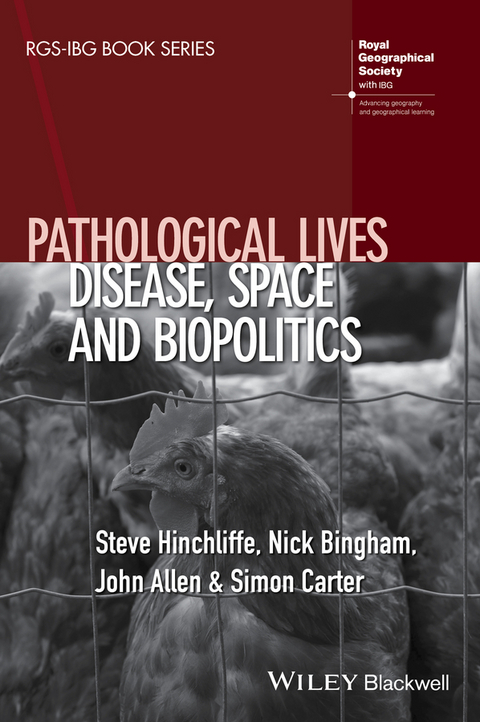
Pathological Lives (eBook)
John Wiley & Sons (Verlag)
978-1-118-99761-1 (ISBN)
- Uses empirical and social theoretical resources developed in the course of a 40-month research project entitled 'Biosecurity borderlands'
- Focuses on the food and farming sector, where the generation and subsequent transmission of disease has the ability to reach pandemic proportions
- Demonstrates the importance of a geographical and spatial analysis, drawing together social, material and biological approaches, as well as national and international examples
- The book makes three main conceptual contributions, reconceptualising disease as situated matters, the spatial or topological analysis of situations and a reformulation of biopolitics
- Uniquely brings together conceptual development with empirically and politically informed work on infectious and zoonotic disease, to produce a timely and important contribution to both social science and to policy debate
Steve Hinchliffe is Professor of Human Geography at Exeter University, UK. He is an elected Fellow of the Academy of Social Sciences and author and editor of numerous books and articles on issues ranging from risk and food, to biosecurity, urban ecologies and nature conservation. He sits on the UK's Food Standards Agency Social Science Research Committee and has advised DEFRA on responses to exotic disease events.
Nick Bingham is a Senior Lecturer in the Faculty of Social Sciences, The Open University, UK. Nick's current areas of research focus include the management of food safety, responses to the pollination crisis, and matters of coordination in smart cities. He is the author of numerous journal articles and book chapters and is joint editor of Contested Environments (with Andrew Blowers and Chris Belshaw, 2003).
John Allen is Professor of Economic Geography in the Faculty of Social Sciences, The Open University, UK. His teaching and research experience includes work on issues of power and spatiality, more recently in relation to financialization, privatization, biopower and topology. His publications include Lost Geographies of Power (Oxford, Blackwell, 2003) and Topologies of Power: Beyond Territory and Networks (2016), in addition to numerous authored and edited books.
Simon Carter is a Senior Lecturer in the Faculty of Social Sciences, The Open University, UK. Hisresearch interests are in Science and Technology Studies, especially as applied to issues of health and medicine. Most recently, he has been working on an ESRC funded study into how biosecurity interfaces with other concerns in our globalized world. He is the author of Rise and Shine (2007) as well as numerous book chapters and journal articles.Pandemics, epidemics and food borne diseases are a major global challenge. Focusing on the food and farming sector, and mobilising social theory as well as empirical enquiry, Pathological Lives investigates current approaches to biosecurity and ask how pathological lives can be successfully regulated without making life more dangerous as a result. Uses empirical and social theoretical resources developed in the course of a 40-month research project entitled Biosecurity borderlands Focuses on the food and farming sector, where the generation and subsequent transmission of disease has the ability to reach pandemic proportions Demonstrates the importance of a geographical and spatial analysis, drawing together social, material and biological approaches, as well as national and international examples The book makes three main conceptual contributions, reconceptualising disease as situated matters, the spatial or topological analysis of situations and a reformulation of biopolitics Uniquely brings together conceptual development with empirically and politically informed work on infectious and zoonotic disease, to produce a timely and important contribution to both social science and to policy debate
Steve Hinchliffe is Professor of Human Geography at Exeter University, UK. He is an elected Fellow of the Academy of Social Sciences and author and editor of numerous books and articles on issues ranging from risk and food, to biosecurity, urban ecologies and nature conservation. He sits on the UK's Food Standards Agency Social Science Research Committee and has advised DEFRA on responses to exotic disease events. Nick Bingham is a Senior Lecturer in the Faculty of Social Sciences, The Open University, UK. Nick's current areas of research focus include the management of food safety, responses to the pollination crisis, and matters of coordination in smart cities. He is the author of numerous journal articles and book chapters and is joint editor of Contested Environments (with Andrew Blowers and Chris Belshaw, 2003). John Allen is Professor of Economic Geography in the Faculty of Social Sciences, The Open University, UK. His teaching and research experience includes work on issues of power and spatiality, more recently in relation to financialization, privatization, biopower and topology. His publications include Lost Geographies of Power (Oxford, Blackwell, 2003) and Topologies of Power: Beyond Territory and Networks (2016), in addition to numerous authored and edited books. Simon Carter is a Senior Lecturer in the Faculty of Social Sciences, The Open University, UK. Hisresearch interests are in Science and Technology Studies, especially as applied to issues of health and medicine. Most recently, he has been working on an ESRC funded study into how biosecurity interfaces with other concerns in our globalized world. He is the author of Rise and Shine (2007) as well as numerous book chapters and journal articles.
Title Page 5
Copyright Page 6
Contents 9
List of Figures 11
Series Editors’ Preface 12
Acknowledgements 13
Foreword 15
Part I Framing Pathological Lives 21
Chapter One Pathological Lives – Disease, Space and Biopolitics 23
Introduction: The Emergency of Emergent Infectious Diseases 23
The Four Moves of Pathological Lives 28
References 41
Chapter 2 Biosecurity and the Diagramming of Disease 45
Disease Diagrams 47
The Disease Multiple: Germs and the Return of the Outside 51
Biosecurity and the Diagramming of Disease 54
Conclusions 67
References 69
Chapter Three Reconfiguring Disease Situations 72
Disease Situations 74
Microbial Life and Contagion as Difference and Repetition 87
A Topological Disease Situation 92
Conclusions 100
References 101
Part II Disease Situations 107
Introduction 107
References 109
Chapter Four ‘Just-in-Time’ Disease: A Campylobacter Situation 111
Factory-Farmed Chicken and Food-borne Disease 113
Relational Economy of Disease 121
Powers of Life 127
Conclusions 128
References 129
Chapter Five The De-Pasteurisation of England: Pigs, Immunity and the Politics of Attention 132
Birth of the Sty 133
Pigs in Practice – Fieldwork and Translations 139
Immunity, Attention and More-than-Human Responses 152
Conclusions 159
Endnotes 159
References 159
Chapter Six Attending to Meat 163
Introduction 163
Mapping the Current Landscape of Food Safety 164
A Failure of Coordination? 171
Inspection as Tending the Tensions of Food Safety 174
Being Stretched 182
Conclusions 184
References 186
Chapter 7 A Surfeit of Disease: Or How to Make a Disease Public 189
The Media Background to Disease Publics 191
Publicising Disease: From Public ‘Understanding’ to ‘Engagement’ 194
Understanding and Engaging Disease Publics 197
Understanding the Surfeit 199
Conclusions: Making a Disease Public 207
References 209
Chapter Eight Knowing Birds and Viruses – from Biopolitics to Cosmopolitics 212
Sensing Life 213
A Livelier Biopolitics and a Noisier Sentience 218
A Perceptual Ecology of Knowing Birds 220
Surveying Life 224
Knowing Viruses 226
The Significance of Observation 228
Conclusions 230
Endnotes 231
References 231
Chapter Nine Conclusions – Living Pathological Lives 234
Time-Space and Intra-Actions 236
A livelier Politics of Life 238
A new Kind of Emergency? 240
References 242
Index 243
EULA 264
'Pathological Lives is much more than an original contribution to the analysis of biosecurity and biopolitics. It shows us how an attentiveness to the complexity of situations can also generate vital normative conclusions.'
Andrew Barry, Chair of Human Geography and Vice-Dean (Interdisciplinarity), University College London
'Multi-species worlds also include pathogenic microbes. How, for better or worse, to co-exist with these and face the challenges they pose - whilst avoiding the tropes of total warfare and eradication? Pathological Lives is an acute and well-researched book that bravely faces up to this concern and that sets the scene for a new wave of fresh thinking about biopolitics.'
Annemarie Mol, Professor of Anthropology of the Body, The University of Amsterdam
'Pathological Lives offers an illuminating new approach to the problem of emerging infectious disease. The authors outline a relational understanding of disease where host and infective agent are held together by infrastructures of greater or lesser pathogenicity. This book is a rare thing in contemporary social science: a combination of close ethnographic study, critical policy analysis, and a profound philosophical intervention into contemporary theories of life, biopolitics and emergence.'
Melinda Cooper, Associate Professor of Sociology and Social Policy, The University of Sydney
"This book length account is to date the most thorough, detailed, and accessible treatment of the whole issue [of emerging diseases]. (...) the book asks new questions. In particular: "how various matters (including not only microbes) combine with other conditions to produce disease" (p.6). However, it goes much further than this. The very notions of health and disease are being challenged, as are terms such as pathogens, infection, and immunity. Hinchliffe et al. set out on a journey through barns, farms, slaughterhouses, restaurant kitchens, households, and wildfowl reserves. In the book we find five meticulously executed case studies that rely on data mainly gathered through participant observation, interviews, and focus groups in the respective locations. Whenever the logics of profit-making, austerity, and intensified agricultural practices meet, pathogenicity is on the rise. The situation becomes critical when contacts with other beings and organisms are severely reduced to the point of creating isolated ecologies. Being deprived of the possibility of learning and engaging with difference, these ecologies are highly unstable and prone to collapse. In reading Hinchliffe et al.'s book, we may need to reevaluate which circulations and movements we should allow and foster and which need to be controlled and kept in check. Reversing the current dominant logic of pathological geopolitics, we may need less economic and more social globalisation."
Jonathan Everts, Universität Bonn (writing in Antipode)
| Erscheint lt. Verlag | 27.4.2017 |
|---|---|
| Reihe/Serie | RGS-IBG Book Series | RGS-IBG Book Series |
| Sprache | englisch |
| Themenwelt | Naturwissenschaften ► Biologie ► Ökologie / Naturschutz |
| Naturwissenschaften ► Geowissenschaften ► Geografie / Kartografie | |
| Sozialwissenschaften ► Politik / Verwaltung | |
| Technik | |
| Weitere Fachgebiete ► Land- / Forstwirtschaft / Fischerei | |
| Schlagworte | Avian Influenza. Food borne disease • Biopolitics • biosecurity • Cosmopolitics • Disease • Ecological Politics • Epidemics • Epizootic • European politics • food-borne disease • food security • Geographical theory • Geographie • Geography • Global Health • human-animal interface • Human geography • infectious disease • <p>Spatial thinking • Materialities • multi-species ethnography • One Health</p> • pandemics • Pathogens • Political Geography • Political Science • Politik • Politik / Europa • Politikwissenschaft • Politische Geographie • Social & Cultural Geography • Sozio- u. Kulturgeographie • Swine Flu • Viruses |
| ISBN-10 | 1-118-99761-1 / 1118997611 |
| ISBN-13 | 978-1-118-99761-1 / 9781118997611 |
| Informationen gemäß Produktsicherheitsverordnung (GPSR) | |
| Haben Sie eine Frage zum Produkt? |
 PDF (Adobe DRM)
Kopierschutz: Adobe-DRM
Adobe-DRM ist ein Kopierschutz, der das eBook vor Mißbrauch schützen soll. Dabei wird das eBook bereits beim Download auf Ihre persönliche Adobe-ID autorisiert. Lesen können Sie das eBook dann nur auf den Geräten, welche ebenfalls auf Ihre Adobe-ID registriert sind.
Details zum Adobe-DRM
Dateiformat: PDF (Portable Document Format)
Mit einem festen Seitenlayout eignet sich die PDF besonders für Fachbücher mit Spalten, Tabellen und Abbildungen. Eine PDF kann auf fast allen Geräten angezeigt werden, ist aber für kleine Displays (Smartphone, eReader) nur eingeschränkt geeignet.
Systemvoraussetzungen:
PC/Mac: Mit einem PC oder Mac können Sie dieses eBook lesen. Sie benötigen eine
eReader: Dieses eBook kann mit (fast) allen eBook-Readern gelesen werden. Mit dem amazon-Kindle ist es aber nicht kompatibel.
Smartphone/Tablet: Egal ob Apple oder Android, dieses eBook können Sie lesen. Sie benötigen eine
Geräteliste und zusätzliche Hinweise
Buying eBooks from abroad
For tax law reasons we can sell eBooks just within Germany and Switzerland. Regrettably we cannot fulfill eBook-orders from other countries.
aus dem Bereich