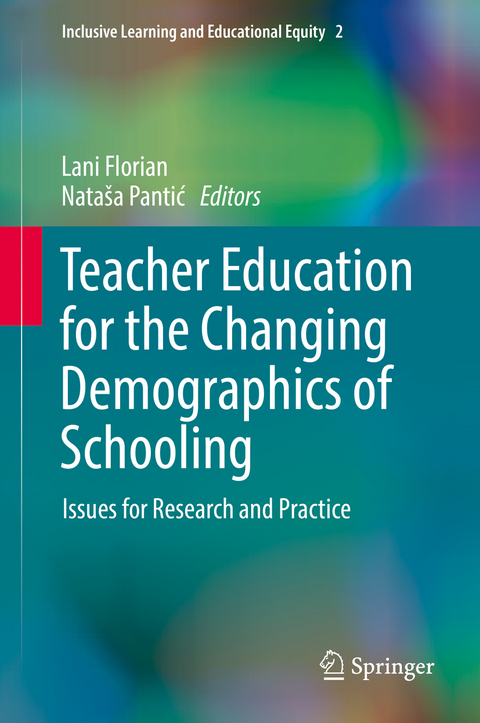
Teacher Education for the Changing Demographics of Schooling (eBook)
VIII, 241 Seiten
Springer International Publishing (Verlag)
978-3-319-54389-5 (ISBN)
The book takes as its premise the argument that diverse learner groups are a fact of demographic change that should be considered foundational in the preparation of teachers rather than be problematized as a challenge. It promotes the idea of teacher education for inclusive education based on a consideration of what it means to educate all children together. Divided into four parts, the book considers key issues for teacher education, teacher agency, teacher education for diversity, and a research agenda for the future.
In today's world, the demographic profile of students in schools is more complex than ever before, and the increasing cultural, linguistic and developmental diversity of today's classrooms, along with the pressure to achieve high academic standards for everybody has significant implications for how classroom teachers should be prepared to meet these demands. This book advances a new understanding of inclusive education that addresses the limitations inherent in current approaches that problematize differences between learner groups by promoting a view of difference as an aspect of human individuality. It considers the implications of the research evidence underpinning teacher education for diversity and makes suggestions for future research in the field.
Acknowledgments 6
Contents 7
Chapter 1: Teacher Education for the Changing Demographics of Schooling: Policy, Practice and Research 9
1.1 Introduction 9
1.2 Structure of the Book 11
References 12
Part I: Key Issues for Teacher Education 14
Chapter 2: Teacher Education for the Changing Demographics of Schooling: Inclusive Education for Each and Every Learner 15
2.1 Introduction 15
2.2 Inclusion Is About Each and Every Learner Rather Than Most and Some 17
2.3 All Learners Will Vary and Differences Are to Be Expected 18
2.4 Silos in Approaches to Teacher Education 19
2.5 Teacher Education for Inclusive Education 20
2.6 A Pedagogy for Everyone 21
2.7 Linking Inequality and Teacher Education 23
2.8 Conclusion 23
References 25
Chapter 3: European Teacher Education in the Grip of ‘Academic Tribes and Territories’ 27
3.1 Introduction 27
3.2 Teacher Education: Which Tribe? Which Territory? 28
3.3 Teacher Education in the Grip of National and European Higher Education Reform 32
3.4 Teacher Education and the Issue of Academic Autonomy 37
3.5 Conclusion 41
References 42
Chapter 4: Diversity, Development, Devolution: The Three Ds of UK Teacher Education and Professional Development in the Twenty-First Century 44
4.1 Introduction 44
4.2 D for Diversity 45
4.3 D for Development 48
4.4 D for Devolution 51
4.5 Conclusion 53
References 55
Part II: Teacher Agency 57
Chapter 5: Educating Teachers as Agents of Social Justice: A Virtue Ethical Perspective 58
5.1 Introduction 58
5.2 The Fair and Just Classroom Teacher 60
5.3 Educating Teachers for Justice and Fairness 63
5.3.1 ‘No Rules, However Wise, Are a Substitute for Affection and Tact’ 65
5.4 Implications for Teacher Education 67
References 67
Chapter 6: A Knowledge Base for Teachers on Teacher-Student Relationships 69
6.1 An Interpersonal Perspective on Teaching 69
6.2 The Questionnaire on Teacher Interaction 70
6.3 Teacher-Student Relationships and Student Outcomes 72
6.4 Relationships Over Time 74
6.5 Interpersonal Relations Across the Teaching Career 75
6.6 Complementarity in Interactions 77
6.7 Coercive and Supportive Behaviour and Teacher-Student Relationship 79
6.8 Conclusion 80
References 81
Chapter 7: The Place of Leadership Development for Change Agency in Teacher Education Curricula for Diversity 84
7.1 Introduction 84
7.2 Initial Teacher Education 86
7.2.1 Assumption 1: The Initial Phase Is the Main (Only) Time When Teachers Learn 87
7.2.2 Assumption 2: The Kind of Knowledge Teachers Need Can Be Transmitted to Them During This Initial Phase 88
7.2.3 Assumption 3: Teachers Demonstrate Their Grasp of Knowledge by ‘Using’ It, or ‘Applying’ It in Practice 89
7.3 The Concept of Leadership 90
7.3.1 Identity 92
7.3.2 Agency 93
7.3.3 Expertise 94
7.4 Developing Teacher Education 96
References 98
Part III: Teacher Education for Diversity 101
Chapter 8: How Effectively Are Mainstream Teachers Prepared to Meet the Needs of Learners for Whom English Is an Additional Language? 102
8.1 Background 102
8.2 EAL Learners: Languages, Literacies, Power and Identity 103
8.2.1 Second Language ‘Acquisition’ 103
8.2.2 Language Diversity and Literacies 104
8.3 Investigating Teacher Educators’ and Student Teachers’ Preparedness to Support EAL Learners 105
8.3.1 Focus and Structure 105
8.4 Design and Methods of the Study 105
8.4.1 The Intervention 107
8.4.2 The Second Student Survey 108
8.5 Teacher Educators’ Perceptions and Development Needs Concerning EAL 109
8.6 Student Teachers’ Perceptions, Attitudes and Development Needs Concerning EAL 110
8.6.1 Responsibility for Meeting the Needs of EAL Learners? 111
8.6.2 Perceived Challenges for EAL Learners 112
8.6.3 Development Needs in Relation to EAL 113
8.6.4 Perceptions of the Intervention 114
8.7 Strategies and Ideas for Responding to EAL Learners 114
8.8 Policy and Practice in Initial Teacher Education for EAL: Ways Forward 116
References 117
Chapter 9: Teaching Culturally Diverse Pupils: How Ready Are Scottish Student-Teachers? 120
9.1 Introduction 120
9.2 The Study: Design and Methodology 123
9.3 A White and Monolingual Teacher Profile 123
9.4 Teacher Education for Culturally Diverse Classrooms 126
References 129
Chapter 10: A Framework for Preparing Teachers for Classrooms That Are Inclusive of All Students 131
10.1 Introduction 131
10.2 A Framework for Preparing Teachers for Inclusive Classrooms 133
10.2.1 Orientations for Teaching a Diverse Student Population 134
10.2.1.1 Sociocultural Consciousness 134
10.2.1.2 Affirming Views About Diversity and Students from Diverse Backgrounds 136
10.2.1.3 Commitment to Acting as Agents of Change and Advocates for Students 137
10.2.2 Pedagogical Perspectives and Practices for Teaching Diverse Learners 138
10.2.2.1 Understanding How Learners Construct Knowledge 138
10.2.2.2 Knowing About Students’ Lives 139
10.2.2.3 Helping Students Build Bridges to Learning 141
10.3 Transforming the Teacher Education Curriculum for Diversity: Working Toward Coherence 142
10.4 Conclusion 143
References 144
Chapter 11: Navigating the Boundaries of Difference: Using Collaboration in Inquiry to Develop Teaching and Progress Student Learning 147
11.1 Introduction 147
11.2 Professional Stance 148
11.3 The Shifting Boundaries of Difference 149
11.4 Is Difference of Any Educational Consequence? 151
11.5 University-School Partnership: Navigating Between the Local and Broader Context 152
11.6 The Dynamics of Power and Voice 153
11.6.1 Working with and Against National High Stakes Testing 154
11.6.2 Working Silently and with Hidden Agendas 156
11.7 Sharing Expertise: What Counts and for Whom? 158
11.8 Navigating the Boundaries of Difference – Final Thoughts 159
References 160
Chapter 12: Professional Learning to Support the Development of Inclusive Curricula in Scotland 164
12.1 Introduction 164
12.2 The Scottish Policy Context 164
12.3 Challenges to Education for Diversity in Scotland 166
12.4 Inclusive Pedagogy as the Fundamental Premise of Teacher Professional Development for Diversity 167
12.5 The ‘Curriculum Transformation and Change’ Module 169
12.6 Process of Critically Reflecting on the Course 171
12.7 Key Concepts Resonating with Participants 171
12.7.1 Laura – Co-construction of Certificated Learning for Senior Pupils 172
12.7.2 Benjamin – Parental Involvement in Choosing Values of Mission Statement 173
12.7.3 Josephine – Co-construction of New Curriculum on Disability 174
12.8 Discussion 175
12.9 Conclusions 177
References 178
Chapter 13: Feeling Our Way Toward Inclusive Counter-Hegemonic Pedagogies in Teacher Education 180
13.1 Introduction 180
13.2 Schools as Homogenizing Agents 181
13.3 (Re)Producing Cultural Hegemony in Schools 183
13.3.1 The Practice of Ableism 183
13.3.2 The Enactment of White Supremacy 184
13.4 Teacher Education for Critical Consciousness 186
13.4.1 Critical Autobiographical Analysis 187
13.4.2 Embodied Dialogue 188
13.5 Inclusive Classroom Practices as Counter-Hegemonic Pedagogies 191
13.6 Teaching Toward Inclusive Counter-Hegemonic Classroom Pedagogies 192
References 193
Chapter 14: A Lifeworld Perspective on the Role of the Body in Developing Inclusive Pedagogy 196
14.1 Introduction 196
14.1.1 Inclusive Pedagogy 197
14.1.2 Phenomenology and a Lifeworld Perspective 198
14.1.3 Body-Consciousness and Body-World 199
14.2 An Exploratory Study 201
14.3 Discussion 205
14.4 Conclusion 207
References 207
Part IV: A Research Agenda for the Future 209
Chapter 15: A Dynamic Model for the Next Generation of Research on Teacher Education for Inclusion 210
15.1 Introduction 210
15.2 The Need for a New Generation of Research 211
15.3 A Proposed Model for Research on Teacher Education for Inclusion 212
15.4 How the Model Highlights the Dynamic, Complex Components of Research on Teacher Education for Inclusion 214
15.5 Disrupting the Discourses of Teacher Education for Inclusion to Move the Research Agenda Forward 215
15.5.1 Meanings of Inclusive Education 215
15.5.2 Communities for Pre-service Learning (CPLs) 216
15.5.3 Understandings of Diversity 217
15.5.4 Conceptions of Practice 218
15.6 Implications of Using the Proposed Model for Research on Teacher Education for Inclusion 219
15.6.1 What Do Models Require of the Community of Researchers Who Study Teacher Education for Inclusion? 219
15.6.2 What Would Research on Teacher Education Look Like Using This Model? 220
15.7 Conclusion: Complexity as the Key to the Next Generation of Research 222
References 222
Chapter 16: Teacher Education for the Changing Demographics of Schooling: Pathways for Future Research 224
16.1 Introduction 224
16.2 Key Issues for Teacher Education Research 225
16.3 Conclusion 228
References 230
Erratum 232
Index 233
| Erscheint lt. Verlag | 9.4.2017 |
|---|---|
| Reihe/Serie | Inclusive Learning and Educational Equity | Inclusive Learning and Educational Equity |
| Zusatzinfo | VIII, 241 p. 10 illus. |
| Verlagsort | Cham |
| Sprache | englisch |
| Themenwelt | Sozialwissenschaften ► Politik / Verwaltung |
| Sozialwissenschaften ► Soziologie ► Spezielle Soziologien | |
| Schlagworte | Disability Studies • dissatisfaction in student performance • reform in teacher education • students from ethnic minorities • student-teacher relationships and interactions • Teacher agency • teacher agency for social justice • Teacher competence • Teacher development • Teacher education policy • teacher identity and competence • university-based teacher education |
| ISBN-10 | 3-319-54389-X / 331954389X |
| ISBN-13 | 978-3-319-54389-5 / 9783319543895 |
| Informationen gemäß Produktsicherheitsverordnung (GPSR) | |
| Haben Sie eine Frage zum Produkt? |
 PDF (Wasserzeichen)
DRM: Digitales Wasserzeichen
Dieses eBook enthält ein digitales Wasserzeichen und ist damit für Sie personalisiert. Bei einer missbräuchlichen Weitergabe des eBooks an Dritte ist eine Rückverfolgung an die Quelle möglich.
Dateiformat: PDF (Portable Document Format)
Mit einem festen Seitenlayout eignet sich die PDF besonders für Fachbücher mit Spalten, Tabellen und Abbildungen. Eine PDF kann auf fast allen Geräten angezeigt werden, ist aber für kleine Displays (Smartphone, eReader) nur eingeschränkt geeignet.
Systemvoraussetzungen:
PC/Mac: Mit einem PC oder Mac können Sie dieses eBook lesen. Sie benötigen dafür einen PDF-Viewer - z.B. den Adobe Reader oder Adobe Digital Editions.
eReader: Dieses eBook kann mit (fast) allen eBook-Readern gelesen werden. Mit dem amazon-Kindle ist es aber nicht kompatibel.
Smartphone/Tablet: Egal ob Apple oder Android, dieses eBook können Sie lesen. Sie benötigen dafür einen PDF-Viewer - z.B. die kostenlose Adobe Digital Editions-App.
Buying eBooks from abroad
For tax law reasons we can sell eBooks just within Germany and Switzerland. Regrettably we cannot fulfill eBook-orders from other countries.
aus dem Bereich