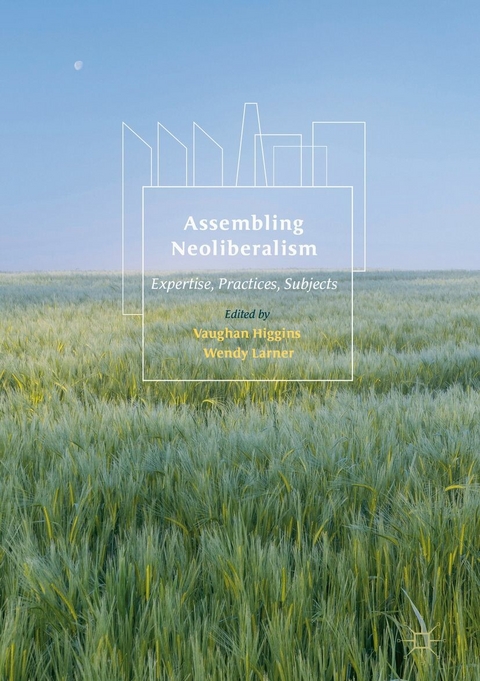
Assembling Neoliberalism (eBook)
XVII, 331 Seiten
Palgrave Macmillan US (Verlag)
978-1-137-58204-1 (ISBN)
Vaughan Higgins is Associate Professor of Sociology at Charles Sturt University, Australia. His research encompasses the sociology of science and technology, and the sociology of agriculture and food. He is co-editor of Calculating the Social: Standards and the Reconfiguration of Governing with Wendy Larner.
Wendy Larner is Provost at Victoria University of Wellington, New Zealand. Her research sits in the interdisciplinary fields of globalization, governance, and gender. She is a fellow of the Royal Society of New Zealand and the Academy of Social Sciences, UK.
This book examines how neoliberalism is constituted from multiple, diverse elements; how these elements are brought together and made to cohere; and the challenges, contestations, and consequences of such. Informed by assemblage thinking, the collection builds on research that emphasizes the forms of experimentation, adaptation, and mutation through which neoliberalism is enacted and rendered workable across different spaces. Contributors provide original case studies on topics such as democratic administration, carbon markets, the sharing economy, behavioral economics, disease management, free trade, and youth volunteering. They interrogate the forms of expertise through which neoliberalism is rendered knowable; the diverse socio-technical practices that make neoliberalism governable; and the practices, effects, and tensions involved in the assembling of neoliberal subjects.
Vaughan Higgins is Associate Professor of Sociology at Charles Sturt University, Australia. His research encompasses the sociology of science and technology, and the sociology of agriculture and food. He is co-editor of Calculating the Social: Standards and the Reconfiguration of Governing with Wendy Larner. Wendy Larner is Provost at Victoria University of Wellington, New Zealand. Her research sits in the interdisciplinary fields of globalization, governance, and gender. She is a fellow of the Royal Society of New Zealand and the Academy of Social Sciences, UK.
1. Introduction: Assembling NeoliberalismPart I: Expertise2. Neoliberalism and Rule by Experts3. Assuming Everything Except Responsibility: Can We Blame Economists for Neoliberalism?4. Assembling Climate Expertise: Carbon Markets, Neoliberalism and Science5. The Politics of Expertise: Neoliberalism, Governance, and the Practice of PoliticsPart II: Practices6. Assembling Citizenship in Austere Times7. (Re)Assembling Neoliberal Logics in the Service of Climate Justice: Fuzziness and Perverse Consequences in the Fossil Fuel Divestment Assemblage8. The Mouse that Died: Stabilizing Economic Practices in Free Trade Space9. Mapping Neoliberalism: Animal Health and the Spatial Practices of Disease Management10. Mapping Happiness, Managing Urban EmotionsPart III: Subjects11. Sharing Subjects and Legality: Ambiguities in Moving Beyond Neoliberalism12. “Doing Good”: Affect, Neoliberalism, and Responsibilization Among Volunteers in China and the United States13. The Resilient Subject14. Economics, Experiments, Evidence: Poor Behavior and the Development of Market SubjectsPart IV: Conclusion15. Conclusion: Awkward Assemblages
| Erscheint lt. Verlag | 6.4.2017 |
|---|---|
| Zusatzinfo | XVII, 331 p. 7 illus. in color. |
| Verlagsort | New York |
| Sprache | englisch |
| Themenwelt | Sozialwissenschaften ► Politik / Verwaltung |
| Sozialwissenschaften ► Soziologie ► Allgemeines / Lexika | |
| Sozialwissenschaften ► Soziologie ► Spezielle Soziologien | |
| Schlagworte | assemblage thinking • Carbon markets • Citizenship • climate change • climate justice • Globalization • Institutions • Market-oriented • Neoliberalism • political-economic ideas • Political Science • political theory • Politics • technopolitical |
| ISBN-10 | 1-137-58204-9 / 1137582049 |
| ISBN-13 | 978-1-137-58204-1 / 9781137582041 |
| Informationen gemäß Produktsicherheitsverordnung (GPSR) | |
| Haben Sie eine Frage zum Produkt? |
 PDF (Wasserzeichen)
DRM: Digitales Wasserzeichen
Dieses eBook enthält ein digitales Wasserzeichen und ist damit für Sie personalisiert. Bei einer missbräuchlichen Weitergabe des eBooks an Dritte ist eine Rückverfolgung an die Quelle möglich.
Dateiformat: PDF (Portable Document Format)
Mit einem festen Seitenlayout eignet sich die PDF besonders für Fachbücher mit Spalten, Tabellen und Abbildungen. Eine PDF kann auf fast allen Geräten angezeigt werden, ist aber für kleine Displays (Smartphone, eReader) nur eingeschränkt geeignet.
Systemvoraussetzungen:
PC/Mac: Mit einem PC oder Mac können Sie dieses eBook lesen. Sie benötigen dafür einen PDF-Viewer - z.B. den Adobe Reader oder Adobe Digital Editions.
eReader: Dieses eBook kann mit (fast) allen eBook-Readern gelesen werden. Mit dem amazon-Kindle ist es aber nicht kompatibel.
Smartphone/Tablet: Egal ob Apple oder Android, dieses eBook können Sie lesen. Sie benötigen dafür einen PDF-Viewer - z.B. die kostenlose Adobe Digital Editions-App.
Buying eBooks from abroad
For tax law reasons we can sell eBooks just within Germany and Switzerland. Regrettably we cannot fulfill eBook-orders from other countries.
aus dem Bereich