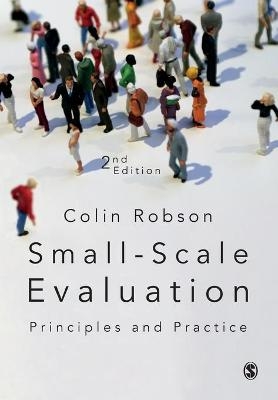
Small-Scale Evaluation
SAGE Publications Inc (Verlag)
978-1-4129-6248-3 (ISBN)
Key features include discussion of:
Different approaches to evaluation and how to choose between them
The advantages and disadvantages of randomized controlled trials (RCTs)
Realist evaluation and its increasing importance
The centrality of ethical and political issues
The influence and opportunity of the Internet
Tightly focused on the realities of carrying out small-scale evaluation, Small-Scale Evaluation is a highly practical guide covering the needs of both social scientists and others without this background.
Colin Robson is an Emeritus Professor in the School of Human & Health Sciences at the University of Huddersfield.
Colin Robson is an Emeritus Professor in the School of Human & Health Sciences at the University of Huddersfield. He directed a series of local, regional and national research and evaluation projects, mainly in aspects of special educational needs, at Huddersfield in association with the Hester Adrian Research Centre, University of Manchester. He subsequently was a supervisor for over twenty research students, mainly at Doctoral level, covering a wide range of disciplines - education, social work, management, music, and aspects of health, including nursing, midwifery and osteopathy, while developing and leading a postgraduate programe in Social Research and Evaluation. More recently he was, for over a decade, chief Consultant at the Centre for Educational Research and Innovation at OECD in Paris, for projects evaluating and comparing national systems for the education of students with disabilities, learning and behavioural difficulties and social disadvantages, and a follow-up project for Eurostat, the statistical arm of the European Union.
Chapter 1: Introduction
Who is the book for?
What do you need to be able to carry out an evaluation?
Evaluation research
Small-scale evaluation research
The literature search
The Internet
Using the book
A note on ′Tasks′
Chapter 2: Evaluation: The What and the Why
What is evaluation?
Why evaluate?
Evaluation and social research
What do they think they want?
What are they going to find credible?
Chapter 3: The Advantages of Collaboration
Stakeholders
Other models of involvement
Using consultants
Persuading others to be involved
When is some form of participatory evaluation indicated?
Chapter 4: Evaluation Designs
Different approaches to evaluation
Needs assessment
Outcome evaluation
Process evaluation
Combining process and outcome approaches
Formative and summative evaluation
Efficiency evaluation
Reviews
Program monitoring
Theory-based evaluation
An interim summing up
Chapter 5: Designing Your Evaluation
Reviewing the ′literature′
Research questions
Methods of data collection
Data quality
Sampling
Prespecified and emergent designs
Doing a shoe-string evaluation
Chapter 6: Ethical and Political Considerations
Ethical issues
The problem of unintended consequences
Evaluations involving children and other vulnerable populations
Ethical issues in online research
Ethical boards and committees
The politics of evaluation
Chapter 7: Practicalities
Time budgeting
Gaining access
Getting organized
Getting help and support
Chapter 8: Dealing with the Data
Coding data
Analysis and interpretation of quantitative data
Analysis and interpretation of qualitative data
Chapter 9: Communicating the Findings
Evaluation reports
Facilitating the implementation of evaluation findings
Chapter 10: Taking it further
Further reading
Postscript
Appendix A: Chapter Tasks
Appendix B: Simple Evaluations
| Erscheinungsdatum | 16.10.2017 |
|---|---|
| Verlagsort | Thousand Oaks |
| Sprache | englisch |
| Maße | 170 x 242 mm |
| Gewicht | 410 g |
| Themenwelt | Sozialwissenschaften ► Soziologie ► Empirische Sozialforschung |
| ISBN-10 | 1-4129-6248-X / 141296248X |
| ISBN-13 | 978-1-4129-6248-3 / 9781412962483 |
| Zustand | Neuware |
| Informationen gemäß Produktsicherheitsverordnung (GPSR) | |
| Haben Sie eine Frage zum Produkt? |
aus dem Bereich