Being Ethnographic
SAGE Publications Ltd (Verlag)
978-1-4739-5215-7 (ISBN)
- Titel erscheint in neuer Auflage
- Artikel merken
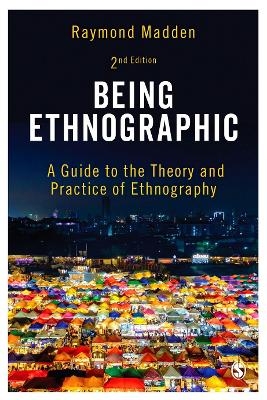
Driven by classic and anecdotal case studies, Being Ethnographic highlights the challenges introduced by the ethnographers′ own interests, biases and ideologies and demonstrates the importance of methodological reflexivity. Addressing both the why and how questions of doing ethnography well, Madden demonstrates how both theory and practice can work together to produce insights into the human condition. This fully updated second edition includes:
New material on intersubjectivity
Information on digital inscription tools
A practical guide to qualitative analysis software
New coverage of cyberethnography and social media
Expanded information on ethnographic possibilities with animals
Filled with invaluable advice for applying ethnographic principles in the field, it will give researchers across social sciences everything they need to walk a mile in someone else’s shoes.
Raymond Madden is an anthropologist in the School of Social Sciences, La Trobe University, Melbourne, Australia. He has taught ethnographic methods, applied anthropology, and human and animal anthropology for over a decade. He published textbook, Being Ethnographic in 2010 and a second edition in 2017 (SAGE). He has also worked extensively in the area of native title research in South East Australia and has an emerging interest in human and animal sociality.
Section One: Key Concepts and Theoretical Frames
Chapter 1: ‘Definitions’, methods and applications
Characterising ethnography
Reflexivity
Intersubjectivity
Methods
Practical and conceptual origins
Applications and ethics
Chapter 2: Ethnographic fields: home and away
Making place: what is an ethnographic field?
Some favourite fields
Ethnography at home
Multisited and un-sited ethnography
Section Two: Doing Ethnography
Chapter 3: Talking to people: negotiations, conversations and interviews
Negotiation
Conversation
Interviewing
Chapter 4: Being with people: participation
Immersion ethnography
Step-in-step-out ethnography
Embodiment and the ethnographer
The ethical participant
Chapter 5: Looking at people: observations and images
The ethnographic gaze
The systematic eye
Visual ethnography
Seeing is believing
Section Three: Inscription
Chapter 6: Description: writing ‘down’ fieldnotes
Writing ‘down’
The systematic hand
What goes into notebooks
Examples of fieldnotes
Chapter 7: Analysis to interpretation: writing ‘out’ data
Organising primary data
Organising secondary data
Writing ‘out’ data
Chapter 8: Interpretation to story: writing ‘up’ ethnography
The storied reality
Author and audience
Writing as the continuation of interpretation
Structure in an ethnographic story
Style in ethnographic writing
Section Four: Expanding Ethnography
Chapter 9: Conclusion: ethnographic horizons
Review
Cyber Ethnography
Non-human ethnography
| Erscheinungsdatum | 31.01.2018 |
|---|---|
| Verlagsort | London |
| Sprache | englisch |
| Maße | 156 x 234 mm |
| Gewicht | 350 g |
| Themenwelt | Sozialwissenschaften ► Ethnologie |
| Sozialwissenschaften ► Soziologie | |
| ISBN-10 | 1-4739-5215-8 / 1473952158 |
| ISBN-13 | 978-1-4739-5215-7 / 9781473952157 |
| Zustand | Neuware |
| Informationen gemäß Produktsicherheitsverordnung (GPSR) | |
| Haben Sie eine Frage zum Produkt? |
aus dem Bereich