Health Communication (eBook)
John Wiley & Sons (Verlag)
978-0-7456-9776-5 (ISBN)
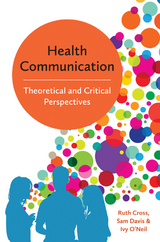
Health communication is key to promoting good population and individual health outcomes. As the field has developed, there is a growing need for a critical appraisal of the ideologies and theories underpinning health communication in order to ensure effective practice.
This book clearly situates health communication within its social context. It provides a critical overview of three key disciplinary areas - education, psychology and communication. Drawing on international examples throughout, the book challenges the underlying assumptions that drive the design and delivery of health promotion interventions. The authors argue that health communication is inherently political and pay close attention to issues of power, ethics and inequality throughout the text.
This book will be valuable for those students at all levels who require a critical perspective, as well as practitioners in health communication and health promotion. With reference to detailed examples and annotated suggestions for further reading, the book is an accessible resource for analysing contemporary health communication.
Ruth Cross is Senior Lecturer in Health Promotion at Leeds Beckett University
Sam Davis is Senior Lecturer in Health Promotion at Leeds Beckett University
Ivy O'Neil is former Principal Lecturer and Professional Lead for the Health Promotion team at Leeds Beckett University
Health communication is key to promoting good population and individual health outcomes. As the field has developed, there is a growing need for a critical appraisal of the ideologies and theories underpinning health communication in order to ensure effective practice. This book clearly situates health communication within its social context. It provides a critical overview of three key disciplinary areas education, psychology and communication. Drawing on international examples throughout, the book challenges the underlying assumptions that drive the design and delivery of health promotion interventions. The authors argue that health communication is inherently political and pay close attention to issues of power, ethics and inequality throughout the text.This book will be valuable for those students at all levels who require a critical perspective, as well as practitioners in health communication and health promotion. With reference to detailed examples and annotated suggestions for further reading, the book is an accessible resource for analysing contemporary health communication.
Ruth Cross is Senior Lecturer in Health Promotion at Leeds Beckett University Sam Davis is Senior Lecturer in Health Promotion at Leeds Beckett University Ivy O'Neil is former Principal Lecturer and Professional Lead for the Health Promotion team at Leeds Beckett University
Detailed table of contents
Acknowledgements
Part 1: Theoretical Perspectives
Chapter 1: Introduction to Health Communication: Theoretical and Critical Perspectives
Chapter 2: Communication Theory
Chapter 3: Educational Theory
Part 2: Key Topics
Chapter 4: Psychological Theory
Chapter 5: Methods and Media
Chapter 6: Social Marketing
Chapter 7: Health Literacy
Part 3: Issues and Challenges
Chapter 8: Challenges in Health Communication and Behaviour Change
Chapter 9: The Politics of Health Communication and Behaviour Change
Chapter 10: Looking to the Future
References
Index
"This text provides the reader with a clear background to communication theories, models of communication, and education theory as well as an examination of key theoretical themes and perspectives on health communication. With the inclusion of discussions around new and emerging social media as well as social marketing techniques, Health Communication offers much to students as well as those working in health today."
--Dr Ranjit Khutan, University of Wolverhampton
"This is an original and good quality contribution to the literature. The authors are setting an important and new critical agenda, drawing together contributions from a variety of disciplines. The clear focus on the social construction of health and health related decision making encourages critical analysis of many of the 'taken for granted' assumptions about how to communicate successfully with people about health."
--Dr Paul Reid, University of Central Lancashire
1
Introduction to Health Communication: Theoretical and Critical Perspectives
In this introductory chapter we set the scene for Health Communication: Theoretical and Critical Perspectives. We begin by explaining how this book came about and locate health communication within the broader notion of health promotion. We introduce the style of the book and outline the indicative content providing a rationale for the inclusion of the subject matter and emphasizing the global and international outlook of the book. This chapter introduces the three key disciplinary areas which underpin the book’s approach – communication, education and psychology. These disciplinary areas link to later chapters and thread through the discussion and debate therein. We also outline the key themes that run through the book in keeping with the ideological, political and philosophical perspectives that underpin it.
This book came about because we, as lecturers of health communication, noted a dearth of more critical perspectives written for a post-graduate and practitioner audience. There are a number of very good undergraduate and practically focused books on health communication on the market which have made a significant contribution to the field. We were conscious, however, that a more in-depth critique of the issues is relatively lacking. Indeed, we have been unable to find a text which focuses solely on health communication with an in-depth insight into the underpinning disciplines and ideology of health promotion and the more critical, analytical research-informed debates on health communication pertinent to post-graduate level. Spotting this gap in the literature we have set out to produce a text which lays bare some of the more sticky issues in health communication as we see them. We unapologetically dismantle what we view as some problematical underpinning assumptions in the field of health communication and turn to a range of critical perspectives to do this. At the outset, however, it is important that we outline our ideological, political and philosophical position since it is against this background that the book is cast.
We teach health communication on the suite of health promotion and public health masters programmes delivered by Leeds Beckett University. Our main discipline, however, is health promotion and we subscribe to the values and principles of this discipline. As such the ideological, political and philosophical basis of health promotion sets the context to this book. It is via a ‘health promotion’ lens that we will view health communication. We adhere to the position that health promotion is the ‘militant wing’ and ‘critical conscience of public health’ (Green et al., 2015: 48). What we hope to do in this book is explain this position with regard to health communication. As such, while we do offer insights for reflective practice and suggest implications for practice throughout, we have not written a ‘how to do it’ text. As previously stated, there are already plenty of good examples of such texts on the market which we would urge readers to turn to if that is what they are looking for. Instead, we have produced a higher level critical textbook on health communication which challenges many of the ‘taken for granted’, underpinning assumptions of current understanding and practice. We turn to key theoretical and critical perspectives to tease out what we see as the major ideological and political concerns. The book is structured to enable this to take place in a coherent and logical way which, we hope, will aid readers who are relatively new to the debates at hand.
The main purpose of this book is to critically reflect on the assumptions, ideologies and values underpinning well-rehearsed approaches in health communication and, as such, it is aimed at the more advanced reader. This book will appraise health communication and its role in promoting health. Drawing on the evidence base for effectiveness and published international research within the field the book critically considers what works and what does not work in communication for health and health promotion, unpicking common approaches. Moreover, it seeks to scrutinize what we do and why. Crucially the book links theory to practice examining how research relates to real life and what this means for public health and health promotion in our social world.
There is a general assumption that an increase in knowledge directly translates into a change of healthy lifestyle behaviour. The focus of many writers and practitioners is often on why the recipients of health communication efforts do not act on the information and advice given. Increasingly we look to aspects such as message design, health literacy skills, information technologies and social marketing strategies as a means of promoting effectiveness. Recent developments in the use of information communication technology, both software and hardware in health promotion such as internet, social media, mobile devices run through the book and the content is drawn from international research, knowledge and expertise offering a global perspective on the issues raised. In addition we make use of the valuable international health promotion teaching experience we have acquired through working with students on Leeds Beckett courses run in West and sub-Saharan Africa as well as with students who come from all over the world to study on our UK course. We acknowledge the contribution that each of them brings to our growing understanding and appreciation of health communication in a range of contexts.
The ideological, political and philosophical position of health communication: theoretical and critical perspectives
As we briefly outlined earlier, the foundations of this book are located within our ideological, political and philosophical position which mirrors health promotion’s disciplinary perspective. Health promotion adheres to a specific set of values and principles which distinguishes it from the broader field of public health. These include empowerment, equity, tackling health inequalities, addressing the social determinants of health, privileging a social model of health, advocacy, ethical practice, participation, collaboration and upstream approaches. As defined by Dixey et al. (2013: 1) we understand health promotion to be ‘a social movement with the central aim of tackling the social determinants of health and so bringing about greater social and health justice’. At the outset it is also important to define what we understand by health education as opposed to health promotion. We see health education as an integral part of health promotion but health promotion does not stop there; it goes much further. While health education focuses on the behavioural determinants of health and seeks to address these through preventive and educational efforts aimed largely at the individual, health promotion addresses structural, social and environmental determinants of health as well (Green et al., 2015). So, where does health communication sit within this? We would argue that contemporary health communication practice is more akin to health education than health promotion with its attendant focus on the individual and behaviour change. We aim, in this book, to explain this in some detail. What we would advocate, then, is that health communication adopts approaches which are more ideologically, politically and philosophically akin to health promotion. For example, we privilege the concept of empowerment recognizing the centrality of power in health in all domains. Health communication efforts should, in our opinion, challenge uneven power distribution and advocate for those who are relatively disempowered the challenging of structures, policies and practices which result in subordination and oppression. Therefore the ideological basis of this book is in keeping with the more radical roots of health promotion and this is reflected in the key themes within it that we return to throughout. We will now outline these key themes.
Key themes within health communication: theoretical and critical perspectives
Several important central concepts thread through this book and we will return to them again and again with regard to the different debates. Empowerment is a key concept in health promotion. While open to some debate around definition, conceptualization and measurement empowerment is absolutely central to health promotion (Woodall et al., 2012; Christens, 2013). We advocate empowering approaches in health communication. Linked to this we reject, and are critical of, victim-blaming approaches. Too often health communication efforts result in pointing the finger of blame at individuals or groups who ‘fail’ to take up advice and change their behaviour without taking into consideration the wider, complex contexts of everyday life. Health promotion takes into account the social, political and environmental factors that influence behavioural choices and practices acknowledging the fundamental importance of these in determining health outcomes. In this book we therefore explore the wider social determinants of health and the influence of these on health communication.
Health promotion is not about telling people what to do or doing things to people, it is about working with people. Key to this is true participation. Our position is that health communication efforts should involve the people for whom they are intended. Individuals and communities should be meaningfully engaged in interventions designed to address their concerns. We are therefore critical of top-down, paternalistic and tokenistic...
| Erscheint lt. Verlag | 3.4.2017 |
|---|---|
| Sprache | englisch |
| Themenwelt | Sachbuch/Ratgeber ► Gesundheit / Leben / Psychologie |
| Studium ► Querschnittsbereiche ► Prävention / Gesundheitsförderung | |
| Sozialwissenschaften ► Soziologie | |
| Schlagworte | Allg. Public Health • Gesundheits- u. Sozialwesen • Gesundheitswesen • Health & Social Care • Public Health • Public Health General • public health, health studies, nursing, health behaviours, health promotion • Sociology • Sociology of Health & Illness • Soziologie • Soziologie d. Gesundheit u. Krankheit |
| ISBN-10 | 0-7456-9776-3 / 0745697763 |
| ISBN-13 | 978-0-7456-9776-5 / 9780745697765 |
| Informationen gemäß Produktsicherheitsverordnung (GPSR) | |
| Haben Sie eine Frage zum Produkt? |
 EPUB (Adobe DRM)
Kopierschutz: Adobe-DRM
Adobe-DRM ist ein Kopierschutz, der das eBook vor Mißbrauch schützen soll. Dabei wird das eBook bereits beim Download auf Ihre persönliche Adobe-ID autorisiert. Lesen können Sie das eBook dann nur auf den Geräten, welche ebenfalls auf Ihre Adobe-ID registriert sind.
Details zum Adobe-DRM
Dateiformat: EPUB (Electronic Publication)
EPUB ist ein offener Standard für eBooks und eignet sich besonders zur Darstellung von Belletristik und Sachbüchern. Der Fließtext wird dynamisch an die Display- und Schriftgröße angepasst. Auch für mobile Lesegeräte ist EPUB daher gut geeignet.
Systemvoraussetzungen:
PC/Mac: Mit einem PC oder Mac können Sie dieses eBook lesen. Sie benötigen eine
eReader: Dieses eBook kann mit (fast) allen eBook-Readern gelesen werden. Mit dem amazon-Kindle ist es aber nicht kompatibel.
Smartphone/Tablet: Egal ob Apple oder Android, dieses eBook können Sie lesen. Sie benötigen eine
Geräteliste und zusätzliche Hinweise
Buying eBooks from abroad
For tax law reasons we can sell eBooks just within Germany and Switzerland. Regrettably we cannot fulfill eBook-orders from other countries.
aus dem Bereich