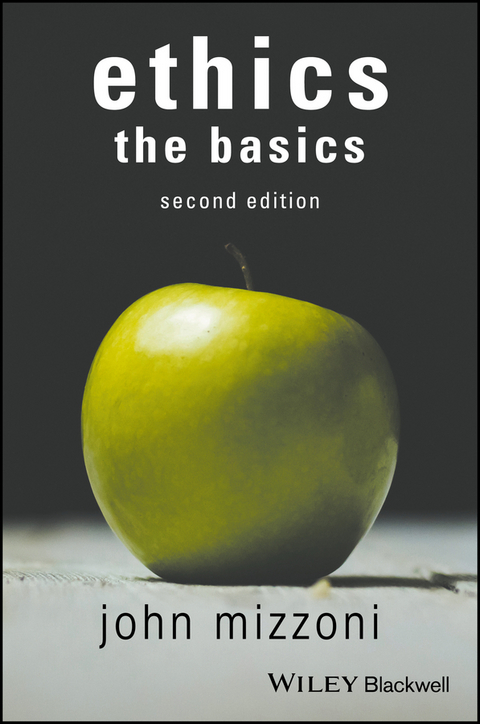
Ethics: The Basics, 2nd Edition (eBook)
John Wiley & Sons (Verlag)
978-1-119-15070-1 (ISBN)
Updated and revised, Ethics: The Basics, Second Edition, introduces students to fundamental ethical concepts, principles, theories, and traditions while providing them with the conceptual tools necessary to think critically about ethical issues.
- Introduces students to core philosophical problems in ethics in a uniquely reader-friendly manner
- Lays out clearly and simply a rich collection of ethical concepts, principles, theories, and traditions that are prevalent in today's society
- Considers western and non-western viewpoints and religious interpretations of ethical principles
- Offers a framework for students to think about and navigate through an array of philosophical questions about ethics
John Mizzoni holds a PhD from Temple University, and is an Associate Professor of Philosophy at Neumann college in Pennsylvania where he teaches a wide range of philosophy courses. A specialist in moral and environmental philosophy, he has over twenty publications in journals such The Journal of Philosophical Research, The International Journal of Applied Philosophy, Environmental Ethics, Journal of Interdisciplinary Studies, The Philosopher's Magazine, Bridges: An Interdisciplinary Journal of Theology, Philosophy, History, and Science, The International Journal of the Humanities, Teaching Ethics and Environmental Philosophy. He is also a semi-professional musician.
John Mizzoni holds a PhD from Temple University, and is an Associate Professor of Philosophy at Neumann college in Pennsylvania where he teaches a wide range of philosophy courses. A specialist in moral and environmental philosophy, he has over twenty publications in journals such The Journal of Philosophical Research, The International Journal of Applied Philosophy, Environmental Ethics, Journal of Interdisciplinary Studies, The Philosopher's Magazine, Bridges: An Interdisciplinary Journal of Theology, Philosophy, History, and Science, The International Journal of the Humanities, Teaching Ethics and Environmental Philosophy. He is also a semi-professional musician.
Introduction
Let’s begin with a few ethical questions. Do murderers, because of their actions, deserve the death penalty? Is executing murderers morally justified because it will likely have more good consequences for society than sentencing them to life in prison?
A pregnant woman who drinks alcoholic beverages while pregnant stands the chance that her baby will be born with hearing and vision problems, motor‐skill problems, language‐use problems, or memory or attention problems. Is it morally permissible – is it ethically right – for a woman to drink alcohol while pregnant? We need some way to assess the importance of the risks involved.
How would we begin to answer ethical questions like these? Are there ethical standards we can use to help us answer ethical questions? If so, where do these ethical standards come from? Do ethical standards come from one’s society? Do they come from God or religion? Are they in some way derived from rationality and logic? Perhaps ethical standards are derived from human nature that has been designed by God. Or maybe ethical standards somehow sprang from our human nature that has been shaped by millions of years of evolution.
Each of these questions about ethical standards is closely related, yet slightly different. One way to sum up what they all have in common is to say that they are concerned with the origins of ethics. As we will see in this book, people have attempted to formulate and support answers to these philosophical questions about ethics for many centuries, stretching far back into antiquity. Philosophers, in addition to thinking about such questions and attempting to formulate answers to them, are known for their skill in grouping questions together as a first step in organizing our thoughts on these issues. As a way of organizing the above cluster of questions, we can describe the cluster as the philosophical problem of the origins of ethics.
Solving the problem and fully answering its questions would involve providing a well‐developed account of where ethical standards come from. Someone might claim that philosophical questions do not have answers and therefore philosophical problems cannot be solved. But that couldn’t be the case in this situation; for each of us surely uses ethical standards (at least some of the time), and these ethical standards surely came from somewhere! Where did they come from? Solving this problem might be an exceedingly difficult task, but why would it be impossible to solve? The challenge is in providing a convincing and well‐supported case for where ethical standards actually come from. And even if we have a well‐supported case, experience tells us that we might still be wrong! The difficulty, then, is not that there are no answers to these philosophical questions about ethics, but that it is hard to be sure which answers are the correct answers.
There are other philosophical problems in ethics related to the philosophical problem of the origins of ethics; that is, there are other philosophical questions about ethics that can be thematically clustered. For instance, do we always learn ethics from others, or are there ethical standards somehow prepackaged inside our hearts and minds? If we always learn ethics from others, and ethical standards are wholly derived from one’s society, then doesn’t that imply that all ethical standards are relative, since each society is different and has its own unique history? And, on the other hand, if ethical standards come from our individual hearts and minds, doesn’t that also imply that ethical standards are relative, since each individual person is different and unique?
Thinking about the close relationship between ethics and society might prompt us to wonder what life would be like and how human beings would behave if they didn’t live in civilized society. Would ethical standards apply to these people? How would these people become aware of ethical standards and principles? This particular cluster of questions that centers on the issue of whether ethics is always a direct function of society can be considered the philosophical problem of relativism. This is a philosophical problem of ethics that is all the more pressing as globalization advances, that is, as global interactions of societies become more extensive.
In attempting to answer questions about the origins of ethics and the seeming relativity of ethics, many thinkers have had to closely examine human nature. But what is human nature? The difficulty in answering this question ushers in yet another philosophical problem close to the heart of ethics: the philosophical problem of human nature. One way to begin to get a handle on this problem is to focus on human characteristics. Which characteristics are essential to being a human person? Rationality? Emotional intelligence? Made in the image of God? Do men and women have different essential characteristics? If men and women have different characteristics, would that mean they use different ethical standards? Is there, then, such a thing as a feminist ethics, as opposed to a masculine ethics?
Another important dimension of human nature that bears upon ethics is the question of whether human beings are selfish creatures who act only to benefit themselves. Is it the case that when people help others in need, for instance, they are truly motivated by genuine concern for others? Or are they calculating how they themselves will need help in the future? Are human beings social creatures who genuinely care for the well‐being of others? For many centuries, thinkers have pursued answers to this cluster of questions that forms the philosophical problem of human nature; the same is true for the problem of the origins of ethics, and the problem of relativism.
Aside from these three rather theoretical problems of ethics, there is a more basic and fundamental ethical problem, one that we face all the time (and it is the philosophical problem of ethics that occupies most of this book). The problem is captured in the following question: How should I determine the right thing to do? Or, more broadly expressed, how should I live my life? What counts as a life lived well? What kind of person should I become? We will call this the problem of conduct. As opposed to the three previous ethical problems mentioned, this one is very practical. The answers to the questions at the core of this problem will require us to take action: it is a philosophical problem about what we should do.
Just to give you some idea of the immense range of solutions to this fundamental ethical problem, consider some of the following philosophical questions that are relevant. The questions themselves provide clues to how different people have attempted to solve the problem of conduct.
Is ethics about doing one’s duty, being responsible; or is ethics about being happy and working toward making others happy? Is ethics about doing what’s best for me? Am I responsible for the person I am, the choices I make, the characteristics I possess, and the happiness I attain? What is happiness? Does happiness have to do with pleasure or spirituality? Can human beings really achieve happiness in this life, or is an afterlife needed for complete human happiness and fulfillment? How is ethics informed by religion? Is the golden rule a Christian ethical principle? How is ethics informed by science? How is ethics shaped by society? How might ethics be derived from rationality? If ethics is derived from rationality, does that mean that only rational beings count, morally speaking? Or are non‐rational beings worthy of respect, too? What are rights? Are they something all humans possess, or do only rational beings possess them?
In attempting to solve the philosophical problem of conduct, in this book we will consider an extensive assortment of ethical concepts, principles, theories, and traditions. I introduce you, the reader, to a range of ethical concepts, ethical principles, ethical theories, and ethical traditions that you can consider as you attempt to solve this problem for yourself. You are living a life right now, so you have no choice but to attempt to deal with the problem and answer the following questions, How should I live my life? What counts as a life lived well? What kind of person should I become? What makes an action morally right or wrong? And how should I determine the right thing to do? In this book, what I am offering is a framework to help you organize a truly bewildering array of philosophical questions about ethics. Part of the framework I offer is the fourfold distinction between ethical concepts, principles, theories, and traditions.
Let’s take a further look at the framework. Ethical concepts are the most basic building blocks of ethics. An introduction to ethics will involve becoming familiar with a range of concepts such as virtue, rights, duty, happiness, freedom, etc. Next come principles. An introduction to ethics will gather together basic ethical principles that most people have heard of, like the golden rule, or the principle “the end does not justify the means.” But an introduction to ethics will also include lesser‐known principles, such as the principle of utility and the categorical imperative.
The ethical theories and traditions discussed will range from those first formulated in ancient Greece over 2,000 years ago, to those first formulated in the twentieth century. We can think of an ethical theory as an attempt to pull together a collection of ethical concepts and principles into a coherent whole in order to answer...
| Erscheint lt. Verlag | 27.3.2017 |
|---|---|
| Sprache | englisch |
| Themenwelt | Geisteswissenschaften ► Philosophie ► Allgemeines / Lexika |
| Geisteswissenschaften ► Philosophie ► Ethik | |
| Sozialwissenschaften | |
| Schlagworte | Angewandte Ethik • Applied Ethics • ethics • Ethik • <p>Ethics, virtue ethics, natural law ethics, social contract ethics, utilitarian ethics, deontological ethics, care ethics</p> • Philosophie • Philosophy |
| ISBN-10 | 1-119-15070-1 / 1119150701 |
| ISBN-13 | 978-1-119-15070-1 / 9781119150701 |
| Informationen gemäß Produktsicherheitsverordnung (GPSR) | |
| Haben Sie eine Frage zum Produkt? |
 EPUB (Adobe DRM)
Kopierschutz: Adobe-DRM
Adobe-DRM ist ein Kopierschutz, der das eBook vor Mißbrauch schützen soll. Dabei wird das eBook bereits beim Download auf Ihre persönliche Adobe-ID autorisiert. Lesen können Sie das eBook dann nur auf den Geräten, welche ebenfalls auf Ihre Adobe-ID registriert sind.
Details zum Adobe-DRM
Dateiformat: EPUB (Electronic Publication)
EPUB ist ein offener Standard für eBooks und eignet sich besonders zur Darstellung von Belletristik und Sachbüchern. Der Fließtext wird dynamisch an die Display- und Schriftgröße angepasst. Auch für mobile Lesegeräte ist EPUB daher gut geeignet.
Systemvoraussetzungen:
PC/Mac: Mit einem PC oder Mac können Sie dieses eBook lesen. Sie benötigen eine
eReader: Dieses eBook kann mit (fast) allen eBook-Readern gelesen werden. Mit dem amazon-Kindle ist es aber nicht kompatibel.
Smartphone/Tablet: Egal ob Apple oder Android, dieses eBook können Sie lesen. Sie benötigen eine
Geräteliste und zusätzliche Hinweise
Buying eBooks from abroad
For tax law reasons we can sell eBooks just within Germany and Switzerland. Regrettably we cannot fulfill eBook-orders from other countries.
aus dem Bereich