


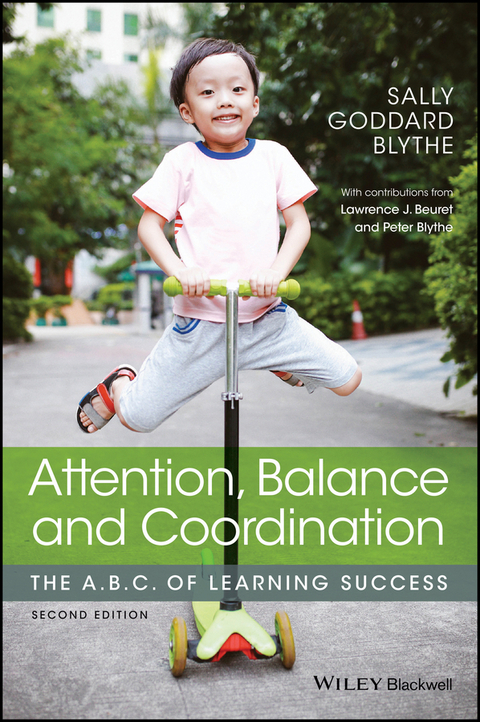
Attention, Balance and Coordination (eBook)
John Wiley & Sons (Verlag)
978-1-119-16475-3 (ISBN)
An updated edition of the definitive handbook on the physical basis for learning for professionals involved in education and child development, written by the respected author of acclaimed titles in the field.
- A comprehensive overview of the relationship between neuromotor maturity and physical development on learning outcomes and behaviour in childhood and later life
- Explores why early reflexes are important, their functions in early development, their effects on learning and behavior if retained, and the possible effects on other aspects of development
- Brings together a specialist body of knowledge and makes it accessible to anyone involved in treating the symptoms of specific learning difficulties and emotional problems.
- Includes new information on the role of the vestibular system in anxiety and agoraphobia, a new chapter of case studies, and an Epilogue placing the INPP Method in a broader scientific context
Sally Goddard Blythe is a Consultant in Neuro-Developmental Education, a frequent media contributor, and International Director of the Institute for Neuro-Physiological Psychology (INPP) in Chester, UK. She has worked in the area of neuro-development for more than twenty years and is the author of many books and papers on child development and neuro-developmental factors in specific learning difficulties. Her first book, Reflexes, Learning and Behavior (1996), provided the basic information for many professions around the world now using reflex assessment. She has since written further books on including Assessing Neuromotor Readiness for Learning (2012) and Neuromotor Immaturity in Children and Adults (2014). She is a regular keynote speaker in the areas of neuromotor immaturity and early years education.
An updated edition of the definitive handbook on the physical basis for learning for professionals involved in education and child development, written by the respected author of acclaimed titles in the field. A comprehensive overview of the relationship between neuromotor maturity and physical development on learning outcomes and behaviour in childhood and later life Explores why early reflexes are important, their functions in early development, their effects on learning and behavior if retained, and the possible effects on other aspects of development Brings together a specialist body of knowledge and makes it accessible to anyone involved in treating the symptoms of specific learning difficulties and emotional problems. Includes new information on the role of the vestibular system in anxiety and agoraphobia, a new chapter of case studies, and an Epilogue placing the INPP Method in a broader scientific context
Sally Goddard Blythe is a Consultant in Neuro-Developmental Education, a frequent media contributor, and International Director of the Institute for Neuro-Physiological Psychology (INPP) in Chester, UK. She has worked in the area of neuro-development for more than twenty years and is the author of many books and papers on child development and neuro-developmental factors in specific learning difficulties. Her first book, Reflexes, Learning and Behavior (1996), provided the basic information for many professions around the world now using reflex assessment. She has since written further books on including Assessing Neuromotor Readiness for Learning (2012) and Neuromotor Immaturity in Children and Adults (2014). She is a regular keynote speaker in the areas of neuromotor immaturity and early years education.
Title Page 5
Copyright Page 6
Contents 7
About the Author 9
About the Contributors 11
Chapter 1 Windows on the Brain 13
1.1 Introduction 13
1.2 Developmental Readiness for Education 14
1.3 What Is Neuromotor Immaturity? 15
1.4 What Is the Connection between NMI and Specific Learning Difficulties? 16
1.5 Primitive and Postural Reflexes—the Medical Model 18
1.6 How Can Testing of Primitive and Postural Reflexes Be Used? 20
1.7 Neurological Dysfunction in Specific Learning Difficulties 20
1.8 Diagnostic Criteria, Signs, and Symptoms of Specific Learning Difficulties 21
1.9 Dyslexia—Signs and Symptoms 23
1.9.1 Dyslexia 23
1.9.2 Associated Symptoms 23
1.9.3 Neurological Factors in Dyslexia 23
1.9.4 Laterality 25
1.10 Developmental Coordination Disorder 25
1.10.1 Learning Problems 31
1.11 Attention Deficit Disorder 32
1.11.1 Symptoms of ADHD 33
1.12 Underachievement 34
1.13 The Sensory–Motor Connection 34
1.14 Theories of Motor Control 35
References 36
Chapter 2 The Significance of Primitive and Postural Reflexes 41
2.1 What Are Primitive and Postural Reflexes? 42
2.2 What Do Primitive and Postural Reflexes Tell Us? 42
2.3 The Developing Brain 42
2.4 The Emergence of Spinal Reflexes 44
2.5 Reflexes Mediated at the Spinal Level 44
2.5.1 Flexor Withdrawal Reflex 44
2.5.2 Crossed Extensor Reflex 45
2.6 Reflexes Mediated in the Brainstem 45
2.7 Reflexes as Reflections of Hierarchical Development 47
2.7.1 Intrauterine Reflexes 48
2.7.2 Primitive Reflexes 48
2.7.3 Postural Reactions (Reflexes) 49
2.8 Areas of the Brain Involved in the Mediation of Primitive and Postural Reflexes 50
2.8.1 Brainstem 50
2.9 The Multisensory Reflex—the Moro Reflex 53
2.9.1 The Fear Paralysis Reflex 57
2.10 Characteristics of the Fear Paralysis Reflex 60
2.11 Moro Reflex Activators 63
2.12 Functions of the Moro Reflex 63
2.13 Physiological Response to the Moro Reflex 63
2.14 Implications of a Retained Moro Reflex 63
2.15 Symptoms of SSS 68
2.16 General Symptoms Associated with a Retained Moro Reflex 69
2.16.1 Links to Auditory Processing 69
2.16.2 Effects on Behavior 71
2.17 Behavioral Outcomes Associated with a Retained Moro Reflex 72
2.17.1 Possible Secondary Psychological Effects 72
Endnotes 72
References 73
Chapter 3 Primitive Reflexes of Position 77
3.1 Tonic Labyrinthine Reflex 77
3.2 Development of Head Control 80
3.3 Why Is Head Control So Important? 83
3.4 The TLR and Early Feeding 84
3.4.1 Symptoms Suggestive of a Residual TLR 84
3.5 ATNR 85
3.5.1 Early Training for Hand–Eye Coordination 87
3.5.2 Functions of the ATNR (18 Weeks In Utero to Four to Six Months of Postnatal Life) 90
3.6 Symmetrical Tonic Neck Reflex (STNR) 94
3.6.1 Functions of the STNR 97
3.6.2 Helping to Train Visual Skills 98
3.6.3 Functions of the STNR 101
3.6.4 Effects of a Retained or Residual STNR 101
3.6.5 Effects of a Retained or Residual STNR 106
References 107
Chapter 4 Primitive Tactile Reflexes 111
4.1 Palmar Grasp Reflex 111
4.1.1 Functions of the Palmar Grasp Reflex 113
4.1.2 Effects of a Retained or Residual Palmar Reflex 115
4.2 Plantar Reflex 115
4.2.1 Functions of the Babinski Reflex 118
4.2.2 Effects of a Residual or Retained Babinski Reflex 118
4.2.3 Effects of a Residual or Retained Babinski Reflex 119
4.2.4 Functions of the Plantar (Flexor) Reflex 119
4.2.5 Effects of Residual or Retained Plantar (Flexor) Reflex 119
4.3 Rooting Reflex 119
4.3.1 Functions of the Rooting Reflex 122
4.3.2 Effects of a Residual or Retained Rooting Reflex 124
4.4 Suckling and Sucking Reflexes 124
4.4.1 Functions of the Suckling Reflex 126
4.4.2 Effects of a Retained or Residual Suck Reflex 126
4.5 The Spinal Galant Reflex 127
4.5.1 Functions of the Spinal Galant Reflex 131
4.5.2 Effects of a Residual or Retained Spinal Galant Reflex 131
4.5.3 Nocturnal Enuresis 132
4.5.4 Effects of a Retained or Residual Spinal Galant Reflex 134
Endnote 134
References 134
Chapter 5 Postural Reflexes 139
5.1 Head Righting Reflexes 143
5.2 Righting, Placing, and Equilibrium Reactions 153
5.2.1 Righting Reactions 153
5.2.2 Placing Reactions 155
5.2.3 Equilibrium Reactions 156
5.3 Parachute Reflex 157
Endnote 158
References 158
Chapter 6 Use of the INPP Screening Questionnaire 161
6.1 The INPP Screening Questionnaire for Children 162
6.2 How to Use the INPP Questionnaire 165
6.2.1 Question 1: Family History 165
6.2.2 Question 2: Was Your Child Conceived as a Result of In Vitro Fertilization (IVF)? 167
6.2.3 Question 3: When You Were Pregnant, Did You Have Any Medical Problems? 171
6.2.4 Question 4: Was Your Child Born Approximately at Term, Early for Term, or Late for Term? 186
6.2.5 Question 5: Was the Birth Process Unusual or Difficult in Any Way? 191
Endnote 197
References 197
Chapter 7 Postnatal Factors Using the INPP Questionnaire 203
7.1 How to Use the INPP Questionnaire 203
7.1.1 Question 6: When Your Child Was Born, Was He/She Small for Term? Please Give Birth Weight, if Known 203
7.1.2 Question 7: When He/She Was Born, Was There Anything Unusual About Him/Her? That is, the skull distorted, heavy bruising, definitely blue, heavily jaundiced, covered with a calcium-type coating or requiring intensive care. If yes, please give detail 205
7.1.3 Question 8: In The First 13 Weeks of Your Child’s Life, Did He/She Have Difficulty in Sucking, Feeding Problems, Keeping Food Down, or Colic? 207
7.1.4 Question 9: In the First Six Months of Your Child’s Life, Was He/She a Very Still Baby, so Still That at Times You Wondered if it Was a Cot Death? 210
7.1.5 Question 10: Between 6 and 18 Months, Was Your Child Very Active and Demanding, Requiring Minimal Sleep Accompanied by Continual Screaming? 210
7.1.6 Question 11: When Your Child Was Old Enough to Sit up in the Pram and Stand up in the Cot, Did He/She Develop a Violent Rocking Motion, so Violent that Either the Buggy or Cot Was Actually Moved? 211
7.1.7 Question 12: Did Your Child Become a “Head?Banger,” that is, Bang His/Her Head Deliberately into Solid Objects? 211
7.1.8 Question 13: Was Your Child Early (Before 10 Months) or Late (Later than 16 Months) at Learning to Walk? 211
7.1.9 Question 14: Did He/She Go Through a Motor Stage of: 212
7.1.10 Question 15: Was Your Child Late at Learning to Talk? (Two- to Three-Word Phrases by Two Years) 213
7.1.11 Question 16: In the First 18 Months of Life, Did Your Child Experience Any Serious Illness Involving High Temperatures and/or Convulsions? If Yes, Please Give Details 213
7.1.12 Question 17: Was There Any Sign of Infant Eczema or Asthma? 215
7.1.13 Question 18: Was There Adverse Reaction to Any of the Childhood Inoculations? 217
7.1.14 Question 19: Did Your Child Have Difficulty Learning to Dress Him/Herself? 219
7.1.15 Question 20: Did Your Child Suck His/Her Thumb Through to Five Years or More? If so, Which Thumb? 220
7.1.16 Question 21: Did Your Child Wet the Bed, Albeit Occasionally, Above the Age of Five Years? 221
7.1.17 Question 22: Does Your Child Suffer From Travel Sickness? 222
7.2 Schooling 224
7.2.1 Question 23: When Your Child Went to the First Formal School, that is, Infant School, in the First Two Years of Schooling, Did He/She Have Problems Learning to Read? 224
7.2.2 Question 24: In the First Two Years of Formal Schooling Did He/She Have Problems Learning to Write? Did He/She Have Problems Learning to Do “Joined Up” or Cursive Writing? 226
7.2.3 Question 25: Did He/She Have Difficulty Learning to Tell the Time from a Traditional Clock Face as Opposed to a Digital Clock? 226
7.2.4 Question 26: Did He/She Have Difficulty Learning to Ride a Two-wheeled Bicycle? 226
7.2.5 Question 27: Was or Is He/She an Ear, Nose, and Throat (ENT) Child, that is, Suffer Numerous Ear Infections, Is a “Chesty” Child or Suffer from Sinus Problems? 227
7.2.6 Question 28: Does/Did Your Child Have Difficulty Catching a Ball? 229
7.2.7 Question 29: Is Your Child One Who Cannot Sit Still, that is, Has “Ants-in-the-Pants” and Is Continually Being Criticized by the Teachers? 230
7.2.8 Question 30: Does Your Child Make Numerous Mistakes When Copying from a Book? 230
7.2.9 Question 31: When Your Child Is Writing an Essay or News Item at School, Does He/She Occasionally Put Letters Back to Front or Miss Letters or Words Out? 231
7.2.10 Question 32: If There Is a Sudden, Unexpected Noise or Movement, Does Your Child Over-React? 232
7.3 Scoring the INPP Questionnaire 233
7.4 Research into the Reliability of the INPP Questionnaire 233
References 235
Chapter 8 The Development of the Vestibular–Cerebellar Theory 239
8.1 Origins 239
8.2 Development of Balance 246
8.3 Cerebellum and Balance 246
8.4 Significance of Vestibular Dysfunction 263
8.5 Symptoms of Vestibular Problems [65] 263
References 265
Chapter 9 The Effects of Neuromotor Immaturity in Adults and in Adolescents 271
9.1 Problems in Higher Education 274
9.1.1 Dyscalculia 275
9.2 Vestibular Connections to the Reticular Activating System (RAS) 277
9.2.1 Possible Symptoms of Vestibular Disorders 283
9.3 Adolescent and Adult Manifestations of NDD—a Clinical Perspective: By Lawrence J. Beuret, MD 292
References 304
Chapter 10 Development of the INPP Method—from Theory to Fact 307
10.1 Post Script 315
References 316
Chapter 11 Other Factors in Specific Learning Difficulties 319
11.1 Unraveling the Threads 319
11.1.1 Auditory Processing Disorders 319
11.1.2 Receptive Listening 326
11.1.3 Expressive Listening 328
11.1.4 Motor Skills 329
11.1.5 Protection Issues 329
11.1.6 The Level of Energy 329
11.1.7 Developmental History 330
11.1.8 Problems Related to Skeletal Structure 331
11.1.9 Nutrition and Communication in the Nervous System 332
11.2 Use of Physical Tests to Assess Neurological Readiness in Schools 341
11.3 Applications of the INPP Method 351
11.4 The Neuro-Educator 352
Endnote 353
References 353
Chapter 12 Missed and Misdiagnosis 357
12.1 Case Studies 359
12.1.1 Is Autistic Spectrum Disorder the Right “Label”? 359
12.1.2 What Is EEG? 360
12.1.3 Abnormal Brain Wave Variants as a Factor in Attention Deficit and Behavioral Problems 361
12.1.4 Understanding Electrophysiological Brain Wave Dysregulation in Children with Developmental Delays Can Open Windows to Their Minds and Promote Their Health, Learning, and Well-Being: By Valerie Scaramella-Nowinski 364
12.1.5 The Multifactorial Nature of Neurodevelopmental Disorders 368
12.1.6 Dyspraxia and ASD 369
12.1.7 Assessment Findings and Recommendations 373
12.2 Summary: Attention, Balance, and Coordination 375
Reference 376
Appendix 1 Screening for Neurological Dysfunction in the Specific Learning Difficulty Child 377
Abstract 377
Introduction 377
Early Identification 378
Aim of the Study 379
Method 379
Analysis of the Questionnaire as a Means of Identifying Specific Learning Difficulties 381
Analysis of Individual Questions 381
Results 381
Analysis of the Questionnaire 381
Analysis of Individual Questions 382
Discussion 383
Conclusion 385
Endnotes 385
References 385
Appendix 2 Frequency Range of Vocals and Musical Instruments 389
Glossary of Terms 391
Bibliography 397
Index 419
EULA 442
| Erscheint lt. Verlag | 16.3.2017 |
|---|---|
| Co-Autor | Lawrence J. Beuret, Peter Blythe, Valerie Scaramella-Nowinski |
| Sprache | englisch |
| Themenwelt | Geisteswissenschaften ► Psychologie ► Entwicklungspsychologie |
| Geisteswissenschaften ► Psychologie ► Pädagogische Psychologie | |
| Sozialwissenschaften ► Pädagogik ► Allgemeines / Lexika | |
| Sozialwissenschaften ► Pädagogik ► Bildungstheorie | |
| Sozialwissenschaften ► Pädagogik ► Sonder-, Heil- und Förderpädagogik | |
| Schlagworte | behaviour • Bildungswesen • child development • Developmental Disorders • Developmental Psychology • Education • Entwicklungspsychologie • Entwicklungsstörungen • learning • Learning Disabilities • Lernstörungen, Lernschwächen • motor skills • posture • Psychologie • Psychology • reflexes |
| ISBN-10 | 1-119-16475-3 / 1119164753 |
| ISBN-13 | 978-1-119-16475-3 / 9781119164753 |
| Informationen gemäß Produktsicherheitsverordnung (GPSR) | |
| Haben Sie eine Frage zum Produkt? |
 PDF (Adobe DRM)
Kopierschutz: Adobe-DRM
Adobe-DRM ist ein Kopierschutz, der das eBook vor Mißbrauch schützen soll. Dabei wird das eBook bereits beim Download auf Ihre persönliche Adobe-ID autorisiert. Lesen können Sie das eBook dann nur auf den Geräten, welche ebenfalls auf Ihre Adobe-ID registriert sind.
Details zum Adobe-DRM
Dateiformat: PDF (Portable Document Format)
Mit einem festen Seitenlayout eignet sich die PDF besonders für Fachbücher mit Spalten, Tabellen und Abbildungen. Eine PDF kann auf fast allen Geräten angezeigt werden, ist aber für kleine Displays (Smartphone, eReader) nur eingeschränkt geeignet.
Systemvoraussetzungen:
PC/Mac: Mit einem PC oder Mac können Sie dieses eBook lesen. Sie benötigen eine
eReader: Dieses eBook kann mit (fast) allen eBook-Readern gelesen werden. Mit dem amazon-Kindle ist es aber nicht kompatibel.
Smartphone/Tablet: Egal ob Apple oder Android, dieses eBook können Sie lesen. Sie benötigen eine
Geräteliste und zusätzliche Hinweise
Buying eBooks from abroad
For tax law reasons we can sell eBooks just within Germany and Switzerland. Regrettably we cannot fulfill eBook-orders from other countries.
aus dem Bereich


