


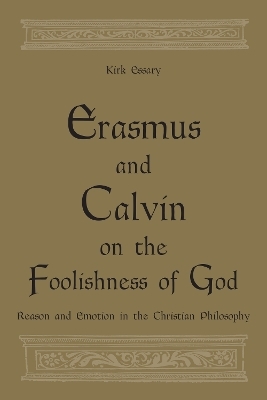
Erasmus and Calvin on the Foolishness of God
Reason and Emotion in the Christian Philosophy
Seiten
2017
University of Toronto Press (Verlag)
9781487501884 (ISBN)
University of Toronto Press (Verlag)
9781487501884 (ISBN)
What did Paul mean when he wrote that the foolishness of God is wiser than human wisdom? Through close analysis of the sixteenth-century reception of Paul's discourses of folly, this book examines the role of the New Testament in the development of what Erasmus and John Calvin refer to as the "Christian philosophy."
Erasmus and Calvin on the Foolishness of God reveals the importance of Pauline rhetoric in the development of humanist critiques of scholasticism while charting the formation of a specifically affective approach to religious epistemology and theological method. As the first book-length examination of Calvin's indebtedness to Erasmus, which also considers the participation of Bullinger, Pellikan, and Melanchthon in an Erasmian exegetical milieu, it is a case study in the complicated cross-confessional exchange of ideas in the sixteenth century. Kirk Essary examines assumptions about the very nature of theology in the sixteenth century, how it was understood by leading humanist reformers, and how ideas about philosophy and rhetoric were received, appropriated, and shared in a complex intellectual and religious context.
Erasmus and Calvin on the Foolishness of God reveals the importance of Pauline rhetoric in the development of humanist critiques of scholasticism while charting the formation of a specifically affective approach to religious epistemology and theological method. As the first book-length examination of Calvin's indebtedness to Erasmus, which also considers the participation of Bullinger, Pellikan, and Melanchthon in an Erasmian exegetical milieu, it is a case study in the complicated cross-confessional exchange of ideas in the sixteenth century. Kirk Essary examines assumptions about the very nature of theology in the sixteenth century, how it was understood by leading humanist reformers, and how ideas about philosophy and rhetoric were received, appropriated, and shared in a complex intellectual and religious context.
Kirk Essary is Lecturer in History and Classics at the University of Western Australia.
Preface
Chapter One
Calvin’s Erasmus, Theologia Rhetorica, and Pauline Folly
Chapter Two
Foolishness as Religious Knowledge
Chapter Three
Hidden Wisdom and the Revelation of the Spirit
Chapter Four
Milk for Babes: A Pauline Eloquence
Chapter Five
Blaming Philosophy, Praising Folly
Chapter Six
The Affective Christian Philosophy
Conclusion
Notes
Bibliography
| Erscheinungsdatum | 06.06.2017 |
|---|---|
| Reihe/Serie | Erasmus Studies |
| Verlagsort | Toronto |
| Sprache | englisch |
| Maße | 160 x 235 mm |
| Gewicht | 610 g |
| Themenwelt | Geschichte ► Allgemeine Geschichte ► Neuzeit (bis 1918) |
| Geisteswissenschaften ► Geschichte ► Regional- / Ländergeschichte | |
| Geschichte ► Teilgebiete der Geschichte ► Religionsgeschichte | |
| Geisteswissenschaften ► Philosophie ► Geschichte der Philosophie | |
| Geisteswissenschaften ► Religion / Theologie | |
| Sozialwissenschaften | |
| ISBN-13 | 9781487501884 / 9781487501884 |
| Zustand | Neuware |
| Informationen gemäß Produktsicherheitsverordnung (GPSR) | |
| Haben Sie eine Frage zum Produkt? |
Mehr entdecken
aus dem Bereich



aus dem Bereich


