Ideology of the Offensive (eBook)
272 Seiten
Cornell University Press (Verlag)
978-0-8014-6862-9 (ISBN)
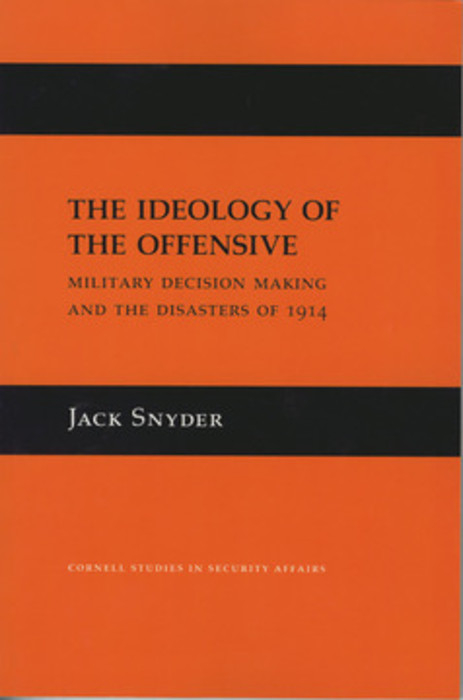
Jack Snyder's analysis of the attitudes of military planners in the years prior to the Great War offers new insight into the tragic miscalculations of that era and into their possible parallels in present-day war planning. By 1914, the European military powers had adopted offensive military strategies even though there was considerable evidence to support the notion that much greater advantage lay with defensive strategies. The author argues that organizational biases inherent in military strategists' attitudes make war more likely by encouraging offensive postures even when the motive is self-defense.Drawing on new historical evidence of the specific circumstances surrounding French, German, and Russian strategic policy, Snyder demonstrates that it is not only rational analysis that determines strategic doctrine, but also the attitudes of military planners. Snyder argues that the use of rational calculation often falls victim to the pursuit of organizational interests such as autonomy, prestige, growth, and wealth. Furthermore, efforts to justify the preferred policy bring biases into strategists' decisions-biases reflecting the influences of parochial interests and preconceptions, and those resulting from attempts to simplify unduly their analytical tasks.The frightening lesson here is that doctrines can be destabilizing even when weapons are not, because doctrine may be more responsive to the organizational needs of the military than to the implications of the prevailing weapons technology. By examining the historical failure of offensive doctrine, Jack Snyder makes a valuable contribution to the literature on the causes of war.
Jack Snyder is the Robert and Renée Belfer Professor of International Relations in the Department of Political Science and Institute of War and Peace Studies at Columbia University. He is the author of The Ideology of the Offensive: Military Decision Making and the Disasters of 1914; Myths of Empire: Domestic Politics and International Ambition (both published by Cornell); and From Voting to Violence: Democratization and Nationalist Conflict; and is the coeditor of Civil Wars, Insecurity, and Intervention.
Jack Snyder's analysis of the attitudes of military planners in the years prior to the Great War offers new insight into the tragic miscalculations of that era and into their possible parallels in present-day war planning. By 1914, the European military powers had adopted offensive military strategies even though there was considerable evidence to support the notion that much greater advantage lay with defensive strategies. The author argues that organizational biases inherent in military strategists' attitudes make war more likely by encouraging offensive postures even when the motive is self-defense.Drawing on new historical evidence of the specific circumstances surrounding French, German, and Russian strategic policy, Snyder demonstrates that it is not only rational analysis that determines strategic doctrine, but also the attitudes of military planners. Snyder argues that the use of rational calculation often falls victim to the pursuit of organizational interests such as autonomy, prestige, growth, and wealth. Furthermore, efforts to justify the preferred policy bring biases into strategists' decisions-biases reflecting the influences of parochial interests and preconceptions, and those resulting from attempts to simplify unduly their analytical tasks.The frightening lesson here is that doctrines can be destabilizing even when weapons are not, because doctrine may be more responsive to the organizational needs of the military than to the implications of the prevailing weapons technology. By examining the historical failure of offensive doctrine, Jack Snyder makes a valuable contribution to the literature on the causes of war.
| Erscheint lt. Verlag | 21.5.2013 |
|---|---|
| Sprache | englisch |
| Themenwelt | Geschichte ► Allgemeine Geschichte ► Neuzeit (bis 1918) |
| Geschichte ► Allgemeine Geschichte ► 1918 bis 1945 | |
| Geisteswissenschaften ► Geschichte ► Regional- / Ländergeschichte | |
| Geschichte ► Teilgebiete der Geschichte ► Militärgeschichte | |
| Sozialwissenschaften ► Politik / Verwaltung ► Europäische / Internationale Politik | |
| ISBN-10 | 0-8014-6862-0 / 0801468620 |
| ISBN-13 | 978-0-8014-6862-9 / 9780801468629 |
| Informationen gemäß Produktsicherheitsverordnung (GPSR) | |
| Haben Sie eine Frage zum Produkt? |
 PDF (Adobe DRM)
Kopierschutz: Adobe-DRM
Adobe-DRM ist ein Kopierschutz, der das eBook vor Mißbrauch schützen soll. Dabei wird das eBook bereits beim Download auf Ihre persönliche Adobe-ID autorisiert. Lesen können Sie das eBook dann nur auf den Geräten, welche ebenfalls auf Ihre Adobe-ID registriert sind.
Details zum Adobe-DRM
Dateiformat: PDF (Portable Document Format)
Mit einem festen Seitenlayout eignet sich die PDF besonders für Fachbücher mit Spalten, Tabellen und Abbildungen. Eine PDF kann auf fast allen Geräten angezeigt werden, ist aber für kleine Displays (Smartphone, eReader) nur eingeschränkt geeignet.
Systemvoraussetzungen:
PC/Mac: Mit einem PC oder Mac können Sie dieses eBook lesen. Sie benötigen eine
eReader: Dieses eBook kann mit (fast) allen eBook-Readern gelesen werden. Mit dem amazon-Kindle ist es aber nicht kompatibel.
Smartphone/Tablet: Egal ob Apple oder Android, dieses eBook können Sie lesen. Sie benötigen eine
Geräteliste und zusätzliche Hinweise
Buying eBooks from abroad
For tax law reasons we can sell eBooks just within Germany and Switzerland. Regrettably we cannot fulfill eBook-orders from other countries.
aus dem Bereich