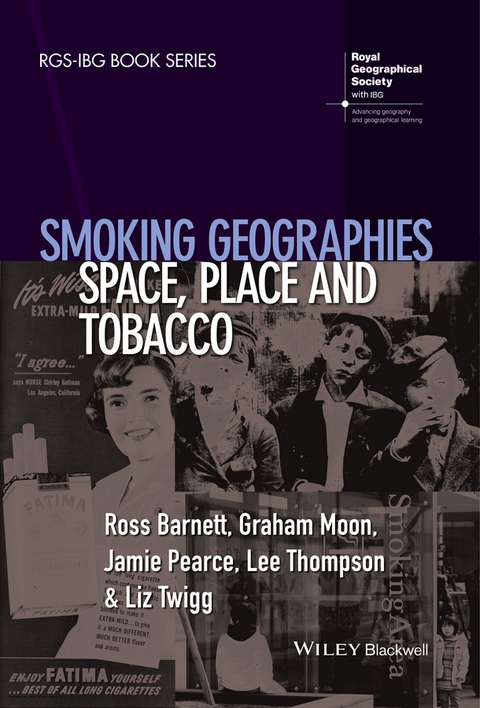
Smoking Geographies (eBook)
John Wiley & Sons (Verlag)
978-1-118-34916-8 (ISBN)
Ross Barnett is Adjunct Professor at the University of Canterbury, Christchurch, New Zealand. He is particularly interested in the implementation of smoking cessation policies and their effectiveness in increasing quit rates among disadvantaged groups. He also acts as a consultant to the Centre for Tobacco Control Research, Zhejiang University in Shanghai.
Graham Moon is Professor of Spatial Analysis in Human Geography at the University of Southampton, England. He has acted as a consultant and advisor to national and local governments on smoking cessation policy. Recent work has focused on longitudinal changes in the impact of ethnic segregation on smoking and on smoking-related mortality.
Jamie Pearce is Professor of Health Geography and co-Director of the Centre for Research on Environment, Society & Health (CRESH) at the University of Edinburgh, Scotland. His research considers social, political and environmental processes affecting social and spatial inequalities in health. Recent work has examined the influence of the local availability and marketing of tobacco products on smoking norms and behaviour.
Lee Thompson is Senior Lecturer at the University of Otago, Christchurch, New Zealand. Her research has centred on the governance of population health, with a special interest in tobacco control and the unintended consequences of tobacco control interventions.
Liz Twigg is Professor in Human Geography at the University of Portsmouth, England. She has research and consultancy experience concerning place effects on smoking behaviour, and is particularly interested in identifying hard-to-reach groups in terms of smoking cessation policy.
Smoking Geographies provides a research-led assessment of the impact of geographical factors on smoking. The contributors uncover how geography can show us not only why people smoke but also broader issues of tobacco control, providing deeper clarity on how smoking and tobacco is governed . The text centres on one of the most important public health issues worldwide, and a major determinant of preventable mortality and morbidity in developed and developing countries Records the outcomes of a long-term research collaboration that brings a geographical lens to smoking behaviour Uncovers how geography can play a part in understanding not only why people smoke but also broader issues of tobacco control Provides a deeper understanding of how smoking and tobacco is governed , regarding where people may smoke, but also more subtle governance as a climate is produced in which smoking becomes denormalised Brings both quantitative and qualitative perspectives to bear on this major source of mortality and morbidity
Ross Barnett is Adjunct Professor at the University of Canterbury, Christchurch, New Zealand. He is particularly interested in the implementation of smoking cessation policies and their effectiveness in increasing quit rates among disadvantaged groups. He also acts as a consultant to the Centre for Tobacco Control Research, Zhejiang University in Shanghai. Graham Moon is Professor of Spatial Analysis in Human Geography at the University of Southampton, England. He has acted as a consultant and advisor to national and local governments on smoking cessation policy. Recent work has focused on longitudinal changes in the impact of ethnic segregation on smoking and on smoking-related mortality. Jamie Pearce is Professor of Health Geography and co-Director of the Centre for Research on Environment, Society & Health (CRESH) at the University of Edinburgh, Scotland. His research considers social, political and environmental processes affecting social and spatial inequalities in health. Recent work has examined the influence of the local availability and marketing of tobacco products on smoking norms and behaviour. Lee Thompson is Senior Lecturer at the University of Otago, Christchurch, New Zealand. Her research has centred on the governance of population health, with a special interest in tobacco control and the unintended consequences of tobacco control interventions. Liz Twigg is Professor in Human Geography at the University of Portsmouth, England. She has research and consultancy experience concerning place effects on smoking behaviour, and is particularly interested in identifying hard-to-reach groups in terms of smoking cessation policy.
About the Authors vi
Series Editors' Preface vii
Preface viii
Acknowledgements ix
1 Introduction 1
2 The Geo?]epidemiology of an Addiction 16
3 The Economic Geography of Tobacco 50
4 Context Matters: Area Effects, Socio?]economic Status and Smoking 89
5 Place?]Based Practices: Pathways to Smoking Behaviour 108
6 Smoking, Denormalisation and the Messy Terrain of Unintended Consequences 128
7 Smoking Gateways: Burdens and Co?]behaviours 147
8 Place and Tobacco Regulation 168
9 Conclusion 205
References 223
Index 277
'The authors of this ground-breaking book have combined their substantial research expertise in the geography of smoking to produce this well-argued, accessible book which reveals how geographical factors act and inter-act at international, national and local levels in smoking initiation, maintenance and cessation. This book is a must-read for researchers and policymakers in tobacco control, irrespective of their disciplinary backgrounds.'
Amanda Amos, Professor of Health Promotion, University of Edinburgh, UK
'Too often we only encounter partial accounts of seemingly intractable societal problems. In this book, five experts join forces to grapple with the complex issues at the heart of tobacco availability, smoking behaviour and regulation. Their achievement is to emphatically demonstrate the potency of geography in understanding and addressing these public health issues.'
Robin Kearns, Professor of Geography, The University of Auckland, New Zealand
Chapter One
Introduction
1.1 Background
The global tobacco industry is one of the most profitable and deadly in the world. In 2014, 5.8 trillion cigarettes were sold to more than one billion smokers worldwide, 64% of whom were in the Asia Pacific region (Euromonitor International 2014). Over the next five years it is predicted that the industry will continue to grow, especially in emerging markets, in Asia, the Middle East and Africa, where tobacco companies have taken full advantage of rising populations, increased incomes and lax regulatory environments. If current consumption trends continue, approximately one billion people will die from tobacco use during the twenty‐first century (Jha 2009). The tobacco industry also remains a major employer, but, especially in countries such as China or Malawi where tobacco is central to the economy and in addition to causing many premature deaths, the industry has also contributed to deforestation and a reduction in food growing (The Guardian 2015).
In richer nations tobacco smoking was, until recently, a regular, normal, everyday activity. While smoking rates have passed their peak and substantially declined since the 1970s, social and ethnic inequalities in consumption have risen as smoking has become concentrated among more marginalised groups. In low‐ and middle‐income countries social differences in smoking are also now becoming more apparent, but gender differences remain most significant. Male smoking prevalence rates remain high and approximate those of higher‐income countries in the early twentieth century (Thun et al. 2012). By contrast smoking prevalence among women is usually low, but in those countries where cultural constraints have lessened, the number of female smokers is on the rise. These epidemiological trends are paralleled by changes in the global tobacco industry. In higher‐income countries contracting markets have meant that tobacco has reduced in significance, both as an agricultural crop and production industry, but in low‐income countries this picture is reversed. Understanding such trends and their significance is important not only for public health but also for the future regulation and control of tobacco consumption.
Whilst the use of tobacco can be traced back to around 5000 BCE, and tobacco trade began during the early sixteenth century, it was the introduction of automated cigarette production in the 1880s that enabled a rapid increase in consumption. Between 1880 and 1910 the number of manufactured cigarettes rose from 500 million to 10 billion (Brooks 1952). By the mid‐twentieth century, smoking had transformed in high‐income countries into a non‐contentious, socially accepted activity which, significantly, involved both men and women. Until the 1920s smoking by women had been stigmatised; smoking was a manly attribute. Female emancipation and, perhaps more importantly, competition between cigarette companies for market share, saw smoking by women become far more common, with their smoking rates coming to approximate those of men. The success of the cigarette was nothing short of spectacular and from the 1930s onwards it became a central icon of the new consumer culture and, among women, a symbol of glamour and independence.
In high‐income countries, the trends in smoking prevalence and tobacco consumption over the latter half of the twentieth century are closely tied to the epidemiological evidence that emerged from the 1930s onwards demonstrating a causal link between prolonged smoking and poor health (Doll & Hill, 1954; Hammond & Horn, 1954; Royal College of Physicians of London, 1962; United States Department of Health and Human Services, 1964). This led to changes in public perceptions of the health risks of tobacco consumption and the social norms around smoking. Whilst these early studies were later shown to greatly underestimate the health hazards of smoking (Peto 1994), they were fundamental in initiating the slow shift in public attitudes and the development of anti‐smoking policies over the next few decades. By the 1970s, the risks for other groups, most notably women who smoke during pregnancy, were recognised and central to policy efforts (Berridge & Loughlin 2005). The emerging scientific consensus on the dangers of exposure to second‐hand smoke (‘passive smoking’ or ‘environmental tobacco smoke (ETS)’) was essential in compelling many national governments to act in limiting the places in which people could smoke (Brandt 2003). Policies of the 1980s and 1990s recast smoking as a wider threat to public health, and tobacco control policies tended to focus on reducing exposure to second‐hand smoke amongst non‐smokers.
Despite the concerted efforts of the tobacco industry to manufacture doubt (Proctor 2012), public awareness of the health hazards of smoking and ETS rose, with the result that smoking is now considered by many to be a remarkable, unclean, or even immoral activity. It has evolved from a normalised activity embedded in the practices of everyday life to an abnormal activity that is often viewed with disdain, and tends to be displaced from everyday human interactions across much, but not all, of the world (Chapman 2008). Tobacco control policies have, through information campaigns and restrictions on where and when people can smoke, been designed to convey smoking as a socially unacceptable, unusual practice and the times, opportunities and spaces for smoking have been radically constrained. Whilst the denormalisation of smoking in high‐income countries has been widely regarded as a significant public health success, this transition raises a number of new and important research concerns and policy dilemmas. Important among these has been the globalisation of the tobacco industry. Contracting markets in richer nations have, in turn, resulted in the incursion of large multinational tobacco companies into poorer countries. As these companies have sought new markets, global smoking prevalence has risen, especially amongst women and younger people. Further, in high‐income countries, the unacceptability of smoking and the reduction in tobacco use has been far more pronounced among higher socioeconomic groups. Social and ethnic gradients in smoking thus have significantly increased, resulting in smoking now being an indicator of social deprivation and disadvantaged places. As smoking becomes denormalised, it is likely that those who continue to smoke will become increasingly marginalised and stigmatised.
On the basis of the above evidence it is undeniable that smoking and tobacco are significant topics for study. The public health ‘toll’ of the ‘smoking epidemic’ is well documented, with an estimated 100 million deaths attributed to tobacco over the twentieth century, more than the total deaths in World War I and World War II. Smoking remains one of the most important public health challenges worldwide, and is identified as a key determinant of preventable mortality and morbidity in developed and developing countries. Active smoking has adverse health effects including lung cancer, cerebrovascular disease and heart disease, and has been estimated to cause at least five million premature deaths annually (WHO 2008). It is thought that the consumption of tobacco is complicit in approximately 18% of all deaths and 40% of cancer deaths worldwide (WHO 2008). In the UK, one in five deaths are attributable to smoking and it is estimated that the total direct cost to the National Health Service of treating diseases directly caused by smoking is over £5 billion per year (Allender et al. 2009).
1.2 Smoking and Tobacco; The Importance of Geography
Given the widespread and significant health, social and economic burdens that have been attributed to tobacco consumption, it is unsurprising that tobacco research has received a great deal of academic attention. Research into tobacco consumption and smoking spans a number of disciplines with important contributions from the medical sciences, social sciences and the humanities. Collectively, this body of work has provided a variety of insights into issues such as: the biological effects of prolonged smoking; the implications of environmental tobacco smoke for public health; smoking as marker of social class; stigmatisation of smoking and the smoker; smoking as a performed identity; and representations of smoking in literature and on film. The work has not only broadened our appreciation of the medical and conceptual understanding of tobacco consumption, but also it has profoundly shaped public health policy development and underpins on‐going tobacco control measures.
Geographers are relative newcomers to these debates, perhaps reflecting the predominant focus until recently amongst health geographers on disease distribution and care provision (Kearns & Moon 2002). While geographers have made important intellectual and policy‐related contributions including exploring the macro‐ and micro‐level spatial processes implicated in understanding health, they have paid little attention to smoking. This is unfortunate, not only because smoking remains a leading cause of death and disease but also because many geographical processes, such as globalisation, urbanisation, increased poverty and inequality, give rise to stresses that are directly implicated in smoking. Thus, it is important to understand the contexts within which different health behaviours, including smoking, take place, for in the absence of such an approach our view can only be a partial one. Geographical approaches...
| Erscheint lt. Verlag | 13.3.2017 |
|---|---|
| Reihe/Serie | RGS-IBG Book Series |
| RGS-IBG Book Series | RGS-IBG Book Series |
| Sprache | englisch |
| Themenwelt | Naturwissenschaften ► Geowissenschaften ► Geografie / Kartografie |
| Sozialwissenschaften ► Soziologie ► Makrosoziologie | |
| Technik | |
| Schlagworte | active smoking • Anthropogeographie • Big Tobacco • Cancer • Cancer deaths • denormalising smoking • developing world • Geographie • Geography • health geography • Health inequalities • health-related behaviour • Human geography • <p>Smoking • Lung Cancer • Morbidity • Mortality • Passive smoking • place and smoking • Political Geography • Politische Geographie • Public Health • smoker identities • smoking ban</p> • Smoking cessation • smoking epidemic • smoking islands • smoking norms • smoking-related mortality • social inequalities • socioeconomic • Sociology • Sociology of Health & Illness • Soziologie • Soziologie d. Gesundheit u. Krankheit • Spatial inequalities • Tabak • tobacco • Tobacco advertising • tobacco consumption • Tobacco Control • WHO |
| ISBN-10 | 1-118-34916-4 / 1118349164 |
| ISBN-13 | 978-1-118-34916-8 / 9781118349168 |
| Informationen gemäß Produktsicherheitsverordnung (GPSR) | |
| Haben Sie eine Frage zum Produkt? |
 EPUB (Adobe DRM)
Kopierschutz: Adobe-DRM
Adobe-DRM ist ein Kopierschutz, der das eBook vor Mißbrauch schützen soll. Dabei wird das eBook bereits beim Download auf Ihre persönliche Adobe-ID autorisiert. Lesen können Sie das eBook dann nur auf den Geräten, welche ebenfalls auf Ihre Adobe-ID registriert sind.
Details zum Adobe-DRM
Dateiformat: EPUB (Electronic Publication)
EPUB ist ein offener Standard für eBooks und eignet sich besonders zur Darstellung von Belletristik und Sachbüchern. Der Fließtext wird dynamisch an die Display- und Schriftgröße angepasst. Auch für mobile Lesegeräte ist EPUB daher gut geeignet.
Systemvoraussetzungen:
PC/Mac: Mit einem PC oder Mac können Sie dieses eBook lesen. Sie benötigen eine
eReader: Dieses eBook kann mit (fast) allen eBook-Readern gelesen werden. Mit dem amazon-Kindle ist es aber nicht kompatibel.
Smartphone/Tablet: Egal ob Apple oder Android, dieses eBook können Sie lesen. Sie benötigen eine
Geräteliste und zusätzliche Hinweise
Buying eBooks from abroad
For tax law reasons we can sell eBooks just within Germany and Switzerland. Regrettably we cannot fulfill eBook-orders from other countries.
aus dem Bereich