


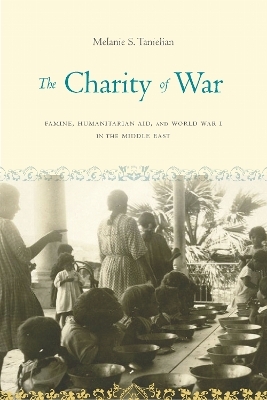
The Charity of War
Famine, Humanitarian Aid, and World War I in the Middle East
Seiten
2017
|
New edition
Stanford University Press (Verlag)
978-1-5036-0352-3 (ISBN)
Stanford University Press (Verlag)
978-1-5036-0352-3 (ISBN)
With the exception of a few targeted aerial bombardments of the city's port, Beirut and Mount Lebanon did not see direct combat in World War I. Yet civilian casualties in this part of the Ottoman Empire reached shocking heights, possibly numbering half a million people. No war, in its usual understanding, took place there, but Lebanon was incontestably war-stricken. As a food crisis escalated into famine, it was the bloodless incursion of starvation and the silent assault of fatal disease that defined everyday life.
The Charity of War tells how the Ottoman home front grappled with total war and how it sought to mitigate starvation and sickness through relief activities. Melanie S. Tanielian examines the wartime famine's reverberations throughout the community: in Beirut's municipal institutions, in its philanthropic and religious organizations, in international agencies, and in the homes of the city's residents. Her local history reveals a dynamic politics of provisioning that was central to civilian experiences in the war, as well as to the Middle Eastern political landscape that emerged post-war. By tracing these responses to the conflict, she demonstrates World War I's immediacy far from the European trenches, in a place where war was a socio-economic and political process rather than a military event.
The Charity of War tells how the Ottoman home front grappled with total war and how it sought to mitigate starvation and sickness through relief activities. Melanie S. Tanielian examines the wartime famine's reverberations throughout the community: in Beirut's municipal institutions, in its philanthropic and religious organizations, in international agencies, and in the homes of the city's residents. Her local history reveals a dynamic politics of provisioning that was central to civilian experiences in the war, as well as to the Middle Eastern political landscape that emerged post-war. By tracing these responses to the conflict, she demonstrates World War I's immediacy far from the European trenches, in a place where war was a socio-economic and political process rather than a military event.
Melanie S. Tanielian is Assistant Professor of History at the University of Michigan.
Introduction: Total War: Politics, Power, and Benevolence
1. A City and Its Mountain, a Mountain and Its City
2. Wartime Famine: Strategies, Logistics, and Catastrophe
3. The Politics of Food: Wartime Provisioning for Civilians
4. Prayers and Patrons: The Politics of Neutrality
5. Rats, Lice and Microbes: The Struggle against Infectious Diseases
6. Local Relief Initiatives: Civil Society, Women, and the State
7. Beneficial Benevolence: International Wartime Relief Efforts
Conclusion: Beirut 1919: The Chaos of Memory and Politics
| Erscheinungsdatum | 26.10.2017 |
|---|---|
| Zusatzinfo | 16 halftones, 3 maps |
| Verlagsort | Palo Alto |
| Sprache | englisch |
| Maße | 152 x 229 mm |
| Themenwelt | Sachbuch/Ratgeber ► Geschichte / Politik ► Allgemeines / Lexika |
| Geisteswissenschaften ► Geschichte ► Allgemeine Geschichte | |
| Geisteswissenschaften ► Geschichte ► Regional- / Ländergeschichte | |
| Sozialwissenschaften ► Soziologie | |
| ISBN-10 | 1-5036-0352-0 / 1503603520 |
| ISBN-13 | 978-1-5036-0352-3 / 9781503603523 |
| Zustand | Neuware |
| Informationen gemäß Produktsicherheitsverordnung (GPSR) | |
| Haben Sie eine Frage zum Produkt? |
Mehr entdecken
aus dem Bereich



aus dem Bereich
Handbuch zum Lesen des Himmels
Buch | Hardcover (2025)
Harpercollins (Verlag)
CHF 30,80
historische Porträts von George Washington bis Donald Trump
Buch | Softcover (2025)
C.H.Beck (Verlag)
CHF 33,55


