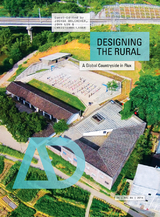
Designing the Rural (eBook)
John Wiley & Sons (Verlag)
978-1-118-95106-4 (ISBN)
Contributors: Neil Brenner, Christiane Lange, Charlotte Malterre-Barthes, Sandra Parvu, Cole Roskam, Grahame Shane, Deane Simpson, and Milica Topalovic and Bas Princen
Architects: Anders Abraham, Joshua Bolchover and John Lin (Rural Urban Framework), Ambra Fabi and Giovanni Piovene (Piovenefabi), Rainer Hehl, Stephan Petermann (OMA), Huang Sheng Yuan (FieldOffice), and Sandeep Virmani (Hunnarshala)
Joshua Bolchover is an urban researcher, academic and architectural designer. He is an Assistant Professor at the University of Hong Kong. His research focuses on understanding urban transformation in China. He exhibited his work, 'Rural Urban Ecology' at the Venice Biennale 2010. He is the author with John Lin of Rural Urban Framework: Transforming the Chinese Countryside (Birkhauser), 2014.
John Lin is an architect based in Hong Kong and currently an Assistant Professor at The University of Hong Kong. His current projects include the design of several school buildings, a village community centre, a hospital and a sustainable house prototype in China. He was the overall winner of the Architectural Review's House Award in 2012 for his 'House For All Seasons' a rural house in Shaanxi Province, China.
Christiane Lange is a Visiting Assistant Professor at the Department of Architecture of the University of Hong Kong. She teaches Urban Design in the Bachelor and Master Program and works in the Community Project Workshop of the University of Hong Kong. Her research focuses on the urbanization process of developing countries.
The rural is not what it used to be. No longer simply a site for agricultural production for the city, the relationship between the rural and urban has become much more complex. Established categories such as rural /urban and village/city no longer hold true. Rural and urban conditions have become increasingly blurred, so how can we identify and distinguish their specific characteristics? Where is the rural, and what role does it play in an urbanised world? In developing countries the countryside is a volatile and contradictory landscape: legally designated rural areas look like dense slums; factories intersect fields and farmers no longer farm. In contrast, in developed regions, the rural has become a highly controlled landscape of production and consumption: industrialised agriculture coexists with leisure landscapes for tourism, retirement and recreation. This issue of AD investigates how architects and researchers are critically engaging with the rural as an experimental field of exploration. Contributors: Neil Brenner, Christiane Lange, Charlotte Malterre-Barthes, Sandra Parvu, Cole Roskam, Grahame Shane, Deane Simpson, and Milica Topalovic and Bas Princen Architects: Anders Abraham, Joshua Bolchover and John Lin (Rural Urban Framework), Ambra Fabi and Giovanni Piovene (Piovenefabi), Rainer Hehl, Stephan Petermann (OMA), Huang Sheng Yuan (FieldOffice), and Sandeep Virmani (Hunnarshala)
Joshua Bolchover is an urban researcher, academic and architectural designer. He is an Assistant Professor at the University of Hong Kong. His research focuses on understanding urban transformation in China. He exhibited his work, 'Rural Urban Ecology' at the Venice Biennale 2010. He is the author with John Lin of Rural Urban Framework: Transforming the Chinese Countryside (Birkhauser), 2014. John Lin is an architect based in Hong Kong and currently an Assistant Professor at The University of Hong Kong. His current projects include the design of several school buildings, a village community centre, a hospital and a sustainable house prototype in China. He was the overall winner of the Architectural Review's House Award in 2012 for his "House For All Seasons" a rural house in Shaanxi Province, China. Christiane Lange is a Visiting Assistant Professor at the Department of Architecture of the University of Hong Kong. She teaches Urban Design in the Bachelor and Master Program and works in the Community Project Workshop of the University of Hong Kong. Her research focuses on the urbanization process of developing countries.
Cover 1
Title Page 3
Contents 4
Copyright Page 6
About the Guest-Editors 7
Introduction: Where is the Rural in an Urban World? 8
The Global Rural 10
Rural Urban Framework 10
The Real and Imagined Rural 14
The Urban Future 15
Inventing the Rural: A Brief History of Modern Architecture in the Countryside 16
Cities in the Countryside 17
Modernism’s Architectural Pastoral 18
Return to the Rural 20
Settling the Nomads: Rural Urban Framework, an Incremental Urban Strategy for Ulaanbaatar, Mongolia 22
Becoming Urban 25
Incremental Change 26
Reality Check 26
Notes 29
Indefinitely Intermediate: Processes of Ruralisation in Chisinau, Moldova 30
Intermediary Society 31
The Persistence of the Vernacular 32
Design and Ruralisation 33
Notes 35
Cultivating the Field in the Global Hinterland: Community Building for Mass Housing in the Amazon Region 37
Frontier Zone of Global Capitalism 38
Generic Housing Models Versus Specific Adaptations 40
Test Site: Bairro dos Mineiros 41
Social, Technical and Design Assistance 42
The Civic Centre as a Field 42
Setting the Frame for Future Urban Growth 43
Notes 43
Palm Oil: A New Ethics of Visibility for the Production Landscape 44
Geography of Paradise 45
Geography of Production 45
Invisible Industrialisation of the Rural 47
Representing and Designing Production Landscapes 48
Notes 49
Notes on Villages as a Global Condition 50
Villages and the Agricultural Revolution 51
Villages, Industry and the Metropolis in the Modern Nation State 52
Networks of Villages in the Megalopolis and the Fragmented Metropolis 53
Multiple Village Networks in the Contemporary Megacity and Metacity 55
Designing for Villages in an Extended Urban Field 58
Notes 59
Fieldoffice Architects In Situ: Reflecting on the Rural–Urban Mix in Yilan, Taiwan 60
Reflecting on ‘Time as a Friend’ 63
Reflecting on ‘The Sheltering Capacity of the Urban-Field Canopy’ 64
Reflecting on ‘Learning from the Delta, Water and Territory’ 66
Final Reflections on ‘Living in the Rural-Urban Mix, Yilan’ 67
Notes 67
In the Hands of the People: Harnessing the Collective Power of Village Life in India 68
Housing: An Opportunity to Build Social Capital 70
Artisans as Knowledge Bearers 72
Balancing Process and Product 73
Note 73
Designing for an Uncertain Future: Rural Urban Framework, Shichuang Village House Prototype, Guangdong Province, China 74
Dissolving the Rural–Urban Divide 76
From Houses to Housing 76
A Flexible Prototype 79
The Hunstad Code: Rules for the Planning of a Rural Town 80
A New Nature 83
Notes 87
The Villages, Florida: Small-town Metropolitanism and the ‘Middle of Nowhere’ 88
From Orange Blossom Gardens to The Villages 90
Small-Town Metropolitanism: Scaling Up 91
Small-Town Metropolitanism: Scaling Down 92
Scalar Elastics 93
Notes 93
New Territories: Deconstructing and Constructing Countryside – The Great Divide of Rural and Urban in Hong Kong 94
Old Territory (On the Perception of Countryside) 96
New Territories (On the Force of Urbanisation) 97
The Old Territory and The New Territory (On the Division of Rural and Urban) 97
New Territories (On the Design of the Countryside) 99
Notes 99
The Toshka Project: Colossal Water Infrastructures, Biopolitics and Territory in Egypt 100
Notes 107
Best of Both Worlds: Lamenting Our Path to the Future 109
‘Do I dare Disturb the universe?’ 111
Swansong 111
Line-Up 111
Arrested Development 112
Camouflage 113
Notes 115
Durana, Albania: A Field of Possibilities 116
The Hinterland, Urbanised? 120
The Urbanisation Problématique 122
Interiorising the Constitutive Outside 124
Designing Other Urbanisations 127
Notes 129
Counterpoint: Don’t Waste Your Time in the Countryside 130
Rural Architecture? 132
Metropolitan Brain Versus Rural Muscle 133
Avant-Garde Versus Avant-Gardism 133
Markets Versus Anti-Capitalist Moralising 134
Notes 135
Contributors 136
What is Architectural Design? 138
Forthcoming Titles 139
Back Cover 140
EULA 141
| Erscheint lt. Verlag | 3.3.2017 |
|---|---|
| Reihe/Serie | Architectural Design | Architectural Design |
| Mitarbeit |
Gast Herausgeber: Joshua Bolchover, John Lin, Christiane Lange |
| Sprache | englisch |
| Themenwelt | Sozialwissenschaften ► Soziologie |
| Technik ► Architektur | |
| Schlagworte | AD • Architecture • Architektur • contributors • countryside • Design • discussions • Draws • Field • fieldoffice • Global • Highlights • International experts • Joshua • Landscape Design • Landschaftsarchitektur • Neglect • piovenefabi • prestigious • Rural • rural urban • series • Stadtentwicklung • Successful • title • Trends • Urban • Urban Development • years • Yuan |
| ISBN-10 | 1-118-95106-9 / 1118951069 |
| ISBN-13 | 978-1-118-95106-4 / 9781118951064 |
| Informationen gemäß Produktsicherheitsverordnung (GPSR) | |
| Haben Sie eine Frage zum Produkt? |
 PDF (Adobe DRM)
Kopierschutz: Adobe-DRM
Adobe-DRM ist ein Kopierschutz, der das eBook vor Mißbrauch schützen soll. Dabei wird das eBook bereits beim Download auf Ihre persönliche Adobe-ID autorisiert. Lesen können Sie das eBook dann nur auf den Geräten, welche ebenfalls auf Ihre Adobe-ID registriert sind.
Details zum Adobe-DRM
Dateiformat: PDF (Portable Document Format)
Mit einem festen Seitenlayout eignet sich die PDF besonders für Fachbücher mit Spalten, Tabellen und Abbildungen. Eine PDF kann auf fast allen Geräten angezeigt werden, ist aber für kleine Displays (Smartphone, eReader) nur eingeschränkt geeignet.
Systemvoraussetzungen:
PC/Mac: Mit einem PC oder Mac können Sie dieses eBook lesen. Sie benötigen eine
eReader: Dieses eBook kann mit (fast) allen eBook-Readern gelesen werden. Mit dem amazon-Kindle ist es aber nicht kompatibel.
Smartphone/Tablet: Egal ob Apple oder Android, dieses eBook können Sie lesen. Sie benötigen eine
Geräteliste und zusätzliche Hinweise
Buying eBooks from abroad
For tax law reasons we can sell eBooks just within Germany and Switzerland. Regrettably we cannot fulfill eBook-orders from other countries.
aus dem Bereich