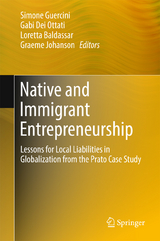
Native and Immigrant Entrepreneurship (eBook)
217 Seiten
Springer International Publishing (Verlag)
978-3-319-44111-5 (ISBN)
Simone Guercini is a Professor of Management at the University of Florence and visiting professor at the Grenoble Graduate School of Business. His research interests include business marketing, heuristics in business, entrepreneurship in communities, and internationalization, with a special focus on the Italian fashion industry. Simone received his PhD in economics from Sant’Anna School of Advanced Studies, Pisa. Gabi Dei Ottati is a Professor of Applied Economics at the University of Florence and a member of the European Research Centre on Regional and Local Development. Her main research interests include industrial organization and economic development, with a special focus on Italy and industrial districts. Having collaborated for many years with Giacomo Becattini, the revitalizer of the Marshallian industrial district concept, she is part of the Florence school of local development. Loretta Baldassar is a Professor of Anthropology and Sociology at the University of Western Australia, and Adjunct Principal Research Fellow at the School of Political and Social Inquiry, Monash University. Her research interests focus on transnational migrants, families, and caregiving, including the question of generations. Loretta received her PhD from the University of Western Australia. Graeme Johanson is an Associate Professor of Anthropology at Monash University. His research interests include social informatics, virtual communities, and e-democracy, with a focus on migration and transnationalism. Graeme received his PhD in economics from Monash University.
Acknowledgements 5
Contents 6
Editors and Contributors 8
1 Introduction 12
Abstract 12
References 17
2 Liabilities of Native and Immigrant Entrepreneurship in the Processes of Globalization 18
Abstract 18
1 Introduction 19
2 Acculturation and Liabilities in Relationships Between Native and Immigrant Entrepreneurship 21
2.1 Acculturation Process and Entrepreneurship 22
2.2 Liabilities Between Native and Immigrant Entrepreneurship 25
3 Impact of Migrant Entrepreneurship on the Evolutionary Processes of the Industrial District 28
4 Immigrants, Second Generation and Integration: Liabilities from a Sociological Perspective 30
5 Sociology of the Economics of Outsidership/Insidership and of Networks 32
References 37
3 Chinese Immigration to Italy and Economic Relations with the Homeland: A Multiscalar Perspective 41
Abstract 41
1 Introduction 41
2 National Models and Rescaling Processes: Immigration and Globalization 42
2.1 Changes in Migration 42
2.2 Rescaling Processes 43
2.3 Rescaling and Transnationalism 43
2.4 Foreignness and Outsidership? Migration and Liabilities in Global Interconnections from a Sociological Perspective 44
3 Trade, Investments, and Remittances: Linking Countries Through Immigration 45
3.1 Immigration and Trade 46
3.2 Immigration and Foreign Direct Investment (FDI) 47
3.3 Immigration and Remittances 48
3.4 The Italian Case 48
4 Immigration and (Co-) Development: The Italian Case 49
4.1 Putting the Italian Case in Context 49
4.2 Immigration in the Italian Production System 51
4.3 Chinese in Italy 52
4.4 Socio-economic Consequences 53
5 Bilateral Integration: Immigration, Trade, and Remittances Between Italy and China 53
5.1 Selecting the Factors 53
5.2 Remittances 54
5.3 Trade 55
6 Conclusion 58
References 59
4 A Social Accounting Matrix for Prato: Interrelating the Chinese Migrant Community and the Provincial Economy 63
Abstract 63
1 Introduction 63
2 Social Accounting Matrix 64
3 Using a Social Accounting Matrix to Describe an Economic System 65
4 Analyzing the Economic System and the Contribution of the Chinese Community Using the Provincial Accounts Extracted from the Social Accounting Matrix 69
5 From the Matrix to the Economic Impact Model 76
6 Economic Evaluation of Provincial Policies 85
7 Conclusions 87
References 88
5 Ethnography of the Fast Fashion Community: Chinese Entrepreneurs in Prato 89
Abstract 89
1 Introduction 89
2 Research Questions and Methods 90
3 Fast Fashion in Macrolotto 1 91
4 Connections Between Chinese Fast-Fashion Businesses and the Local Textile District 96
5 Local Society Concerns Regarding Chinese Entrepreneurs: Misunderstandings and Real Problems 98
6 Conclusions 102
Appendix 1 104
References 104
6 Italian-Schooled Chinese Migrant Youth in Prato: The Liability of Outsidership and Social Identity Formation 107
Abstract 107
1 Introduction 108
2 Method and Approach 109
3 Study Participants, Setting, and Data Collection 111
4 Data Analysis and Discussion 113
5 Conclusion 121
Acknowledgments 122
References 122
7 Smartphones and Outsidership in Prato’s Small Business Community 124
Abstract 124
1 Wayfaring and Reflecting 125
2 Theoretical and Interpretive Conundrums 126
3 How and Why Are Smartphones Used? Statistics and Interviews 128
4 Smartphones for Chinese Business and Family Ties 130
5 Rapid Adoption of Smartphones 132
6 Personal Chinese Business Motivations and External Resistance 133
7 The Future 135
References 138
8 Liabilities of Foreignness and Outsidership in the Evolution of Immigrant Chinese Entrepreneurship 142
Abstract 142
1 Introduction 142
2 Literature Review 143
2.1 The Liability of Foreignness 143
2.2 The Liability of Outsidership 146
3 Methodology 149
4 The Evolution of Immigrant Chinese Entrepreneurship in Prato 150
4.1 Prato’s Textile Industry 150
4.2 Chinese Immigrant Companies 152
5 Discussion and Conclusion 153
References 155
9 Liabilities in Prato’s Industrial District: An Analysis of Italian and Chinese Firm Failures 158
Abstract 158
1 Introduction 159
2 Organizational Ecology and Liabilities 160
2.1 Organizational Ecology in Studying Firm Failures 162
3 Research Design and Data Sources 164
4 Historical Evolution of Prato’s Industrial District: Settled Chinese Firms 165
5 Firm Failures in Prato’s Industrial District: Chinese Firms 168
6 Ecological Analysis of Chinese and Italian Firm Populations 170
7 Conclusions 173
References 174
10 The Mechanism of Sustained Immigrant Entrepreneurship: Wenzhounese Immigrants in Italy 177
Abstract 177
1 Introduction 177
2 Theoretical Framework 178
2.1 Immigrant Entrepreneurship and Cluster Networks 178
2.2 Embeddedness and Ambidextrous Innovation 179
2.3 Cultural Embeddedness and Ambidextrous Innovation 180
3 Methods 181
3.1 Case Selection 181
3.2 Data Collection 182
4 Case Discussions 183
4.1 Case H: Furniture Entrepreneur 183
4.2 Case ZR: Clothing Entrepreneur 185
4.3 Case X: Footwear Entrepreneur 187
4.4 Case ZY: Designer Bag Entrepreneur 189
4.5 Summary 191
5 Conclusions 192
5.1 Primary Findings 192
5.2 Research Limits 194
References 194
11 Understanding Chinese Immigrants in Prato’s Industrial District: Benefits to Local Entrepreneurs 196
Abstract 196
1 Introduction 196
2 Ethnic Chinese Networks 197
2.1 Guanxi 199
2.2 Internationalization of Ethnic Chinese Businesses 202
3 Ethnic Chinese Immigrant Entrepreneurship 203
4 Liabilities of Chinese Networks 205
5 Enclave Economy 206
6 Conclusion 208
References 210
12 Concluding Remarks: The Benefits of Overcoming Local Liabilities 215
Abstract 215
References 222
| Erscheint lt. Verlag | 31.1.2017 |
|---|---|
| Zusatzinfo | XII, 217 p. 15 illus. |
| Verlagsort | Cham |
| Sprache | englisch |
| Themenwelt | Sozialwissenschaften ► Politik / Verwaltung |
| Wirtschaft ► Betriebswirtschaft / Management | |
| Schlagworte | Chinese immigrant firms • Chinese manufacturing entrepreneurship • Immigrant entrepreneurship • Liability of foreignness • Liability of outsidership • Local liability • Migrant entrepreneurship in Italy • Prato industrial district • Wenzhou migrants in Italy |
| ISBN-10 | 3-319-44111-6 / 3319441116 |
| ISBN-13 | 978-3-319-44111-5 / 9783319441115 |
| Informationen gemäß Produktsicherheitsverordnung (GPSR) | |
| Haben Sie eine Frage zum Produkt? |
 PDF (Wasserzeichen)
DRM: Digitales Wasserzeichen
Dieses eBook enthält ein digitales Wasserzeichen und ist damit für Sie personalisiert. Bei einer missbräuchlichen Weitergabe des eBooks an Dritte ist eine Rückverfolgung an die Quelle möglich.
Dateiformat: PDF (Portable Document Format)
Mit einem festen Seitenlayout eignet sich die PDF besonders für Fachbücher mit Spalten, Tabellen und Abbildungen. Eine PDF kann auf fast allen Geräten angezeigt werden, ist aber für kleine Displays (Smartphone, eReader) nur eingeschränkt geeignet.
Systemvoraussetzungen:
PC/Mac: Mit einem PC oder Mac können Sie dieses eBook lesen. Sie benötigen dafür einen PDF-Viewer - z.B. den Adobe Reader oder Adobe Digital Editions.
eReader: Dieses eBook kann mit (fast) allen eBook-Readern gelesen werden. Mit dem amazon-Kindle ist es aber nicht kompatibel.
Smartphone/Tablet: Egal ob Apple oder Android, dieses eBook können Sie lesen. Sie benötigen dafür einen PDF-Viewer - z.B. die kostenlose Adobe Digital Editions-App.
Buying eBooks from abroad
For tax law reasons we can sell eBooks just within Germany and Switzerland. Regrettably we cannot fulfill eBook-orders from other countries.
aus dem Bereich