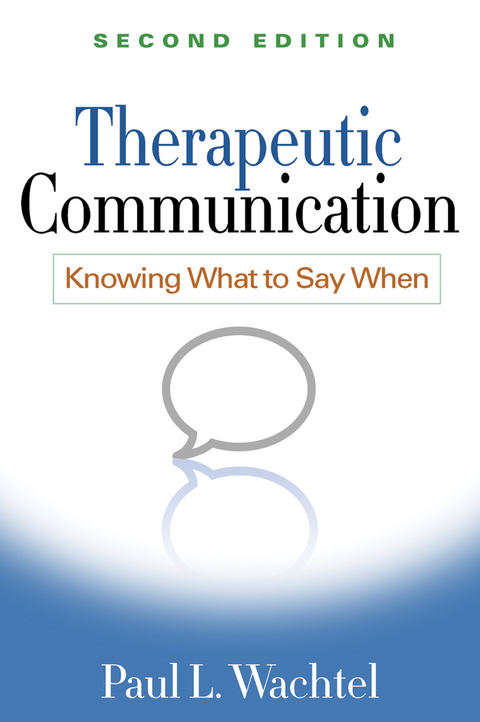
Therapeutic Communication (eBook)
398 Seiten
The Guilford Press (Verlag)
978-1-60918-173-4 (ISBN)
Paul L. Wachtel, PhD, is CUNY Distinguished Professor in the doctoral program in clinical psychology at City College and the Graduate Center of the City University of New York. He received his doctorate in clinical psychology from Yale University and is a graduate of the postdoctoral program in psychoanalysis and psychotherapy at New York University, where he is also a faculty member. Dr. Wachtel has lectured and given workshops throughout the world on psychotherapy, personality theory, and the applications of psychological theory and research to the major social issues of our time. He has been a leading voice for integrative thinking in the human sciences and was a cofounder of the Society for the Exploration of Psychotherapy Integration. Dr. Wachtel is a recipient of the Hans H. Strupp Memorial Award for psychoanalytic writing, teaching, and research; the Distinguished Psychologist Award from Division 29 (Psychotherapy) of the American Psychological Association (APA); and the Scholarship and Research Award from Division 39 (Psychoanalysis) of APA.
Introduction1. Rethinking the Talking Cure: The Therapist Speaks TooI. Theoretical and Empirical Foundations2. The Continuing Evolution of Psychotherapy: New and Converging Developments in Psychoanalytic, Cognitive-Behavioral, Systemic, and Experiential Approaches3. Attending to Attachment: Accelerating Interest in the Therapeutic Implications of Attachment Theory and Research4. Cyclical Psychodynamics I: Vicious and Virtuous Circles5. Cyclical Psychodynamics II: Anxiety, Exposure, and Interpretation6. Cyclical Psychodynamics III: Insight, the Therapeutic Relationship, and the World OutsideII. Clinical Applications and Guidelines7. Accusatory and Facilitative Comments: Criticism and Permission in the Therapeutic Dialogue8. Exploration, Not Interrogation9. Building on the Patient’s Strengths10. Affirmation and Change11. Attribution and Suggestion12. Reframing, Relabeling, and Paradox13. Therapist Self-Disclosure: Prospects and Pitfalls14. Achieving Resolution of the Patient's Difficulties: Resistance, Working Through, and Following ThroughIII. Postscript15. Therapeutic Communication with Couples, Ellen F. Wachtel
| Erscheint lt. Verlag | 3.8.2011 |
|---|---|
| Sprache | englisch |
| Maße | 150 x 150 mm |
| Themenwelt | Geisteswissenschaften ► Psychologie ► Klinische Psychologie |
| Geisteswissenschaften ► Religion / Theologie | |
| Medizin / Pharmazie ► Gesundheitsfachberufe | |
| Medizin / Pharmazie ► Medizinische Fachgebiete ► Psychiatrie / Psychotherapie | |
| Sozialwissenschaften ► Pädagogik ► Sozialpädagogik | |
| Sozialwissenschaften ► Soziologie | |
| Schlagworte | Alliance • Analysts • Attachment • Attachment Theory • behavioral • books on therapists • Clinical • clinical practice • Clinicians • Cognitive • cognitive-behavioral • Communication • conscious • Counseling • CP-NF33 • Diagnosis • Dialogue • formulations • Grad • graduate • hands on guide • Hazards • Integrative • Interactions • Interventions • language • Occupational • orientation • patients • postdoctoral • Practitioners • Profession • Psychoanalysis • psychoanalytic therapy • Psychodynamics • Psychodynamic therapy • Psychotherapists • psychotherapy • Qualification • references to cases • Relational • Self-Disclosure • "substance abuse, behavior change, psychotherapy, interventions, addictions, ambivalence, resistance, therapy, counseling field, counseling students, interviewing skills, meth addiction, life coaching, helping professionals, therapeutic relationship, helping professions, professional counselor, core concepts, social workers, transpersonal, rationales, person-centered, exam, cognitive-behavioral, court-ordered, modality, clinicians, evidence-based, revisions, trainers, therapists, counselors, seminar, exerci • Supplement • tenets • textbooks • Theoretical • therapeutic relationships • Therapists • Treatment |
| ISBN-10 | 1-60918-173-5 / 1609181735 |
| ISBN-13 | 978-1-60918-173-4 / 9781609181734 |
| Informationen gemäß Produktsicherheitsverordnung (GPSR) | |
| Haben Sie eine Frage zum Produkt? |
 EPUB (Adobe DRM)
Kopierschutz: Adobe-DRM
Adobe-DRM ist ein Kopierschutz, der das eBook vor Mißbrauch schützen soll. Dabei wird das eBook bereits beim Download auf Ihre persönliche Adobe-ID autorisiert. Lesen können Sie das eBook dann nur auf den Geräten, welche ebenfalls auf Ihre Adobe-ID registriert sind.
Details zum Adobe-DRM
Dateiformat: EPUB (Electronic Publication)
EPUB ist ein offener Standard für eBooks und eignet sich besonders zur Darstellung von Belletristik und Sachbüchern. Der Fließtext wird dynamisch an die Display- und Schriftgröße angepasst. Auch für mobile Lesegeräte ist EPUB daher gut geeignet.
Systemvoraussetzungen:
PC/Mac: Mit einem PC oder Mac können Sie dieses eBook lesen. Sie benötigen eine
eReader: Dieses eBook kann mit (fast) allen eBook-Readern gelesen werden. Mit dem amazon-Kindle ist es aber nicht kompatibel.
Smartphone/Tablet: Egal ob Apple oder Android, dieses eBook können Sie lesen. Sie benötigen eine
Geräteliste und zusätzliche Hinweise
Buying eBooks from abroad
For tax law reasons we can sell eBooks just within Germany and Switzerland. Regrettably we cannot fulfill eBook-orders from other countries.
aus dem Bereich