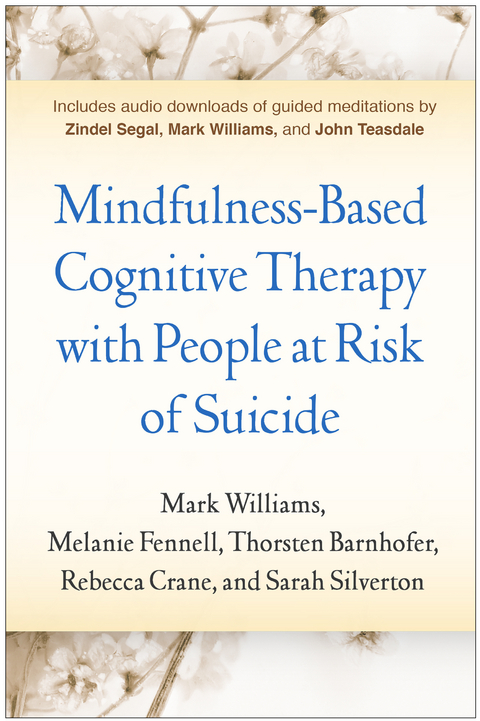
Mindfulness-Based Cognitive Therapy with People at Risk of Suicide (eBook)
334 Seiten
The Guilford Press (Verlag)
978-1-4625-2483-9 (ISBN)
Mark Williams, DPhil, is Emeritus Professor of Clinical Psychology at the University of Oxford, having been Wellcome Principal Research Fellow at Oxford from 2003 to 2012 and at Bangor University from 1991 to 2002. He collaborated with John Teasdale and Zindel Segal in developing mindfulness-based cognitive therapy (MBCT) to prevent relapse and recurrence in major depression; together, they coauthored Mindfulness-Based Cognitive Therapy for Depression, Second Edition (for mental health professionals), as well as the self-help guides The Mindful Way Workbook and (with Jon Kabat-Zinn) The Mindful Way through Depression. Dr. Williams is also coauthor of Mindfulness-Based Cognitive Therapy with People at Risk of Suicide (for mental health professionals). He is a Fellow of the British Psychological Society, the Academy of Medical Sciences and the British Academy. Now retired, he continues to live near Oxford, to teach mindfulness to teachers-in-training across the world, and to explore, with colleagues, how mindfulness might be used in evidence-based public policy. Melanie Fennell, PhD, is a Founding Fellow of the Oxford Cognitive Therapy Centre, where she is now an Associate Trainer. She is also an Associate Trainer at the Oxford Mindfulness Centre. As a research clinician in the University of Oxford Department of Psychiatry, she contributed to the development of evidence-based treatments for depression and anxiety disorders, including MBCT. She developed and led the Oxford Diploma in Cognitive Therapy, the Oxford Diploma/MSc in Advanced Cognitive Therapy Studies, and (with Mark Williams) the Oxford Master of Studies program in Mindfulness-Based Cognitive Therapy. Dr. Fennell is an Honorary Fellow of the British Association of Behavioural and Cognitive Psychotherapies (BABCP) and was voted “Most Influential Female UK Cognitive Therapist” by the BABCP's membership in 2002. Thorsten Barnhofer, PhD, is Professor of Clinical Psychology at the University of Surrey, United Kingdom, where he conducts research into the use of mindfulness-based interventions for the prevention and treatment of mental disorders. He has a particular interest in the mechanisms by which mindfulness meditation benefits psychological and neural functioning. Previously, he worked in Mark Williams’s group at the Oxford Department of Psychiatry, where he was involved in research on MBCT for suicidal and chronic depression. A cognitive-behavioral therapist and yoga teacher, Dr. Barnhofer regularly teaches MBCT training workshops and retreats for mental health professionals. Rebecca Crane, PhD, MA, DipCot, is Director of the Centre for Mindfulness Research and Practice at Bangor University in Wales, and has led the development of its training programs since 2001. She previously worked in the mental health field as an occupational therapist and an integrative counselor. Dr. Crane teaches and trains internationally in both MBCT and mindfulness-based stress reduction (MBSR), and is a certified MBSR teacher with the Center for Mindfulness at the University of Massachusetts Medical School. She is the author of Mindfulness-Based Cognitive Therapy: Distinctive Features. Sarah Silverton, DipCot, MEd, teaches at the Centre for Mindfulness Research and Practice at Bangor University, Wales. She has extensive experience as an occupational therapist, counselor, and mindfulness teacher and trainer. She is the author of The Mindfulness Breakthrough.
1. Introduction I. Theoretical and Research Background 2. The Origins of Despair: An Evolutionary Perspective 3. Why the Idea of Suicide Won't Let Go 4. How Could Mindfulness Help?: Doing and Being II. MBCT for Those at Risk of Suicide 5. Assessing Vulnerability to Depression and Suicidality 6. Developing the Preclass Interview: Encouraging Vulnerable Participants to Engage in and Persist with Mindfulness Meditation 7. Session 1: Awareness and Automatic Pilot 8. Session 2: Living in Our Heads 9. Session 3: Gathering the Scattered Mind 10. Session 4: Recognizing Aversion 11. Session 5: Allowing/Letting Be 12. Session 6: Thoughts Are Not Facts 13. Session 7: How Can I Best Take Care of Myself? 14. Session 8: Maintaining and Extending New Learning 15. How Does MBCT Enable Transformation?: Jane's Story III. Training Teachers and Defining Competence 16. MBCT Teaching Integrity: Assessing Mindfulness-Based Teaching Skills 17. The Experience of Being an MBCT Teacher IV. MBCT--The Results 18. Mindfulness on Trial: Does MBCT Help People at Risk of Suicide? Further Reading and Resources References
| Erscheint lt. Verlag | 12.8.2015 |
|---|---|
| Sprache | englisch |
| Maße | 150 x 150 mm |
| Themenwelt | Geisteswissenschaften ► Psychologie ► Klinische Psychologie |
| Medizin / Pharmazie ► Medizinische Fachgebiete ► Psychiatrie / Psychotherapie | |
| Sozialwissenschaften ► Pädagogik ► Sozialpädagogik | |
| Sozialwissenschaften ► Soziologie | |
| Schlagworte | audio downloads • Audio Files • audio tracks • Body Scan • CBT • Chronic • Cognitive-behavioral therapy • Depression • depressive relapse • Despair • guided meditation practices • hopelessness • Learned Helplessness • MBCT • mindfulness and the transformation of despair • mindfulness-based cognitive therapy • mindfulness meditation • psychotherapy • Relapse Prevention • Suicidal ideation • Suicidality • Suicide Prevention |
| ISBN-10 | 1-4625-2483-4 / 1462524834 |
| ISBN-13 | 978-1-4625-2483-9 / 9781462524839 |
| Informationen gemäß Produktsicherheitsverordnung (GPSR) | |
| Haben Sie eine Frage zum Produkt? |
 EPUB (Adobe DRM)
Kopierschutz: Adobe-DRM
Adobe-DRM ist ein Kopierschutz, der das eBook vor Mißbrauch schützen soll. Dabei wird das eBook bereits beim Download auf Ihre persönliche Adobe-ID autorisiert. Lesen können Sie das eBook dann nur auf den Geräten, welche ebenfalls auf Ihre Adobe-ID registriert sind.
Details zum Adobe-DRM
Dateiformat: EPUB (Electronic Publication)
EPUB ist ein offener Standard für eBooks und eignet sich besonders zur Darstellung von Belletristik und Sachbüchern. Der Fließtext wird dynamisch an die Display- und Schriftgröße angepasst. Auch für mobile Lesegeräte ist EPUB daher gut geeignet.
Systemvoraussetzungen:
PC/Mac: Mit einem PC oder Mac können Sie dieses eBook lesen. Sie benötigen eine
eReader: Dieses eBook kann mit (fast) allen eBook-Readern gelesen werden. Mit dem amazon-Kindle ist es aber nicht kompatibel.
Smartphone/Tablet: Egal ob Apple oder Android, dieses eBook können Sie lesen. Sie benötigen eine
Geräteliste und zusätzliche Hinweise
Buying eBooks from abroad
For tax law reasons we can sell eBooks just within Germany and Switzerland. Regrettably we cannot fulfill eBook-orders from other countries.
aus dem Bereich