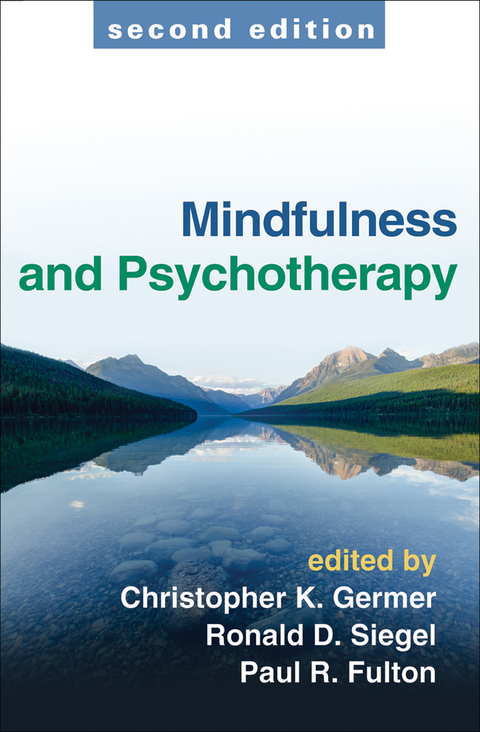
Mindfulness and Psychotherapy (eBook)
382 Seiten
The Guilford Press (Verlag)
978-1-4625-1167-9 (ISBN)
Christopher Germer, PhD, has a private practice in mindfulness- and compassion-based psychotherapy in Arlington, Massachusetts, and is a part-time Lecturer on Psychiatry at Harvard Medical School/Cambridge Health Alliance. He is a founding faculty member of the Institute for Meditation and Psychotherapy and of the Center for Mindfulness and Compassion. His books include The Mindful Self-Compassion Workbook and The Mindful Path to Self-Compassion (for the general public) and Teaching the Mindful Self-Compassion Program, Wisdom and Compassion in Psychotherapy, and Mindfulness and Psychotherapy, Second Edition (for professionals). Dr. Germer lectures and leads workshops internationally. His website is https://chrisgermer.com. Ronald D. Siegel, PsyD, is Assistant Clinical Professor of Psychology, part time, at Harvard Medical School/Cambridge Health Alliance, where he has taught for over 30 years. He serves on the board of directors and faculty of IMP. Dr. Siegel teaches internationally about mindfulness and psychotherapy and mind-body treatment. His books include The Mindfulness Solution, Wisdom and Compassion in Psychotherapy, and Sitting Together: Essential Skills for Mindfulness-Based Psychotherapy. Paul R. Fulton, EdD, is a clinical psychologist in private practice and Clinical Instructor in Psychology at Harvard Medical School/Cambridge Health Alliance. He was formerly the president of IMP and is currently director of the Certificate Program in Mindfulness and Psychotherapy. Dr. Fulton received lay ordination as a Zen Buddhist in 1972, has been a student of psychology and meditation for over 44 years, is on the board of directors of the Barre Center for Buddhist Studies, and teaches internationally.
I. The Meaning of Mindfulness
1. Mindfulness: What Is It? What Does It Matter?, Christopher K. Germer
2. Buddhist and Western Psychology: Seeking Common Ground, Paul R. Fulton and Ronald D. Siegel
II. The Therapy Relationship
3. Mindfulness as Clinical Training, Paul R. Fulton
4. Cultivating Attention and Compassion, William D. Morgan, Susan T. Morgan, and Christopher K. Germer
5. Relational Mindfulness, Janet L. Surrey and Gregory Kramer
6. Practical Ethics, Stephanie P. Morgan
III. Clinical Applications
7. Teaching Mindfulness in Therapy, Susan M. Pollak
8. Depression: Finding a Way In, Finding a Way Out, Thomas Pedulla
9. Anxiety: Accepting What Comes and Doing What Matters, Lizabeth Roemer and Susan M. Orsillo
10. Psychophysiological Disorders: Embracing Pain, Ronald D. Siegel
11. Mindfulness, Insight, and Trauma Therapy, John Briere
12. Breaking the Addiction Loop, Judson A. Brewer
13. Working with Children, Trudy A. Goodman
IV. Past, Present, and Promise
14. Roots of Mindfulness, Andrew R. Olendzki
15. The Neurobiology of Mindfulness, Sara W. Lazar
16. Positive Psychology and the Bodhisattva Path, Charles W. Styron
V. Appendix
Appendix: Glossary of Terms in Buddhist Psychology, Andrew R. Olendzki
| Erscheint lt. Verlag | 8.7.2013 |
|---|---|
| Sprache | englisch |
| Maße | 150 x 150 mm |
| Themenwelt | Geisteswissenschaften ► Psychologie |
| Geisteswissenschaften ► Religion / Theologie | |
| Medizin / Pharmazie ► Gesundheitsfachberufe | |
| Medizin / Pharmazie ► Medizinische Fachgebiete ► Psychiatrie / Psychotherapie | |
| Sozialwissenschaften ► Pädagogik ► Sozialpädagogik | |
| Sozialwissenschaften ► Soziologie | |
| Schlagworte | acceptance • Addictions • Anxiety • APPROACHES • attention • Buddhism • clinical training • Counseling • Depression • Eastern • Empirical • Exercises • Interventions • Meditations • Mindfulness • Pain • Philosophy • Practices • Psychological disorders • Psychology • psychopathology • psychotherapy • PTSD • Relaxation • Self-Compassion • Spirituality • Stress • "substance abuse, behavior change, psychotherapy, interventions, addictions, ambivalence, resistance, therapy, counseling field, counseling students, interviewing skills, meth addiction, life coaching, helping professionals, therapeutic relationship, helping professions, professional counselor, core concepts, social workers, transpersonal, rationales, person-centered, exam, cognitive-behavioral, court-ordered, modality, clinicians, evidence-based, revisions, trainers, therapists, counselors, seminar, exerci • techniques • therapy • Trauma • Treatments |
| ISBN-10 | 1-4625-1167-8 / 1462511678 |
| ISBN-13 | 978-1-4625-1167-9 / 9781462511679 |
| Informationen gemäß Produktsicherheitsverordnung (GPSR) | |
| Haben Sie eine Frage zum Produkt? |
 EPUB (Adobe DRM)
Kopierschutz: Adobe-DRM
Adobe-DRM ist ein Kopierschutz, der das eBook vor Mißbrauch schützen soll. Dabei wird das eBook bereits beim Download auf Ihre persönliche Adobe-ID autorisiert. Lesen können Sie das eBook dann nur auf den Geräten, welche ebenfalls auf Ihre Adobe-ID registriert sind.
Details zum Adobe-DRM
Dateiformat: EPUB (Electronic Publication)
EPUB ist ein offener Standard für eBooks und eignet sich besonders zur Darstellung von Belletristik und Sachbüchern. Der Fließtext wird dynamisch an die Display- und Schriftgröße angepasst. Auch für mobile Lesegeräte ist EPUB daher gut geeignet.
Systemvoraussetzungen:
PC/Mac: Mit einem PC oder Mac können Sie dieses eBook lesen. Sie benötigen eine
eReader: Dieses eBook kann mit (fast) allen eBook-Readern gelesen werden. Mit dem amazon-Kindle ist es aber nicht kompatibel.
Smartphone/Tablet: Egal ob Apple oder Android, dieses eBook können Sie lesen. Sie benötigen eine
Geräteliste und zusätzliche Hinweise
Buying eBooks from abroad
For tax law reasons we can sell eBooks just within Germany and Switzerland. Regrettably we cannot fulfill eBook-orders from other countries.
aus dem Bereich