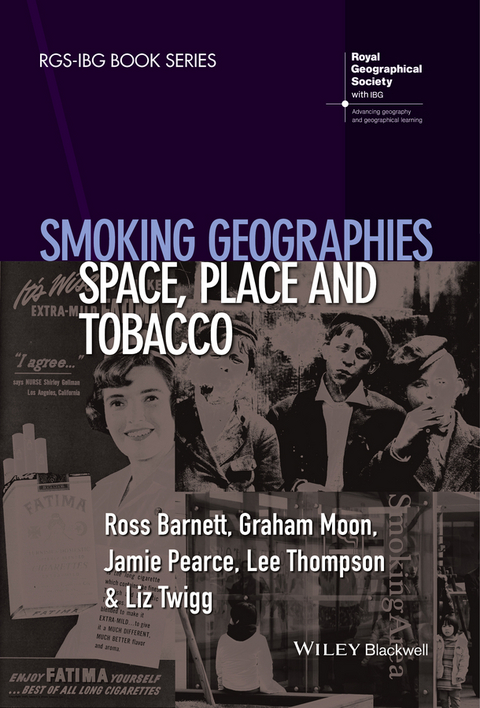
Smoking Geographies (eBook)
John Wiley & Sons (Verlag)
978-1-118-34917-5 (ISBN)
Smoking Geographies provides a research-led assessment of the impact of geographical factors on smoking. The contributors uncover how geography can show us not only why people smoke but also broader issues of tobacco control, providing deeper clarity on how smoking and tobacco is 'governed'.
- The text centres on one of the most important public health issues worldwide, and a major determinant of preventable mortality and morbidity in developed and developing countries
- Records the outcomes of a long-term research collaboration that brings a geographical lens to smoking behaviour
- Uncovers how geography can play a part in understanding not only why people smoke but also broader issues of tobacco control
- Provides a deeper understanding of how smoking and tobacco is 'governed', regarding where people may smoke, but also more subtle governance as a climate is produced in which smoking becomes 'denormalised'
- Brings both quantitative and qualitative perspectives to bear on this major source of mortality and morbidity
Ross Barnett is Adjunct Professor at the University of Canterbury, Christchurch, New Zealand. He is particularly interested in the implementation of smoking cessation policies and their effectiveness in increasing quit rates among disadvantaged groups. He also acts as a consultant to the Centre for Tobacco Control Research, Zhejiang University in Shanghai.
Graham Moon is Professor of Spatial Analysis in Human Geography at the University of Southampton, England. He has acted as a consultant and advisor to national and local governments on smoking cessation policy. Recent work has focused on longitudinal changes in the impact of ethnic segregation on smoking and on smoking-related mortality.
Jamie Pearce is Professor of Health Geography and co-Director of the Centre for Research on Environment, Society & Health (CRESH) at the University of Edinburgh, Scotland. His research considers social, political and environmental processes affecting social and spatial inequalities in health. Recent work has examined the influence of the local availability and marketing of tobacco products on smoking norms and behaviour.
Lee Thompson is Senior Lecturer at the University of Otago, Christchurch, New Zealand. Her research has centred on the governance of population health, with a special interest in tobacco control and the unintended consequences of tobacco control interventions.
Liz Twigg is Professor in Human Geography at the University of Portsmouth, England. She has research and consultancy experience concerning place effects on smoking behaviour, and is particularly interested in identifying hard-to-reach groups in terms of smoking cessation policy.
Smoking Geographies provides a research-led assessment of the impact of geographical factors on smoking. The contributors uncover how geography can show us not only why people smoke but also broader issues of tobacco control, providing deeper clarity on how smoking and tobacco is governed . The text centres on one of the most important public health issues worldwide, and a major determinant of preventable mortality and morbidity in developed and developing countries Records the outcomes of a long-term research collaboration that brings a geographical lens to smoking behaviour Uncovers how geography can play a part in understanding not only why people smoke but also broader issues of tobacco control Provides a deeper understanding of how smoking and tobacco is governed , regarding where people may smoke, but also more subtle governance as a climate is produced in which smoking becomes denormalised Brings both quantitative and qualitative perspectives to bear on this major source of mortality and morbidity
Ross Barnett is Adjunct Professor at the University of Canterbury, Christchurch, New Zealand. He is particularly interested in the implementation of smoking cessation policies and their effectiveness in increasing quit rates among disadvantaged groups. He also acts as a consultant to the Centre for Tobacco Control Research, Zhejiang University in Shanghai. Graham Moon is Professor of Spatial Analysis in Human Geography at the University of Southampton, England. He has acted as a consultant and advisor to national and local governments on smoking cessation policy. Recent work has focused on longitudinal changes in the impact of ethnic segregation on smoking and on smoking-related mortality. Jamie Pearce is Professor of Health Geography and co-Director of the Centre for Research on Environment, Society & Health (CRESH) at the University of Edinburgh, Scotland. His research considers social, political and environmental processes affecting social and spatial inequalities in health. Recent work has examined the influence of the local availability and marketing of tobacco products on smoking norms and behaviour. Lee Thompson is Senior Lecturer at the University of Otago, Christchurch, New Zealand. Her research has centred on the governance of population health, with a special interest in tobacco control and the unintended consequences of tobacco control interventions. Liz Twigg is Professor in Human Geography at the University of Portsmouth, England. She has research and consultancy experience concerning place effects on smoking behaviour, and is particularly interested in identifying hard-to-reach groups in terms of smoking cessation policy.
Title Page 5
Copyright Page 6
Contents 7
About the Authors 8
Series Editors’ Preface 9
Preface 10
Acknowledgements 11
Chapter One Introduction 13
1.1 Background 13
1.2 Smoking and Tobacco The Importance of Geography
1.3 Geographical Approaches to Past Smoking Research 18
1.4 Geographies of Smoking: Making Connections 22
1.5 Writing Smoking Geographies 25
Chapter Two The Geo-epidemiology of an Addiction 28
2.1 Introduction 28
2.2 Measuring Tobacco Consumption 30
2.2.1 The survey approach 30
2.2.2 Measuring smoking prevalence – the census approach 31
2.2.3 Under reporting in census and surveys 32
2.2.4 Integrated survey and synthetic estimation approaches 33
2.3 Spatial Patterns of Smoking and Smoking Transitions 35
2.3.1 Early geographies 37
2.3.2 Global and national shifts in smoking 38
2.3.3 Modelling smoking transitions – socio-economic perspectives 44
2.3.4 Gender and the smoking transition model 48
2.3.5 Gender and smoking: Detail on Britain and New Zealand 53
2.3.6 Ethnic minorities and indigenous populations 56
2.4 Conclusions 60
Endnotes 61
Chapter Three The Economic Geography of Tobacco 62
3.1 Introduction 62
3.2 Growing Tobacco 65
3.2.1 Case Study: European Union tobacco farming subsidies 72
3.3 Manufacturing Cigarettes 73
3.3.1 Case study: Cigarette manufacture in the local economy – BAT in Southampton 80
3.4 Distribution Networks 85
3.5 Tobacco Retail 92
3.6 Conclusion 98
Chapter Four Context Matters: Area Effects, Socio-economic Status and Smoking 101
4.1 Introduction 101
4.2 Contextual Effects on Health 102
4.3 Contextual Effects on Smoking 103
4.3.1 Area deprivation and smoking 104
4.3.2 Demographic and social contexts, disadvantage and smoking 108
4.3.3 Social context and smoking in transition economies 109
4.4 Social Inequality and Smoking 111
4.4.1 Perception, relative inequality and smoking 115
4.4.2 Social inequality and smoking in transition economies 116
4.5 Conclusions 117
Chapter Five Place-Based Practices: Pathways to Smoking Behaviour 120
5.1 Introduction 120
5.2 The Social Context of Smoking 121
5.3 Social Capital 122
5.4 Resilience, Resistance and Smoking Behaviour 125
5.5 Contagion, Networks and Smoking 127
5.6 Neighbourhood ‘Liveability’ and Stressors 128
5.6.1 Liveability, trust and social capital in British neighbourhoods 130
5.7 Supply and Demand: Tobacco Retailing and Availability 133
5.7.1 Tobacco retailing and smoking behaviour in New Zealand 136
5.8 Conclusion 138
Chapter 6 Smoking, Denormalisation and the Messy Terrain of Unintended Consequences 140
6.1 Introduction 140
6.2 Tobacco Denormalisation, Opium and Messy Landscapes of Exclusion 142
6.3 Denormalisation and Purified Space 146
6.3.1 Extending the purification of space 147
6.4 Stigma: The Personal Taint 148
6.5 Taste, Class and Policing the Poor 151
6.6 Contesting Denormalisation: Virtual and Material Space 153
6.7 Concluding Comments 157
Chapter Seven Smoking Gateways: Burdens and Co-behaviours 159
7.1 Introduction 159
7.2 The Small-Area Geography of Smoking?Attributable Mortality 160
7.3 Reducing Smoking-Attributable Morbidity 166
7.4 Co-behaviour: Tobacco and Cannabis 172
7.5 Conclusions 179
Chapter 8 Place and Tobacco Regulation 180
8.1 Introduction 180
8.2 Tobacco Control Policies 182
8.2.1 Taxation and increased prices 182
8.2.2 Smoking bans 186
8.2.3 Controls on advertising 191
8.2.4 Healthcare providers and smoking cessation 192
8.3 Problems of Traditional Tobacco Policies 198
8.3.1 Why have smoking rates remained high amongst disadvantaged populations? 198
8.3.2 Have tobacco control policies accentuated inequalities in smoking? 200
8.3.3 To what extent have national and local variations in enforcement limited the effectiveness of tobacco control policies? 203
8.3.4 Can improvements in the population cessation rate be achieved by complementing traditional tobacco control efforts with area?based interventions? 211
8.4 Conclusions 215
Chapter Nine Conclusion 217
9.1 Introduction 217
9.2 Smoking, Tobacco and Geographical Scholarship 218
9.3 Geography and Tobacco Control Policy 222
9.4 New Directions for Geographical Research on Tobacco and Smoking 224
9.4.1 Methodological innovation 224
9.4.2 Substantive challenges 226
9.4.3 New technologies of smoking 229
9.5 Conclusions 233
References 235
Index 289
EULA 314
'The authors of this ground-breaking book have combined their substantial research expertise in the geography of smoking to produce this well-argued, accessible book which reveals how geographical factors act and inter-act at international, national and local levels in smoking initiation, maintenance and cessation. This book is a must-read for researchers and policymakers in tobacco control, irrespective of their disciplinary backgrounds.'
Amanda Amos, Professor of Health Promotion, University of Edinburgh, UK
'Too often we only encounter partial accounts of seemingly intractable societal problems. In this book, five experts join forces to grapple with the complex issues at the heart of tobacco availability, smoking behaviour and regulation. Their achievement is to emphatically demonstrate the potency of geography in understanding and addressing these public health issues.'
Robin Kearns, Professor of Geography, The University of Auckland, New Zealand
| Erscheint lt. Verlag | 9.2.2017 |
|---|---|
| Reihe/Serie | RGS-IBG Book Series | RGS-IBG Book Series |
| Sprache | englisch |
| Themenwelt | Naturwissenschaften ► Geowissenschaften ► Geografie / Kartografie |
| Sozialwissenschaften ► Soziologie ► Makrosoziologie | |
| Technik | |
| Schlagworte | active smoking • Anthropogeographie • Big Tobacco • Cancer • Cancer deaths • denormalising smoking • developing world • Geographie • Geography • health geography • Health inequalities • health-related behaviour • Human geography • <p>Smoking • Lung Cancer • Morbidity • Mortality • Passive smoking • place and smoking • Political Geography • Politische Geographie • Public Health • smoker identities • smoking ban</p> • Smoking cessation • smoking epidemic • smoking islands • smoking norms • smoking-related mortality • social inequalities • socioeconomic • Sociology • Sociology of Health & Illness • Soziologie • Soziologie d. Gesundheit u. Krankheit • Spatial inequalities • Tabak • tobacco • Tobacco advertising • tobacco consumption • Tobacco Control • WHO |
| ISBN-10 | 1-118-34917-2 / 1118349172 |
| ISBN-13 | 978-1-118-34917-5 / 9781118349175 |
| Informationen gemäß Produktsicherheitsverordnung (GPSR) | |
| Haben Sie eine Frage zum Produkt? |
 PDF (Adobe DRM)
Kopierschutz: Adobe-DRM
Adobe-DRM ist ein Kopierschutz, der das eBook vor Mißbrauch schützen soll. Dabei wird das eBook bereits beim Download auf Ihre persönliche Adobe-ID autorisiert. Lesen können Sie das eBook dann nur auf den Geräten, welche ebenfalls auf Ihre Adobe-ID registriert sind.
Details zum Adobe-DRM
Dateiformat: PDF (Portable Document Format)
Mit einem festen Seitenlayout eignet sich die PDF besonders für Fachbücher mit Spalten, Tabellen und Abbildungen. Eine PDF kann auf fast allen Geräten angezeigt werden, ist aber für kleine Displays (Smartphone, eReader) nur eingeschränkt geeignet.
Systemvoraussetzungen:
PC/Mac: Mit einem PC oder Mac können Sie dieses eBook lesen. Sie benötigen eine
eReader: Dieses eBook kann mit (fast) allen eBook-Readern gelesen werden. Mit dem amazon-Kindle ist es aber nicht kompatibel.
Smartphone/Tablet: Egal ob Apple oder Android, dieses eBook können Sie lesen. Sie benötigen eine
Geräteliste und zusätzliche Hinweise
Buying eBooks from abroad
For tax law reasons we can sell eBooks just within Germany and Switzerland. Regrettably we cannot fulfill eBook-orders from other countries.
aus dem Bereich