Gender and Migration (eBook)
John Wiley & Sons (Verlag)
978-0-7456-8792-6 (ISBN)
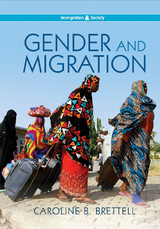
This book will appeal to students and scholars of immigration, race and ethnicity, and gender studies and offers a definitive guide to the key conceptual issues surrounding gender and migration.
Caroline B. Brettell is Ruth Collins Altshuler Professor of Anthropology and Director of the Interdisciplinary Institute at Southern Methodist University
Gender roles, relations, and ideologies are major aspects of migration. This timely book argues that understanding gender relations is vital to a full and more nuanced explanation of both the causes and the consequences of migration, in the past and at present. Through an exploration of gendered labor markets, laws and policies, and the transnational model of migration, Caroline Brettell tackles a variety of issues such as how gender shapes the roles that men and women play in the construction of immigrant family and community life, debates concerning transnational motherhood, and how gender structures the immigrant experience for men and women more broadly. This book will appeal to students and scholars of immigration, race and ethnicity, and gender studies and offers a definitive guide to the key conceptual issues surrounding gender and migration.
Caroline B. Brettell is Ruth Collins Altshuler Professor of Anthropology and Director of the Interdisciplinary Institute at Southern Methodist University
Introduction: Engendering the Study of Immigration
Chapter One: The Gendered Demography of U.S. Immigration History
Chapter Two: The Gendering of Law, Policy, Citizenship, and Political Practice
Chapter Three: Gendered Labor Markets
Chapter Four: Gender and the Immigrant Family
Concluding Thoughts: A Gendered Theory of Migration
Introduction: Engendering the Study of Immigration
Beginning in the 1970s, and emerging from the broader development of feminist analysis, scholars in several disciplines began to formulate a gendered approach to the study of population mobility, both internally and internationally. Although the geographer and statistician E. G. Ravenstein (1885) had observed gendered differences in migration patterns (women participate more heavily in short distance moves while men appear in greater numbers in longer distance mobility) toward the end of the nineteenth century, these differences were not rigorously documented or considered and women in particular remained largely invisible in studies of migration. And even as a new generation of scholars, many of them women, began to highlight the significance of gender and the role of women in migration, they were, as Pierrette Hondagneu-Sotelo and Cynthia Cranford (1999: 105) point out, met with hostility. As late as 2003, anthropologist Patricia Pessar (2003), a well-known scholar of gender and migration, was writing about the marginalization of panels on gendered and family issues at major conferences on migration and immigration. Yet, despite the resistance along the way to gender as a significant analytical category, by the second decade of the twenty-first century it is well established as vital to a full understanding of the migration process.
Some of the earliest research was focused on correcting the omission of women as subjects and hence documenting their participation as social actors in the migration process. In the European context, one can point to a pioneering volume edited by Annie Phizacklea (1983) that emphasized migration and female labor. In the United States, one might note the volume that sociologist Rita James Simon and I edited titled International Migration: The Female Experience (1986), as well as the book edited by historian Donna Gabaccia titled Seeking Common Ground (1992) in which essays addressed how different disciplines were approaching the topic of migrant women. Like much feminist scholarship of this period, this first phase of gendered migration research was characterized by a “women only” or “just add women” approach. It offered any number of descriptive analyses of women who were mobile, some of them in their own right, in pursuit of employment. Even if women were moving largely as dependants, the interest was to hear their voices about the decisions they made and how it impacted their lives. An effort was made to move away from the assumption that whatever migrant men experience is equally characteristic of migrant women.
This “women only” emphasis is perhaps best represented by an important 1984 special issue of the International Migration Review edited by Mirjana Morokvasic (1984) that was titled “Women in Migration”. One article in this issue included a statistical “first look” at female predominance among immigrants who had entered the US since 1930 (Houston et al. 1984); another, from a more historical perspective, explored the emigration of Irish women to the US before and after the famine of 1845 to 1849 (Jackson 1984); another addressed women, migration and development in the South Pacific, examining not only women as migrants but also the impact of migration on non-migratory women (Connell 1984); while another focused on stress and distress among Turkish immigrant women in Denmark (Mirdal 1984). The volume, which was divided into five sections, included several census-based quantitative analyses of female immigrants and labor market characteristics in a range of host societies including the United States, Australia, and Canada. Another section contained articles based on theories and survey research of migrant women in the labor market and included case studies of Dominican women in New York, undocumented Mexican women in Los Angeles, and Turkish women in Germany. The final section included studies of female rural to urban migration in Asia and Africa.
From these impressive and empirically substantive early beginnings, scholarship moved rapidly to a more theoretical approach that considers how gender fundamentally structures the migration process and the immigrant experience for both men and women. Gender refers to the social construction of differences between men and women and how such constructs of difference are played out in daily practices. It encompasses ideals and expectations within particular social and/or cultural contexts regarding men and women and hence ideas about masculinity and femininity – something often referred to as gender ideology. It addresses not only how gender ideologies vary from one cultural context to another, but also through time and in relation to differential processes of change that may occur over time and across space. Thus, to view migration through a gendered lens means to focus on how men and women relate to one another in theory and in practice, how their experiences might differ, and how gender roles (i.e. the particular activities and tasks that are assigned to men and women), which vary from one culture to another, might both affect and be affected by geographic mobility. It also means that we can highlight how gender is constructed by the state in relation to the laws and policies that regulate and control migration as well as processes of exclusion and inclusion that are often associated with the extension or withholding of the rights of citizenship. Thus, understanding gender relations is vital to a full explanation of both the causes and the consequences of migration. Gender must be considered in both sending and receiving contexts, not only in relation to families but also in relation to global labor markets and the wide range of institutions with which migrants interact in places of origin and places of destination.
Ironically, bringing gender fully into the study of migration, as anthropologist Jason Pribilsky (2012: 325) has emphasized, has enhanced our understanding of male migrants. Men have overwhelmingly been the focus of research on migration, but their gendered lives were rarely considered. Sociologist Chad Broughton (2008: 569) argues that what is often omitted from economic and social demographic studies of migration is how individuals make sense of the migrant experience and “how their strategic responses to economic dislocation are shaped not just by instrumental calculation but also by a knotty set of gendered cultural considerations: prevailing normative expectations and standards, social roles and obligations, and shared understandings relating to family, work, and place.” Based on his research with Mexican male migrants, Broughton reveals three masculine stances by which they can be characterized: the traditionalist, the adventurer, and the breadwinner. Broughton suggests that these men “orient gendered understandings and adopt gendered practices increasingly in relation to the specific material forces accelerated by Mexico’s neoliberal turn.” They are, like women, gendered actors in the migration process.
Gender is about inequality, specifically the inequality between men and women and hence about power and prestige differences that are gendered. Sometimes for example, women face double discrimination not only as a migrant but also as a female because gender ideologies that are rooted in patriarchy may be transported if not sometimes even enhanced in the immigrant context. Further, immigrant men, who may feel more disempowered in the public sphere or in jobs in which they have clearly experienced downward mobility, may try to exercise more control over their wives and children in the private sphere. These are just two possible outcomes in relation to issues of gender and power that can characterize the migration process and the immigrant experience. As the research on the gendered dimensions of immigration has accumulated it has become increasingly apparent that gender ideologies and the unequal distribution of power associated with them serve the interests of capitalist enterprises as well as private employers looking for domestic helpers. Both seek a docile labor force willing to work for low wages. Women immigrants often fit this bill and hence the theoretical question of whether geographical mobility is empowering, must in fact be determined empirically and is subject to variation in relation to a host of different variables and contexts.
Thus, as thinking about gender as an analytical concept has developed, attention has increasingly been paid, theoretically, to the intersections among gender, race, class, and religion (often referred to as intersectionality) as these define and influence the unequal distribution of power and the construction of difference (Brah and Phoenix 2004; McCall 2005). Researchers may choose to explore how the unequal distribution of power impacts processes of oppression or discrimination as these are experienced by men and women of various social, economic, religious, and ethnic or racial backgrounds. They might explore how class distinctions mediate the relationship between professional women of the middle and upper classes and their domestic servants. Also of significance is the question of how immigrant men are constructed as sexualized, threatening, and other in relation to their religion or ethnic background. In other words, the overarching theoretical concern, one that is taken up in this book, is how gender identities interact with other social identities in shaping the experience of immigration.
Another important theoretical consideration is the relationship among structure, agency, and gendered migration. Writing about John...
| Erscheint lt. Verlag | 19.1.2017 |
|---|---|
| Reihe/Serie | Immigration and Society |
| PIMS - Polity Immigration and Society series | PIMS - Polity Immigration and Society series |
| Sprache | englisch |
| Themenwelt | Sozialwissenschaften ► Politik / Verwaltung |
| Sozialwissenschaften ► Soziologie ► Gender Studies | |
| Sozialwissenschaften ► Soziologie ► Spezielle Soziologien | |
| Schlagworte | Anthropology • Asian Americans • asians • care chain • Cultural Studies • Diversity • Domestic violence • Ethnic identity • Ethnicity • Familiensoziologie • Family • family life • Feminization • gendered citizenship • Gender Studies • Geschlechterforschung • global care chain • honor crimes • Identity • Immigration • Immigration Law • Intersectionality • Kulturwissenschaften • Labor Market • Latinas • Latinos • Men • Motherhood • parenting • Population & Demography • Populationsforschung u. Demographie • Race • Sex Trafficking • Sociology • Sociology of the Family • Soziologie • transnationalism • Transnational motherhood • Transnational Parenting • Women |
| ISBN-10 | 0-7456-8792-X / 074568792X |
| ISBN-13 | 978-0-7456-8792-6 / 9780745687926 |
| Informationen gemäß Produktsicherheitsverordnung (GPSR) | |
| Haben Sie eine Frage zum Produkt? |
 EPUB (Adobe DRM)
Kopierschutz: Adobe-DRM
Adobe-DRM ist ein Kopierschutz, der das eBook vor Mißbrauch schützen soll. Dabei wird das eBook bereits beim Download auf Ihre persönliche Adobe-ID autorisiert. Lesen können Sie das eBook dann nur auf den Geräten, welche ebenfalls auf Ihre Adobe-ID registriert sind.
Details zum Adobe-DRM
Dateiformat: EPUB (Electronic Publication)
EPUB ist ein offener Standard für eBooks und eignet sich besonders zur Darstellung von Belletristik und Sachbüchern. Der Fließtext wird dynamisch an die Display- und Schriftgröße angepasst. Auch für mobile Lesegeräte ist EPUB daher gut geeignet.
Systemvoraussetzungen:
PC/Mac: Mit einem PC oder Mac können Sie dieses eBook lesen. Sie benötigen eine
eReader: Dieses eBook kann mit (fast) allen eBook-Readern gelesen werden. Mit dem amazon-Kindle ist es aber nicht kompatibel.
Smartphone/Tablet: Egal ob Apple oder Android, dieses eBook können Sie lesen. Sie benötigen eine
Geräteliste und zusätzliche Hinweise
Buying eBooks from abroad
For tax law reasons we can sell eBooks just within Germany and Switzerland. Regrettably we cannot fulfill eBook-orders from other countries.
aus dem Bereich