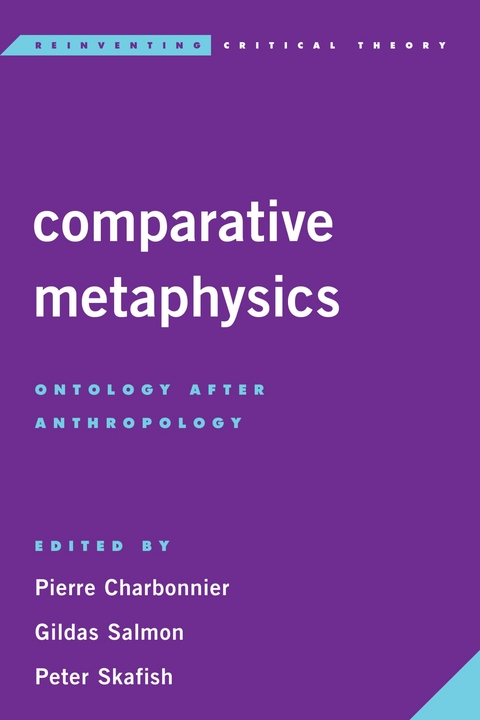
Comparative Metaphysics (eBook)
364 Seiten
Rowman & Littlefield International (Verlag)
978-1-78348-859-9 (ISBN)
How does the ontological turn in anthropology redefine what modern, Western ontology is in practice, and offer the beginnings of a new ontological pluralism? On a planet that is increasingly becoming a single, metaphysically homogeneous world, anthropology remains one of the few disciplines that recognizes that being has been thought with very different concepts and can still be rendered in terms quite different than those placed on it today. Yet despite its critical acuity, even the most philosophically oriented anthropology often remains segregated from philosophical discussions aimed at rethinking such terms. What would come of an anthropology more fully committed to being a source of (post-) philosophical concepts? What would happen to philosophy if it began to think with and through these concepts? How, finally, does comparison condition these two projects ? This book addresses these questions from a variety of perspectives, all of which nonetheless hold in common the view that "e;philosophy"e; has been displaced and altered by the modes of thought of other collectives. An international group of authors, including Eduardo Viveiros de Castro, Marilyn Strathern, Philippe Descola, and Bruno Latour, explore how the new anthropology/philosophy conjuncture opens new horizons of critique.
lt;span style="background:#FFFFFF">Pierre Charbonnier is a researcher in Philosophy at the National Center for Scientific Research, EHESS, Paris.
Gildas Salmon is a researcher in Philosophy at the National Center for Scientific Research, EHESS, Paris.
Peter Skafish is a maître de conférences associé at the Laboratoire d’Anthropologie Sociale and the Collège de France, Paris.
Introduction / Part I: Comparison, symmetry, pluralism / 1. Varieties of Ontological Pluralism, Philippe Descola / 2. On Ontological Delegation: The Birth of Neoclassical Anthropology, Gildas Salmon / 3. Connections, Friends and their Relations: An Issue in Knowledge-making, Marilyn Strathern / 4. We Have Never Been Pluralist: On Lateral and Frontal Comparisons in the Ontological Turn, Matei Candea / Part II: Conceptual Alteration: Theory and Method / 5. Anthropological Meditations, or, The Discourse on Comparative Method, Patrice Maniglier / 6. The Contingency of Concepts: Transcendental Deduction and Ethnographic Expression in Anthropological Thinking, Martin Holbraad / 7. Breaking Out of the Modern Circle: On Conceptual Issues of Critical Anthropology, Pierre Charbonnier / Part III: Life and Agency Outside Nature / 8. Thinking with Thinking Forests, Eduardo Kohn / 9. Nature from the Greeks: Empirical Philology and the Ontological Turn in Historical Anthropology, Arnaud Mace / 10. Moving to Remain the Same: Towards an Anthropological Theory of Nomadism, Morten Axel Pedersen / Part IV: Cosmopolitics and Alterity / 11. Metaphysics as Mythophysics. Or, Why I Have Always Been An Anthropologist, Eduardo Viveiros de Castro / 12. Metamorphosis of Consciousness: Concept, System, and Anthropology in the Thought of American Channels, Peter Skafish / 13. Ordering What Is: The Political Implications of Ontological Knowledge, Baptiste Gille / 14. A Dialog About a New Meaning of Symmetric Anthropology, Bruno Latour / Notes on Contributors / Bibliography / Index
| Erscheint lt. Verlag | 22.12.2016 |
|---|---|
| Reihe/Serie | Reinventing Critical Theory |
| Verlagsort | London |
| Sprache | englisch |
| Themenwelt | Geisteswissenschaften ► Philosophie ► Allgemeines / Lexika |
| Geisteswissenschaften ► Philosophie ► Metaphysik / Ontologie | |
| Sozialwissenschaften ► Ethnologie | |
| Sozialwissenschaften ► Soziologie | |
| Schlagworte | Anthropology • Continental Philosophy • Critical theory • speculative realism |
| ISBN-10 | 1-78348-859-X / 178348859X |
| ISBN-13 | 978-1-78348-859-9 / 9781783488599 |
| Informationen gemäß Produktsicherheitsverordnung (GPSR) | |
| Haben Sie eine Frage zum Produkt? |
 EPUB (Adobe DRM)
Kopierschutz: Adobe-DRM
Adobe-DRM ist ein Kopierschutz, der das eBook vor Mißbrauch schützen soll. Dabei wird das eBook bereits beim Download auf Ihre persönliche Adobe-ID autorisiert. Lesen können Sie das eBook dann nur auf den Geräten, welche ebenfalls auf Ihre Adobe-ID registriert sind.
Details zum Adobe-DRM
Dateiformat: EPUB (Electronic Publication)
EPUB ist ein offener Standard für eBooks und eignet sich besonders zur Darstellung von Belletristik und Sachbüchern. Der Fließtext wird dynamisch an die Display- und Schriftgröße angepasst. Auch für mobile Lesegeräte ist EPUB daher gut geeignet.
Systemvoraussetzungen:
PC/Mac: Mit einem PC oder Mac können Sie dieses eBook lesen. Sie benötigen eine
eReader: Dieses eBook kann mit (fast) allen eBook-Readern gelesen werden. Mit dem amazon-Kindle ist es aber nicht kompatibel.
Smartphone/Tablet: Egal ob Apple oder Android, dieses eBook können Sie lesen. Sie benötigen eine
Geräteliste und zusätzliche Hinweise
Buying eBooks from abroad
For tax law reasons we can sell eBooks just within Germany and Switzerland. Regrettably we cannot fulfill eBook-orders from other countries.
aus dem Bereich