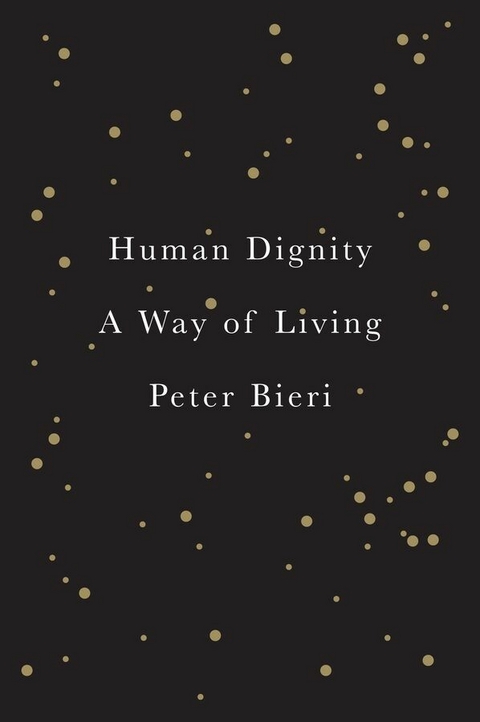
Human Dignity (eBook)
John Wiley & Sons (Verlag)
978-0-7456-8905-0 (ISBN)
Dignity is humanity's most prized possession. We experience the loss of dignity as a terrible humiliation: when we lose our dignity we feel deprived of something without which life no longer seems worth living. But what exactly is this trait that we value so highly?
In this important new book, distinguished philosopher Peter Bieri looks afresh at the notion of human dignity. In contrast to most traditional views, he argues that dignity is not an innate quality of human beings or a right that we possess by virtue of being human. Rather, dignity is a certain way to lead one's life. It is a pattern of thought, experience and action - in other words, a way of living.
In Bieri's account, there are three key dimensions to dignity as a way of living. The first is the way I am treated by others: they can treat me in a way that leaves my dignity intact or they can destroy my dignity. The second dimension concerns the way that I treat other people: do I treat them in a way that allows me to live a dignified life? The third dimension concerns the view that I have of myself: which ways of seeing and treating myself allow me to maintain a sense of dignity? In the actual flow of day-to-day life these three dimensions of dignity are often interwoven, and this accounts in part for the complexity of the situations and experiences in which our dignity is at stake.
So, why did we invent dignity and what role does it play in our lives? As thinking and acting beings, our lives are fragile and constantly under threat. A dignified way of living, argues Bieri, is humanity's way of coping with this threat. In our constantly endangered lives, it is important to stand our ground with confidence. Thus a dignified way of living is not any way of living: it is a particular way of responding to the existential experience of being under threat. It is also a particular way of answering the question: What kind of life do we wish to live?
This beautifully written reflection on our most cherished human value will be of interest to a wide readership.
Peter Bieri was born in Bern in 1944. He studied philosophy and classical philology and was Professor of Philosophy at Bielefeld, Marburg and the Freie Universitat Berlin.
Dignity is humanity's most prized possession. We experience the loss of dignity as a terrible humiliation: when we lose our dignity we feel deprived of something without which life no longer seems worth living. But what exactly is this trait that we value so highly? In this important new book, distinguished philosopher Peter Bieri looks afresh at the notion of human dignity. In contrast to most traditional views, he argues that dignity is not an innate quality of human beings or a right that we possess by virtue of being human. Rather, dignity is a certain way to lead one's life. It is a pattern of thought, experience and action in other words, a way of living. In Bieri's account, there are three key dimensions to dignity as a way of living. The first is the way I am treated by others: they can treat me in a way that leaves my dignity intact or they can destroy my dignity. The second dimension concerns the way that I treat other people: do I treat them in a way that allows me to live a dignified life? The third dimension concerns the view that I have of myself: which ways of seeing and treating myself allow me to maintain a sense of dignity? In the actual flow of day-to-day life these three dimensions of dignity are often interwoven, and this accounts in part for the complexity of the situations and experiences in which our dignity is at stake. So, why did we invent dignity and what role does it play in our lives? As thinking and acting beings, our lives are fragile and constantly under threat. A dignified way of living, argues Bieri, is humanity's way of coping with this threat. In our constantly endangered lives, it is important to stand our ground with confidence. Thus a dignified way of living is not any way of living: it is a particular way of responding to the existential experience of being under threat. It is also a particular way of answering the question: What kind of life do we wish to live? This beautifully written reflection on our most cherished human value will be of interest to a wide readership.
Peter Bieri was born in Bern in 1944. He studied philosophy and classical philology and was Professor of Philosophy at Bielefeld, Marburg and the Freie Universitat Berlin.
Introduction: Dignity as a way of living
1. Dignity as autonomy
Being a subject
Being an end in itself
Slaughterhouses
What if it is voluntary?
Humiliation as demonstrated powerlessness
Escaping to an inner fortress
Having rights
Being patronized
Caring paternalism
Respect for alterity and conviction
Dependence: asking and begging
Begging for feelings
Inner autonomy: thought
Inner autonomy: wanting and deciding
Inner autonomy: emotions
Inner autonomy: self-image and censorship
Humiliation through serfdom
Autonomy through self-knowledge
Needing therapy
Dignity through work
Money
2. Dignity as encounter
When subjects encounter each other
Commitment and distancing
Recognition
Equal rights
Putting someone on display
Sex objects
Human commodity
Neglect
Talk to me!
Laughing at someone
Denying explanation
Manipulation
Deception
Seduction
Overpowering
Working with a therapist
No pity, thank you!
Encounters between autonomous individuals
Leaving an open future to the other
Dignified partings
3. Dignity as respect for intimacy
The dual need for intimacy
Feeling the other's gaze
What is a defect?
The logic of shame
Shame as humiliation
Dignity as conquered shame
The intimate space
The innermost zone
Dignified disclosures
Undignified disclosures
Shared intimacy
Betrayed intimacy as lost dignity
A challenge: Intimacy as a lack of courage
4. Dignity as truthfulness
Lying to others
Lying to oneself
Honesty and its limits
Calling things by their proper name
Saving one's face
Bullshit
5. Dignity as self-respect
Dignity through limits
Fluid self-images
Destroying self-respect
Sacrificing self-respect
Breaking self-respect
Responsibility for oneself
6. Dignity as moral integrity
Moral autonomy
Moral dignity
Dignity in guilt and forgiveness
Punishment: Development instead of destruction
Absolute moral boundaries?
7. Dignity as a sense for what matters
Meaning of life
One's own voice
Equanimity as a sense of proportion
The view from the end
8. Dignity as the acceptance of finitude
When others lose themselves
Escape
Losing oneself: Resistance
Losing oneself: Accepting the journey into darkness
Dying
Letting someone die
Ending one's life
Responsibility towards the dead
References & Further Reading
"An elegant and subtle exploration of dignity and what it means to lose it."
Nigel Warburton, author of A Little History of Philosophy
"Human Dignity shows a rich and insightful exploration of the idea of human dignity from various angles and at several levels. Bieri carefully distinguishes dignity from other similar looking but really quite different concepts and deals with such important questions as how to live and die with dignity. This is an important book."
Bhikhu Parekh, House of Lords
"An important and beautiful book, thoroughly worth reading."
Frankfurter Allgemeine Zeitung
1
Dignity as Autonomy
We want to determine our lives ourselves. We want to be able to decide for ourselves what we do and what we do not do. We do not want to be dependent on the power and will of others. We do not want to have to rely on others. We want to be independent and autonomous. All these words describe a fundamental need – one that we cannot imagine our lives without. There might be times when this need is thwarted, and those times can be long. Yet the need remains. It is the inner compass of our lives. Many human experiences of dignity arise from this need. Situations in which there is a lack of autonomy, in which there is dependence and powerlessness are situations in which we feel as if our dignity is being lost. Then we do all we can to overcome this dependence and powerlessness and to regain our lost autonomy. For we are certain: this is what dignity is founded on.
Yet no matter how simple and clear the words are that we use to explain and conjure up this autonomy, the experience in question is anything but simple and clear. It too is no unified, monolithic experience. To be autonomous – that can mean many and very different things. If we want to get to the bottom of the idea of human dignity by tracing the way of living that it is about, we have to bring to mind the diversity of experiences that lie behind the simple, suggestive words. We are not alone and cannot do everything alone. We depend on others in diverse ways and they depend on us. We have to rely on them. What part of this creates natural human relations that we do not want to be without? And what part do we experience as dependence that threatens our dignity?
Being a Subject
To do justice to this question we need a conceptual story that reminds us of what kind of beings we are, what type of autonomy we seek and why it matters so much to us. It must be a story about what it means to be a subject. Which faculties lead us to experience ourselves as subjects – as opposed to objects, items, things or mere bodies?
Each of us is a centre of experience. It feels a certain way to be a human. Humans are corporeal beings with an internal perspective, an inner world. It has several dimensions. The most basic is that of physical sensation. It includes a grasp of the body's position and its movements, but also typical bodily sensations like desire, pleasure and pain, heat and cold, dizziness and disgust, lightness and heaviness. In addition, there are our sensory experiences: what we see, hear, smell, taste and touch. A further layer of experience is formed by feelings, such as joy and fear, or envy and jealousy, sorrow and melancholy. The pattern of our desires is closely bound up with this. What we desire expresses how we feel. And our desires can be read from what we imagine, from our fantasies and our daydreams. This whole set of experiences has a temporal dimension. It is embedded in memories and in a conception of future life with its hopes and expectations. All of this generates the mental picture we make of the world: what we think and believe about it, what we consider true and false, justified and unjustified, reasonable and unreasonable.
This is thus one of the meanings of being a subject: in that sense, to be a centre of experience or, as one could also say, a being with consciousness. Our behaviour develops out of this experience. There is involuntary behaviour which is pure movement: a twitch, a cramp, a blink. It can have an experienced internal side and thus be sensed behaviour, but it does not originate in this experience and is not its expression. Only when behaviour is the expression of an experience is it action. Those experiences that stand behind the action and express themselves through it are the motives of the action. I do something because I feel and desire something, because I remember or imagine something, because I have thought about and believe in something. When this is the case, I am the author of my action, I am a doer who develops his doing out of his experience. And the motives that guide me give my action its meaning.
We can verbalize the motives of our action. We can find words for our experiences and say out of which thoughts, desires and feelings we act. This way we can explain our action, both to others and to ourselves. We can tell stories about our motives that concern individual acts or longer phases of our action. We are beings that can narrate their lives in that sense. A subject, one could say, is a centre of narrative gravity. We are the ones who our motive stories are about. These stories are recollections, stories about present experience and stories about what we imagine our future to be; stories about where we come from, how we became what we are and what we intend. Through such stories a self-image develops, an image of how we see ourselves.
It belongs to our experience as subjects to discover that in a life there are many more thoughts, feelings, fantasies and desires than the exterior biography shows. And also more than the inner, conscious biography shows. Over time, we learn that there is a dimension of motives for our actions that lies in the dark, and that a subject's life can be concerned with becoming aware of these motives. Not that individuals need to be ceaselessly preoccupied with this. There might also be good reasons to leave some things in the dark, even forever. But it is the mark of subjects that they know about the existence of unconscious, hidden motives and about the possibility of inwardly expanding the radius of self-understanding.
The self-image that we have as subjects is not only an image of how we are, but also an idea of what we would like and ought to be. To our faculties as subjects belongs the capacity to deal critically with ourselves and to ask ourselves whether we are content with our actions and experiences, whether we approve or reject them. It belongs to the nature of subjects that they can experience a conflict between what they are and what they want to be, and that they can see themselves as failures. Subjects are therefore beings that are capable of internal censorship, capable of forbidding themselves actions, but also mere thoughts, desires, feelings and fantasies. By virtue of this ability, they are beings who can blame themselves. Subjects can live in a state of inner conflict, and they can ask themselves whether they can respect themselves for what they do and experience, or whether they must despise themselves for it.
It is the mark of a subject that she can question herself in this way, instead of merely drifting through life. And it does not end with the question. Subjects can not only look after themselves in a critical manner, but also tactically take charge of themselves and change themselves in their actions and experiences in a desired direction. As we are not just the victims of blindly flowing experience, but can evaluate ourselves from a reflective distance, it is possible for us to envisage a new way of thinking, wishing and feeling and to take steps towards such a transformation. Then we are doing something with ourselves and for ourselves. As one could say, we are working on our mental identity.
We now have a first, still sketchy, picture of what it means to be a subject. In the course of this book this image will become increasingly more detailed, richer and denser. The experiences we have with our dignity are intimately linked with the experiences we have as subjects. When our dignity is in danger, it is often because our lives as subjects are in danger. If we trace the individual threats to and defences of our dignity, we will automatically penetrate deeper and deeper into the experiences that belong to us as subjects.
Being an End in Itself
As subjects we do not want only to be used. We do not want to be mere means to an end, which others set and which is their end and not ours. We want, one could say, to be regarded and treated as ends in themselves. When we are not so treated, this is not just unpleasant. It is much more. We feel violated or even destroyed as subjects. When this happens, we experience it as an attempt to take away our dignity. To the extent to which our dignity is dependent on how others treat us, it is founded on the expectation, the claim and the right to be not only treated as a means to an end, but as ends in ourselves.
While travelling, I passed by a fun fair and saw something that I would not have believed to be possible: a dwarf-tossing competition. A strong man grabbed one of the small people and tossed him as far as possible on a soft, bouncy mat. The man who was being tossed wore padded protective clothing with handles and a helmet. The gawping crowd clapped and hooted at every throw. The furthest throw was almost four metres. I learned that the man who was being tossed had been at the world championship in dwarf-tossing. For this had really taken place: a world championship in throwing humans. After my return I discovered that this issue had preoccupied the highest courts. In France the Conseil d'Etat had banned the practice of dwarf-tossing, and the UN Human Rights Committee had dismissed an appeal against this decision. In both cases, the justification had been that human dignity has to be protected.
This was also my spontaneous reaction at the fun fair: you cannot do this to a human being. It violates his dignity. ‘Isn't this terrific?’, the man next to me exclaimed at a particularly far throw. ‘Repulsive’, I said, ‘intolerable!’ ‘But...
| Erscheint lt. Verlag | 12.1.2017 |
|---|---|
| Übersetzer | Diana Siclovan |
| Sprache | englisch |
| Themenwelt | Geisteswissenschaften ► Philosophie ► Allgemeines / Lexika |
| Geisteswissenschaften ► Philosophie ► Ethik | |
| Geisteswissenschaften ► Philosophie ► Geschichte der Philosophie | |
| Geisteswissenschaften ► Philosophie ► Philosophie der Neuzeit | |
| Sozialwissenschaften | |
| Schlagworte | 20th Century Philosophy • ethics • Ethik • human dignity, value, freedom • Philosophie • Philosophie des 20. Jhd. • Philosophy • Philosophy Special Topics • Spezialthemen Philosophie |
| ISBN-10 | 0-7456-8905-1 / 0745689051 |
| ISBN-13 | 978-0-7456-8905-0 / 9780745689050 |
| Informationen gemäß Produktsicherheitsverordnung (GPSR) | |
| Haben Sie eine Frage zum Produkt? |
 EPUB (Adobe DRM)
Kopierschutz: Adobe-DRM
Adobe-DRM ist ein Kopierschutz, der das eBook vor Mißbrauch schützen soll. Dabei wird das eBook bereits beim Download auf Ihre persönliche Adobe-ID autorisiert. Lesen können Sie das eBook dann nur auf den Geräten, welche ebenfalls auf Ihre Adobe-ID registriert sind.
Details zum Adobe-DRM
Dateiformat: EPUB (Electronic Publication)
EPUB ist ein offener Standard für eBooks und eignet sich besonders zur Darstellung von Belletristik und Sachbüchern. Der Fließtext wird dynamisch an die Display- und Schriftgröße angepasst. Auch für mobile Lesegeräte ist EPUB daher gut geeignet.
Systemvoraussetzungen:
PC/Mac: Mit einem PC oder Mac können Sie dieses eBook lesen. Sie benötigen eine
eReader: Dieses eBook kann mit (fast) allen eBook-Readern gelesen werden. Mit dem amazon-Kindle ist es aber nicht kompatibel.
Smartphone/Tablet: Egal ob Apple oder Android, dieses eBook können Sie lesen. Sie benötigen eine
Geräteliste und zusätzliche Hinweise
Buying eBooks from abroad
For tax law reasons we can sell eBooks just within Germany and Switzerland. Regrettably we cannot fulfill eBook-orders from other countries.
aus dem Bereich