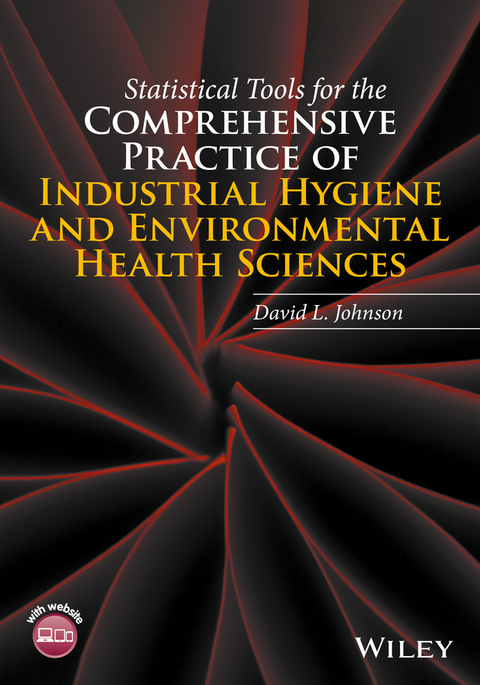
Statistical Tools for the Comprehensive Practice of Industrial Hygiene and Environmental Health Sciences (eBook)
John Wiley & Sons (Verlag)
978-1-119-35137-5 (ISBN)
Reviews and reinforces concepts and techniques typical of a first statistics course with additional techniques useful to the IH/EHS practitioner.
- Includes both parametric and non-parametric techniques described and illustrated in a worker health and environmental protection practice context
- Illustrated through numerous examples presented in the context of IH/EHS field practice and research, using the statistical analysis tools available in Excel® wherever possible
- Emphasizes the application of statistical tools to IH/EHS-type data in order to answer IH/EHS-relevant questions
- Includes an instructor's manual that follows in parallel with the textbook, including PowerPoints to help prepare lectures and answers in the text as for the Exercises section of each chapter.
Reviews and reinforces concepts and techniques typical of a first statistics course with additional techniques useful to the IH/EHS practitioner. Includes both parametric and non-parametric techniques described and illustrated in a worker health and environmental protection practice context Illustrated through numerous examples presented in the context of IH/EHS field practice and research, using the statistical analysis tools available in Excel wherever possible Emphasizes the application of statistical tools to IH/EHS-type data in order to answer IH/EHS-relevant questions Includes an instructor s manual that follows in parallel with the textbook, including PowerPoints to help prepare lectures and answers in the text as for the Exercises section of each chapter.
David L. Johnson has over 40 years of experience in environmental engineering and occupational safety and health practice, research, and teaching. Dr. Johnson was a practicing environmental engineer and industrial hygienist with the United States Army for 20 years, serving in a variety of positions in the United States, Europe, and the Middle East. He joined the faculty of the University of Oklahoma's College of Public Health, Department of Occupational and Environmental Health in 1991.
Chapter 1
Some Basic Concepts
Objectives
At the end of this chapter you should be able to:
- Describe the reasons for conducting occupational and environmental health science (IH/EHS) exposure measurements
- Distinguish between physical sampling and statistical sampling
- Discuss the importance of representative statistical sampling
- Define precision as it relates to IH/EHS measurements
- Calculate joint, marginal, and conditional probabilities and test for independence of events
- Recognize the characteristics of the binomial, normal, and chi-square probability distributions
- Perform calculations related to the binomial, normal, and chi-square probability distributions
1.1 Introduction
Industrial hygiene and environmental health sciences (IH/EHS) practitioners measure things – it is what we do. The range of risks to health and the environment includes those due to chemicals' hazards (irritants, corrosives, carcinogens, reproductive toxins, central nervous system depressants, asphyxiants, heavy metals, etc.), physical energy hazards (extreme heat and cold, vibration, ionizing and nonionizing radiations, noise), biological hazards (airborne infectious agents, bloodborne pathogens, contact infection transmission hazards, allergens, opportunistic pathogens), and ergonomic hazards (cumulative trauma due to repetitive motions, musculoskeletal soft tissue injury, stress-inducing positions). Toxic chemicals may be encountered in indoor occupational environments, ambient outdoor environments, and the water and food we consume. Quantifying these hazards is a crucial step in determining the degree of risk and developing strategies for reducing it if necessary.
The what, when, where, who, and how of our measurements is driven by the why. Why do we measure things? Obviously, it is to answer a question. Some common reasons for measuring are as follows:
- To demonstrate regulatory compliance
- a. Are worker exposures exceeding OSHA Permissible Exposure Limits (PELs) or other occupational exposure guidelines such as the ACGIH Threshold Limit Values (TLV®)?
- b. What are the chemical concentrations in air, water, soil, food, or other media?
- c. Are environmental discharges exceeding emissions permit limits?
- To establish baseline exposure information for specific exposure sources
- a. What are the sources of worker or public exposures to occupational or environmental insults?
- b. At what rates are pollutants being released?
- c. What is the spatial and temporal distribution of exposure levels around a source?
- To evaluate the effectiveness of control measures
- a. Is there a difference in the effectiveness of alternative controls?
- b. How effective is an intervention (engineering control, employee training, process change, etc.), that is, is the exposure or emission different (hopefully reduced!) after its implementation?
- c. Is an engineering control working as well now as it was previously?
- To characterize the frequency distribution of potential exposures or events
- a. What is the range of potential exposures or emissions?
- b. How frequently do different exposure levels occur?
- c. What fraction of worker exposures or process emissions is likely to exceed allowable levels?
- d. Is my company's rate of adverse events (overexposures, emissions exceedances, accidents, etc.) typical of the industry?
- e. Are adverse events occurring more frequently now than in the past?
- To explore associations between exposure variables
- a. What are the process factors and environmental factors that contribute to exposures?
- b. Which factors have the greatest influence on exposures?
- c. Do interactions between different contributors influence exposures?
Other good reasons for conducting measurements are to document exposure levels or emissions that are known to be within allowable limits to protect your employer against unfounded liability claims or undeserved regulatory penalties, or to reassure workers or the public. The first is just good business from an economic standpoint, but an additional benefit is that measurements documenting lower level exposures contribute to the epidemiological data from which improved dose–response relationships and associated exposure guidelines are developed. Measuring to reassure workers or the public is similarly good business because it promotes good public and labor-management relations.
Clearly, answering these very different questions requires different types and amounts of information, so the measurement strategy must be crafted to provide enough data, of high enough quality, to reliably answer the specific question. What “enough data,” “high enough quality,” and “reliably answer” mean are explored as we proceed.
1.2 Physical versus Statistical Sampling
We should distinguish at the outset the difference between “sample” as usually used in IH/EHS practice and “sample” as used in statistics. To the IH/EHS practitioner, “sample” usually means a physical quantity of something, such as a volume of soil, air, water, or other environmental media. In statistics, though, “sample” means a subset of all possible measurements that could be made of a quantity, from which we draw inferences about the whole population. A census is the special case where all possible values are in fact measured. It may seem trivial to point this out, but we should be clear on this distinction from the beginning.
We employ statistical sampling because there are never enough resources – as in time, people, and money – to measure all possible exposures of IH/EHS interest, where by exposure we mean any relevant physical, chemical, biological, or other measure of workplace or ambient environmental quality. For example, airborne contaminant concentrations due to industrial processes will typically vary up and down and over a wide range in the course of a workday, work week, season, and so on, and will likely differ as well across workers performing what appears to be the same task. To measure even one worker's full range of exposures would be extremely resource intensive, and the utility of the information would be limited because only one worker was measured, thus our reliance on statistical sampling to minimize the amount of measurement needed to draw inferences about the whole population of potential exposures. In this case, we might use our professional judgment and experience to identify groups of workers we believe likely to have similar exposures and conduct measurements on a subset of individuals randomly selected from within the group. Results for members of each similar exposure group (SEG) might then be used to draw inferences about the entire group's exposures.
1.3 Representative Measures
Reliable inferences about a population of exposures hinge on the measurements being representative of the population as a whole. Nonrepresentative sampling leads to inferential bias, because we are not measuring what we expect. Representative sampling means we have conducted our measurements such that no potential influences have been excluded or weighted differently than they occur in the exposed population. A simplistic example would be if we wanted to characterize sediment contaminant levels in a lake downstream from a pollution source but only measured sediment collected from readily accessible areas such as the shoreline or off the end of a fishing dock. This would surely give an incomplete if not outright misleading picture regarding the environmental impact of contaminant inflow to the lake. Another example might be selecting subjects only from among the day shift when measuring worker exposures at a multishift facility – there might very well be systematic differences in exposure that are influenced by the shift time, such as the rate of work, tasks performed, training and experience levels of the workers, or environmental conditions. Such differences comprise systematic errors in our characterization, and systematic errors result in bias.
Systematic measurement errors and associated bias can also result even when the sampling strategy is completely correct, through bias in the actual measurements themselves. When using any type of measurement instrument, it is essential to verify that it is working properly and that it is accurate, that is, the indicated result represents “truth.” Repeated measurements of an unchanging quantity using an improperly calibrated instrument may give the same answer every time (plus or minus a bit of random variation), but the answer will be consistently off in one direction. Such systematic measurement errors can be eliminated through good quality control practices and procedures and, therefore, should not occur. If they do occur, it may be difficult if not impossible to correct for the bias afterward or to even know that it has occurred. In all further discussion, we assume that measurements are performed using accurate measurement techniques, so that the measurement results are unbiased.
1.4 Strategies for Representative Sampling
Inferences drawn from statistical samples can only be valid if the samples are representative of the...
| Erscheint lt. Verlag | 27.12.2016 |
|---|---|
| Sprache | englisch |
| Themenwelt | Mathematik / Informatik ► Mathematik |
| Studium ► Querschnittsbereiche ► Prävention / Gesundheitsförderung | |
| Naturwissenschaften ► Chemie | |
| Sozialwissenschaften ► Soziologie | |
| Technik ► Bauwesen | |
| Wirtschaft | |
| Schlagworte | applied statistics</p> • Arbeitssicherheit u. Umweltschutz i. d. Chemie • Bauingenieur- u. Bauwesen • Biostatistics • Chemical and Environmental Health and Safety • Chemie • Chemistry • Civil Engineering & Construction • environmental • Environmental Engineering • Environmental Health • Environmental Management • Environmental Science • Environmental Statistics & Environmetrics • <p>Industrial hygiene • Occupational hygiene • Safety • Statistics • Statistik • Umweltstatistik u. Environmetrics • Umwelttechnik |
| ISBN-10 | 1-119-35137-5 / 1119351375 |
| ISBN-13 | 978-1-119-35137-5 / 9781119351375 |
| Informationen gemäß Produktsicherheitsverordnung (GPSR) | |
| Haben Sie eine Frage zum Produkt? |
 EPUB (Adobe DRM)
Kopierschutz: Adobe-DRM
Adobe-DRM ist ein Kopierschutz, der das eBook vor Mißbrauch schützen soll. Dabei wird das eBook bereits beim Download auf Ihre persönliche Adobe-ID autorisiert. Lesen können Sie das eBook dann nur auf den Geräten, welche ebenfalls auf Ihre Adobe-ID registriert sind.
Details zum Adobe-DRM
Dateiformat: EPUB (Electronic Publication)
EPUB ist ein offener Standard für eBooks und eignet sich besonders zur Darstellung von Belletristik und Sachbüchern. Der Fließtext wird dynamisch an die Display- und Schriftgröße angepasst. Auch für mobile Lesegeräte ist EPUB daher gut geeignet.
Systemvoraussetzungen:
PC/Mac: Mit einem PC oder Mac können Sie dieses eBook lesen. Sie benötigen eine
eReader: Dieses eBook kann mit (fast) allen eBook-Readern gelesen werden. Mit dem amazon-Kindle ist es aber nicht kompatibel.
Smartphone/Tablet: Egal ob Apple oder Android, dieses eBook können Sie lesen. Sie benötigen eine
Geräteliste und zusätzliche Hinweise
Buying eBooks from abroad
For tax law reasons we can sell eBooks just within Germany and Switzerland. Regrettably we cannot fulfill eBook-orders from other countries.
aus dem Bereich