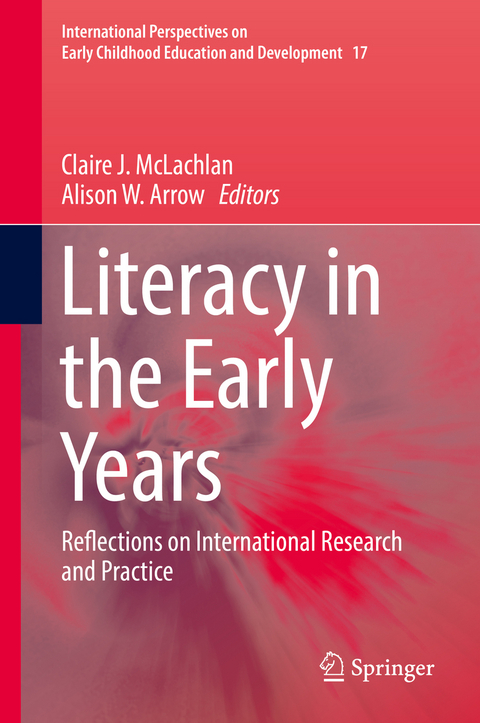
Literacy in the Early Years (eBook)
XV, 279 Seiten
Springer Singapore (Verlag)
978-981-10-2075-9 (ISBN)
This edited collection provides an in-depth exploration of different aspects of contemporary early childhood literacy research and the implications for educational practice. Each chapter details how the research was conducted and any issues that researchers encountered in collecting data with very young children, as well as what the research findings mean for educational practice. It includes photographs of effective literacy practice, detailed explanations of research methods so the studies can be replicated or expanded upon, and key features for promoting effective literacy practice in early childhood settings. This book is an essential read for everyone who is interested in exploring the complexities and challenges of researching literacy acquisition in the youngest children.
Claire McLachlan is a Professor of Education and Head of School for Te Hononga, School of Curriculum and Pedagogy in the Faculty of Education at the University of Waikato. She was formerly a Professor of Childhood Education at Massey University. She holds a B.A. in English and Education and M.A. (Hons, 1st class) and Ph.D in Education from Massey. Her primary research interests are in early literacy, early childhood curriculum, assessment and teachers’ beliefs about practice and she has produced five recent books on curriculum, literacy and assessment. Her current research concerns supporting teachers’ understandings of literacy in order to promote improved literacy outcomes for young children, the effectiveness of family literacy programmes and an intervention study on physical activity in early childhood settings. Claire’s contribution to early childhood research is reflected in her membership in the New Zealand Ministry of Education Early Childhood Research Policy Forum, membership in the UNESCO Panel on Early Reading and her being honored with an award from Massey University for excellence in educational research. She has also recently received an OMEP International research award.Alison Arrow, PhD, is a senior lecturer in literacy at Massey University, having graduated from the University of Auckland in 2008. One of Alison’s research areas is professional development in literacy with early childhood education teachers. This research has included the assessment of literacy abilities with children as young as three years old. She has published on the nature of literacy in early childhood and her current research examines how young children use digital technology at home and school for their literacy learning. Dr. Arrow has won a number of internal Massey University research grants and in 2012 she was the Massey University College of Education Early Career Research Award Winner. More recently, Alison has been successful in obtaining research funding for longitudinal intervention research with children just beginning school.
Preface 6
Acknowledgments 8
Contents 9
Contributors 11
List of Figures 13
List of Tables 14
Chapter 1: Conceptualising Literacy in the Early Childhood Setting 15
The Emergence of the Study of Literacy in Early Childhood 15
Literacy as a Complex Socio-Psycho-Linguistic Activity 16
A Social Practice View of Literacy 19
The Cultural Historical Theoretical Foundation for Literacy Research in This Volume 21
Literacy in the Modern Early Childhood Curriculum 24
Overview of the Chapters in This Book 27
Summary and Conclusion 31
References 31
Chapter 2: In Dialogue with Children: Exploring Children’s Views of Literacy Practices in Their Early Childhood Settings 34
Honouring Children’s Right to Be Heard 34
Research Approach 36
Conceptual Framework 37
Site and Participants 37
The Study’s Children 38
YG and GG Reading Experiences 39
Data Collection and Analysis Procedures 39
Dialogic Encounters with Children 40
Phase One of Dialogic Encounters 41
Phase Two of Dialogic Encounters 42
The Study’s Ethics and Trustworthiness 42
Findings 43
Children’s Views of Reading and Themselves as Readers 43
Children’s Views of Their Classroom Reading Situations 45
Teacher Giving a Reading Lesson to a Class, with a Focus on Phonics 45
Child Reading with Another Child 46
Child Silently Reading Alone 46
Teacher Reading to the Class 47
Child Completing a Reading Worksheet 47
Children Doing a Classroom Reading Game 48
Summary of Key Findings 48
Discussion 50
Endnote 52
References 52
Chapter 3: Linguistic Diversity and Literacy Practices in Early Childhood Education in Norway 55
Introduction 55
Theoretical Framework 57
The Study 59
Drama Play and Learning Vocabulary in Context 60
Picture Book Reading and Ways with Words 62
Socio-Dramatic Play and Literacy Development 64
Multilingual Identities 66
Final Remarks 68
References 70
Chapter 4: “You Guys Should Offer the Program more Often!”: Some Perspectives from Working Alongside Immigrant and Refugee Families in a Bilingual Family Literacy Program 74
Introduction 74
Framework 75
Related Literature 76
Parents As Literacy Supporters in Immigrant Communities (PALS) 77
Method 78
Research Sites 78
Data Collection and Analysis 79
Results 79
Perceived Benefits of the Program 80
Perceived Challenges of the Program 81
Parents’ Perceptions of the Program 83
Discussion and Conclusion 85
Limitations 85
References 87
Chapter 5: Predicting Early Writing: The Role of Parental Writing Mediation and Children’s Private Talk During Writing 90
Introduction 90
Writing Development 91
Parental Writing Mediation 92
Private Speech 92
Understanding the Writing Process 93
The Study 93
Participants 93
Procedure 94
Measures 94
Results 96
Descriptive Statistics 96
Discussion 97
Measures Related to Children’s Writing Level 98
Predicting Writing Level 99
Limitations, Practical Implications, and Summary 100
References 101
Chapter 6: What Brings Children to Writing and Energises Their Early Writing Efforts? 104
Introduction 104
The Present Study 106
Participants 106
Implementation 106
Data Collection 107
Key Findings 108
Summary and Conclusions 117
Implications for Literacy in the Early Childhood Context 118
References 120
Chapter 7: Child Shyness and Reading Ability in Encounters with Difficult Words During Shared Book Reading 122
Introduction 122
Child Characteristics Influencing Reading Behaviour 124
Child Reading Skill in Relation to Parent and Child Behaviour 124
Child Shyness in Relation to Parent and Child Behaviour 125
The Current Study 126
Methods 127
Participants 127
Materials 127
Procedure 128
Coding System 129
Data Preparation 130
Results 131
Preliminary Analyses 131
Prediction of Behaviour in Shared Book Reading 132
Discussion 135
Child Approaches to Difficult Words 135
Parental Approaches to Difficult Words 136
Limitations and Directions for Future Research 137
Conclusion 138
References 139
Chapter 8: The Hakalama: The ?Aha P?nana Leo’s Syllabic Hawaiian Reading Program 144
Introduction 144
The Relationship of Metalinguistic Development to Early Literacy 145
The P?nana Leo Hawaiian Preschools and Follow-Up Programing 147
The Establishment of the Hakalama 148
Adding the Vowel Lines 150
The ?Aha Nu?ukia and Hakalama Teacher Training 151
Assessing Early Literacy from a Hakalama Base 152
Learning the Alphabet After Mastering Syllabic Decoding 153
The Relationship of the Hakalama to Historical Practices 154
The Transfer from Reading Hawaiian to Reading Japanese and English 156
The Hakalama in the Age of NCLB and ESSA 157
Roots in Tradition Bring Forth Life in Today’s World 158
Endnote 159
References 159
Chapter 9: How Effective Is Morphological Awareness Instruction on Early Literacy Skills? 162
Introduction 162
Early Morphological Awareness and Literacy Learning 163
Morphological Awareness Instruction and Early Literacy 165
The Present Study 166
Study 1 168
Method 168
Participants 168
Pre-test and Post-test Measures 168
Early Literacy Skills 169
Morphological Awareness 169
Procedure 170
Results and Discussion 171
Study 2 173
Method 173
Participants 173
Pre-test and Post-test Measures 174
Morphological Awareness Tasks 174
Procedure 175
Results and Discussion 177
General Discussion 180
How Effective Is the Early Instruction in Morphological Awareness? 181
Educational Implications and Future Research 182
References 183
Chapter 10: Early Reading First as a Model for Improving Preschool Literacy Instruction and Outcomes 186
Early Literacy Instruction: Background and Issues 186
Early Literacy 186
Early Literacy Curricula 187
In-Service Professional Development in Early Literacy 188
Family Engagement in Early Literacy 189
Early Reading First 190
Intervention Model 191
Research-Based Curriculum 191
Professional Development and Coaching 195
Family Engagement 196
Methods 196
Participants 196
Measures 197
Results 198
Classroom Quality 198
Family Engagement 199
Child Outcomes 200
Teacher Outcomes 201
Discussion 203
References 205
Chapter 11: Promoting the Predictors of Literacy in Early Childhood Settings: An Analysis of Two Studies in Low SES Settings 209
Definitions of Early Literacy 210
What Do We Know About Literacy in New Zealand Children? 211
Supporting Literacy Prior to Primary School Entry 213
Definitions of Literacy Underpinning the Studies 214
Methodology: Study 1 215
Teachers 216
Children 217
Measures 217
Teachers 217
Children 217
Procedures 218
Results 219
Methodology: Study 2 221
Parents’ Views of Children’s Literacy in Kindergartens 222
Planned Collaborative Review in Kindergarten 1 223
Planned Collaborative Review in Kindergarten 2 224
Teachers’ Reflections on Their Reviews 225
Reflections on Methodology 226
Conclusions 226
References 228
Chapter 12: Digital Technologies in the Literate Lives of Young Children 231
Introduction 231
Literacy Development and Digital Technologies at Home 232
Digital Technologies at School 233
The Studies 235
Analysis 236
Home Interactions in Digital Technologies and Literacies 237
Educators’ Knowledge of Children’s Experiences 239
Tensions and Challenges 240
Uncertainties in Integrating Digital Technologies into Teaching and Learning 242
Discussion 244
Conclusion 246
References 247
Chapter 13: Literacy, Technology and Early Years Education: Building Sustainable Practice 249
Introduction 249
Influences on Early Years Teacher Practice 250
Children’s Learning with Technology in Home, School and ICT Communities 251
Effective Literacy Learning Environments 253
Theoretical Perspective 254
The Research Context 254
Addressing the Research Question 255
Teachers’ Beliefs and Understandings About Technology and Literacy Practices 257
Susie’s Story of Literacy Practices with Technology in the Early Years Context 258
Mollie’s Story of Literacy Practices with Technology in the Early Years Context 260
Technology in the Literacy Practice of Early Years Teachers 262
Conclusion 265
References 265
Chapter 14: The Future of Literacy Research in the Early Childhood Context 268
Introduction 268
Literacy Development Is More than Formal Instruction 269
The Role of Adult Mediation 270
The Value of Families 270
Intentional Teaching, Teacher Knowledge, and Curriculum 272
Second Language Learning and Literacy 273
The ‘New’ New Literacies: The Future of Literacy Learning 274
An Agenda for Further Research 274
Conclusion 276
References 276
About the Editors 278
About the Authors 279
Index 284
| Erscheint lt. Verlag | 7.11.2016 |
|---|---|
| Reihe/Serie | International Perspectives on Early Childhood Education and Development | International Perspectives on Early Childhood Education and Development |
| Zusatzinfo | XV, 279 p. 23 illus. |
| Verlagsort | Singapore |
| Sprache | englisch |
| Themenwelt | Geisteswissenschaften ► Sprach- / Literaturwissenschaft ► Sprachwissenschaft |
| Sozialwissenschaften ► Pädagogik ► Vorschulpädagogik | |
| Schlagworte | Childhood literacy • children’s views of literacy practices • Colorado Child Temperament Inventory • Digital technology in early childhood • Early childhood curriculum and education • Emergent writing instruction • future of literacy research • Hakalama • Hawaiian Syllabic Reading Program • ʻAha Punana Leo • ʻAha Pūnana Leo • language diversity • Literacy assessment • morphological awareness instruction • participatory research approach • Professional development or learning • Research methods in early childhood and literacy • sociocultural perspectives of literacy • sociology of childhood • Storytelling Curriculum • UN Convention on the Rights of the Child |
| ISBN-10 | 981-10-2075-2 / 9811020752 |
| ISBN-13 | 978-981-10-2075-9 / 9789811020759 |
| Informationen gemäß Produktsicherheitsverordnung (GPSR) | |
| Haben Sie eine Frage zum Produkt? |
 PDF (Wasserzeichen)
DRM: Digitales Wasserzeichen
Dieses eBook enthält ein digitales Wasserzeichen und ist damit für Sie personalisiert. Bei einer missbräuchlichen Weitergabe des eBooks an Dritte ist eine Rückverfolgung an die Quelle möglich.
Dateiformat: PDF (Portable Document Format)
Mit einem festen Seitenlayout eignet sich die PDF besonders für Fachbücher mit Spalten, Tabellen und Abbildungen. Eine PDF kann auf fast allen Geräten angezeigt werden, ist aber für kleine Displays (Smartphone, eReader) nur eingeschränkt geeignet.
Systemvoraussetzungen:
PC/Mac: Mit einem PC oder Mac können Sie dieses eBook lesen. Sie benötigen dafür einen PDF-Viewer - z.B. den Adobe Reader oder Adobe Digital Editions.
eReader: Dieses eBook kann mit (fast) allen eBook-Readern gelesen werden. Mit dem amazon-Kindle ist es aber nicht kompatibel.
Smartphone/Tablet: Egal ob Apple oder Android, dieses eBook können Sie lesen. Sie benötigen dafür einen PDF-Viewer - z.B. die kostenlose Adobe Digital Editions-App.
Buying eBooks from abroad
For tax law reasons we can sell eBooks just within Germany and Switzerland. Regrettably we cannot fulfill eBook-orders from other countries.
aus dem Bereich