


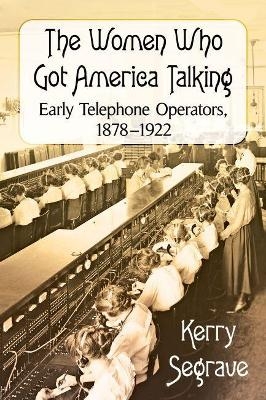
The Women Who Got America Talking
Early Telephone Operators, 1878-1922
Seiten
2017
McFarland & Co Inc (Verlag)
9781476669045 (ISBN)
McFarland & Co Inc (Verlag)
9781476669045 (ISBN)
When the need for telephone operators arose in the 1870s, the assumption was that they should all be male. Wages for adult men were too high, so boys were hired. They proved quick to argue with subscribers, so females replaced them. Women were calmer, had reassuring voices and rarely talked back. Within a few years, telephone operators were all female and would remain so.
When the need for telephone operators arose in the 1870s, the assumption was that they should all be male. Wages for adult men were too high, so boys were hired. They proved quick to argue with the subscribers, so females replaced them. Women were calmer, had reassuring voices and rarely talked back. Within a few years, telephone operators were all female and would remain so.
The pay was low and working conditions harsh. The job often impaired their health, as they suffered abuse from subscribers in silence under pain of dismissal. Discipline was stern--dress codes were mandated, although they were never seen by the public. Most were young, domestic and anything but militant. Yet many joined unions and walked picket lines in response to the severely capitalistic, sexist system they worked under.
When the need for telephone operators arose in the 1870s, the assumption was that they should all be male. Wages for adult men were too high, so boys were hired. They proved quick to argue with the subscribers, so females replaced them. Women were calmer, had reassuring voices and rarely talked back. Within a few years, telephone operators were all female and would remain so.
The pay was low and working conditions harsh. The job often impaired their health, as they suffered abuse from subscribers in silence under pain of dismissal. Discipline was stern--dress codes were mandated, although they were never seen by the public. Most were young, domestic and anything but militant. Yet many joined unions and walked picket lines in response to the severely capitalistic, sexist system they worked under.
Cultural historian Kerry Segrave is the author of dozens of books on such diverse topics as drive-in theaters, ticket-scalping, lie detectors, jukeboxes, smoking and shoplifting. He lives in British Columbia.
Table of Contents
Preface delete
Introduction delete
1. In the Beginning, Men vs. Women
2. The Hello Girl to 1900
3. The Operator, 1901–1922
4. Discipline
5. Health and Swearing and Love and Harassment
6. Strikes and Labor Unions
7. Goodbye to the Hello Girl
Chapter Notes delete
Bibliography delete
Index delete
| Erscheinungsdatum | 01.06.2017 |
|---|---|
| Zusatzinfo | 67 photos, notes, bibliography, index |
| Verlagsort | Jefferson, NC |
| Sprache | englisch |
| Maße | 152 x 229 mm |
| Gewicht | 322 g |
| Themenwelt | Sachbuch/Ratgeber ► Geschichte / Politik ► Allgemeines / Lexika |
| Geisteswissenschaften ► Geschichte ► Regional- / Ländergeschichte | |
| Sozialwissenschaften ► Kommunikation / Medien ► Journalistik | |
| Technik ► Nachrichtentechnik | |
| Wirtschaft | |
| ISBN-13 | 9781476669045 / 9781476669045 |
| Zustand | Neuware |
| Informationen gemäß Produktsicherheitsverordnung (GPSR) | |
| Haben Sie eine Frage zum Produkt? |
Mehr entdecken
aus dem Bereich



aus dem Bereich
Handbuch zum Lesen des Himmels
Buch | Hardcover (2025)
Harpercollins (Verlag)
CHF 30,80
von der Antike bis ins 21. Jahrhundert
Buch | Softcover (2024)
C.H.Beck (Verlag)
CHF 16,80


