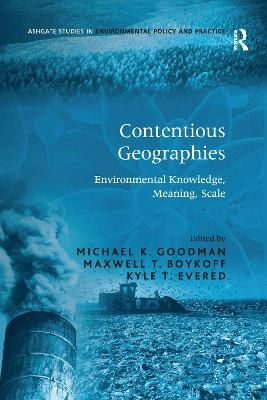
Contentious Geographies
Routledge (Verlag)
978-1-138-27559-1 (ISBN)
The human-environment relationship - intimately intertwined and often contentious - is one of the most pressing concerns of the 21st century. Explored through an array of critical approaches, this book brings together case studies from across the globe to present significant cutting-edge research into political ecologies as they relate to multi-form contestations over environments, resources and livelihoods. Covering a range of issues, such as popular discourses of environmental 'collapse', climate change, water resource struggles, displacement, agro-food landscapes and mapping technologies, this edited volume works to provide a broad and critical understanding of the narratives and policies more subtly shaping and being shaped by underlying environmental conflicts. By exploring the power-laden processes by which environmental knowledge is generated, framed, communicated and interpreted, Contentious Geographies works to reveal how environmental conflicts can be (re)considered and thus (re)opened to enhance efforts to negotiate more sustainable environments and livelihoods.
Dr Michael K. Goodman is a Lecturer in Geography at King's College London, UK, Dr Maxwell T. Boykoff, is a Research Fellow at the Environmental Change Institute, University of Oxford, UK and Dr Kyle T. Evered, is an Assistant Professor of Geography at Michigan State University, USA.
Chapter 1 Contentious Geographies: Environmental Knowledge, Meaning, Scale, Michael K. Goodman, Maxwell T. Boykoff, Kyle T. Evered; Part 1 Translating Contentious Environmental Knowledge and Science; Chapter 2 The Contentious World of Jared Diamond’s Collapse, Tim Forsyth; Chapter 3 Fight Semantic Drift!? Mass Media Coverage of Anthropogenic Climate Change, Maxwell T. Boykoff; Chapter 4 Whose Scarcity? The Hydrosocial Cycle and the Changing Waterscape of La Ligua River Basin, Chile, Jessica Budds; Part 2 Conflicting and Shifting Environmental Knowledges, Livelihoods, and Power; Chapter 5 ‘Environmentality’ in Rajasthan’s Groundwater Sector: Divergent Environmental Knowledges and Subjectivities, Trevor L. Birkenholtz; Chapter 6 Discursive Spearpoints: Contentious Interventions in Amazonian Indigenous Environments, Logan A. Hennessy; Part 3 Environmental Movements: Contested (Re)Scaling of Knowledges, Problems and Narratives; Chapter 7 Confronting Invisibility: Reconstructing Scale in California’s Pesticide Drift Conflict, Jill Harrison; Chapter 8 Scale and Narrative in the Struggle for Environment and Livelihood in Vieques, Puerto Rico, Karen Schmelzkopf; Chapter 9 Making Local Places GE-Free in California’s Contentious Geographies of Genetic Pollution and Coexistence, Dustin Mulvaney; Part 4 Contested Production of Environmental Science, Law, and Knowledge; Chapter 10 Regional Power and the Power of the Region: Resisting Dam Removal in the Pacific Northwest, Eve Vogel; Chapter 11 Law of Regions: Mining Legislation and the Construction of East and West, Johanna Haas; Part 5 Fraught Spatial Technologies and Knowledge Construction; Chapter 12 1An earlier and shorter version of this chapter was published as an Introduction to Mapping Communities: Ethics, Values, Practice (East-West Center, 2005) that documents the collection of case studies covered by our project. Yet another shorter communication was published as ‘Mapping power: ironic effects of spatial information technology’, in Part Icipatory Learning and Action 54: 98–105 (2006). This chapter is based upon work supported by the National Science Foundation under Grant No. SDEST-0221912, the Rockefeller Brothers Fund, and the Ford Foundation (through the Jakarta Office). We would like to thank all the Part Icipants to the workshops for sharing their ideas. Any opinions, findings and conclusions or recommendations expressed in this material are those of the authors and do not necessarily reflect the views of the National Science Foundation (NSF), the East-West Center, or the University of Hawaii., Jefferson Fox, Krisnawati Suryanata, Peter Hershock, Albertus Hadi Pramono; Chapter 13 Competing and Conflicting Social Constructions of ‘Land’ in South Africa: The Case of and Implications for Land Reform, Brent McCusker;
| Erscheinungsdatum | 08.01.2017 |
|---|---|
| Verlagsort | London |
| Sprache | englisch |
| Maße | 156 x 234 mm |
| Gewicht | 453 g |
| Themenwelt | Naturwissenschaften ► Biologie ► Ökologie / Naturschutz |
| Naturwissenschaften ► Geowissenschaften ► Geografie / Kartografie | |
| Sozialwissenschaften ► Soziologie | |
| Technik ► Umwelttechnik / Biotechnologie | |
| Wirtschaft | |
| ISBN-10 | 1-138-27559-X / 113827559X |
| ISBN-13 | 978-1-138-27559-1 / 9781138275591 |
| Zustand | Neuware |
| Informationen gemäß Produktsicherheitsverordnung (GPSR) | |
| Haben Sie eine Frage zum Produkt? |
aus dem Bereich