


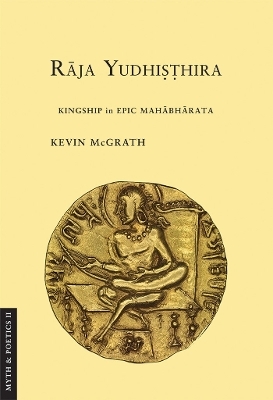
Raja Yudhisthira
Kingship in Epic Mahabharata
Seiten
2017
Cornell University Press (Verlag)
978-1-5017-0498-7 (ISBN)
Cornell University Press (Verlag)
978-1-5017-0498-7 (ISBN)
In Raja Yudhisthira, Kevin McGrath brings his comprehensive literary, ethnographic, and analytical knowledge of the epic Mahabharata to bear on the representation of kingship in the poem. He shows how the preliterate Great Bharata song depicts both archaic and classical models of kingly and premonetary polity and how the king becomes a ruler who is viewed as ritually divine. Based on his precise and empirical close reading of the text, McGrath then addresses the idea of heroic religion in both antiquity and today; for bronze-age heroes still receive great devotional worship in modern India and communities continue to clash at the sites that have been—for millennia—associated with these epic figures; in fact, the word hero is in fact more of a religious than a martial term.
One of the most important contributions of Raja Yudhisthira, and a subtext in McGrath's analysis of Yudhisthira's kingship, is the revelation that neither of the contesting moieties of the royal Hastinapura clan triumphs in the end, for it is the Yadava band of Krsna who achieve real victory. That is, it is the matriline and not the patriline that secures ultimate success: it is the kinship group of Krsna—the heroic figure who was to become the dominant Vaisnava icon of classical India—who benefits most from the terrible Bharata war.
One of the most important contributions of Raja Yudhisthira, and a subtext in McGrath's analysis of Yudhisthira's kingship, is the revelation that neither of the contesting moieties of the royal Hastinapura clan triumphs in the end, for it is the Yadava band of Krsna who achieve real victory. That is, it is the matriline and not the patriline that secures ultimate success: it is the kinship group of Krsna—the heroic figure who was to become the dominant Vaisnava icon of classical India—who benefits most from the terrible Bharata war.
Kevin McGrath is an Associate of the Department of South Asian Studies, Harvard University. He is the author of Arjuna Paava: The Double Hero in Epic Mahabharata; In The Kacch: A Memoir of Love and Place; Heroic Krsna: Friendship in Epic Mahabharata; Jaya: Performance in Epic Mahabharata; Stri: Feminine Power in the Mahabharata; and The Sanskrit Hero: Karna in Epic Mahabharata.
1. The Beginning2. Kingship The Rajasuya Sequence War as Royal Rite The Asvamedha 3. Ideals of Kingship Archaic Ideals Installation Classical Ideals 4. The End
| Erscheinungsdatum | 27.04.2017 |
|---|---|
| Reihe/Serie | Myth and Poetics II |
| Verlagsort | Ithaca |
| Sprache | englisch |
| Maße | 152 x 229 mm |
| Gewicht | 907 g |
| Themenwelt | Geisteswissenschaften ► Sprach- / Literaturwissenschaft ► Anglistik / Amerikanistik |
| Geisteswissenschaften ► Sprach- / Literaturwissenschaft ► Literaturwissenschaft | |
| Sozialwissenschaften ► Soziologie | |
| ISBN-10 | 1-5017-0498-2 / 1501704982 |
| ISBN-13 | 978-1-5017-0498-7 / 9781501704987 |
| Zustand | Neuware |
| Informationen gemäß Produktsicherheitsverordnung (GPSR) | |
| Haben Sie eine Frage zum Produkt? |
Mehr entdecken
aus dem Bereich


aus dem Bereich
Poetik eines sozialen Urteils
Buch | Hardcover (2023)
De Gruyter (Verlag)
CHF 83,90


