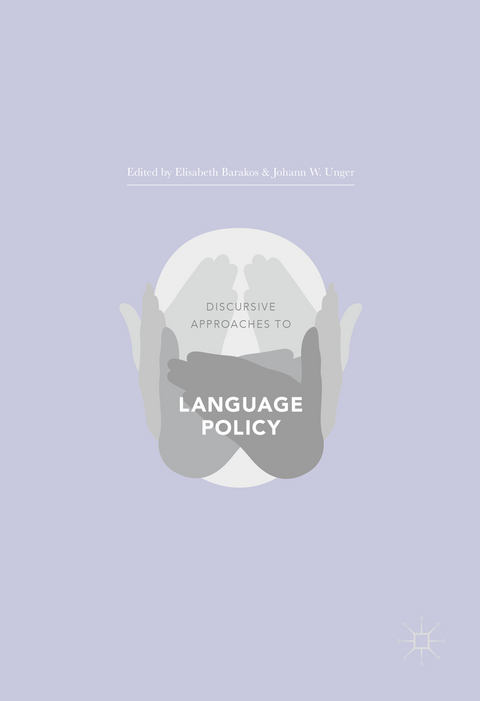
Discursive Approaches to Language Policy (eBook)
299 Seiten
Palgrave Macmillan UK (Verlag)
978-1-137-53134-6 (ISBN)

This book brings together the fields of language policy and discourse studies from a multidisciplinary theoretical, methodological and empirical perspective. The chapters in this volume are written by international scholars active in the field of language policy and planning and discourse studies. The diverse research contexts range from education in Paraguay and Luxembourg via businesses in Wales to regional English language policies in Tajikistan. Readers are thereby invited to think critically about the mutual relationship between language policy and discourse in a range of social, political, economic and cultural spheres. Using approaches that draw on discourse-analytic, anthropological, ethnographic and critical sociolinguistic frameworks, the contributors in this collection explore and refine the 'discursive' and the 'critical' aspects of language policy as a multilayered, fluid, ideological, discursive and social process that can operate as a tool of social change as well as reinforcing established power structures and inequalities.
Elisabeth Barakos is a Lecturer in Applied Linguistics at Aston University, Birmingham, UK. Her research interests focus on language policy discourse and practice, multilingualism and language in the workplace from a critical sociolinguistic perspective.Johann W. Unger is a Lecturer and Academic Director of Summer Programmes at Lancaster University. He researches mainly in the areas of language policy and digitally mediated politics from a critical discourse studies perspective. His 2013 monograph The Discursive Construction of the Scots Language deals extensively with language policy.
Introduction: Why are discursive approaches to language policy necessary?.- PART I THEORETICAL FOUNDATIONS FOR DISCURSIVE APPROACHES TO LANGUAGE POLICY.- Chapter 1: Language policy and critical discourse studies: Towards a combined approach.- Chapter 2: State language policy in time and space: Meaning, transformation, recontextualisation.- Chapter 3: Language policy as metapragmatic discourse: A focus on the intersection of language policy and social identification.- PART II METHODOLOGICAL INNOVATIONS IN DISCURSIVE APPROACHES TO LANGUAGE POLICY.- Chapter 4: A critical integrated approach to language policy as discursive action: Strengths, challenges and opportunities.- Chapter 5: Heteroglossic practices and language ideologies: Combining heteroglossia with critical discourse analysis to investigate digital multilingual discourses on language policies.- PART III EMPIRICAL APPLICATIONS OF DISCURSIVE APPROACHES TO LANGUAGE POLICY.- Chapter 6: Eng flott Diskriminatioun?: Language and citizenship policy in Luxembourg as experience.- Chapter 7: Luxembourgish language-in-education policy in limbo: The tension between ideologies of authenticity and anonymity.- Chapter 8: Language ideologies regarding English-medium instruction in European higher education: Insights from Flanders and Finland.- Chapter 9: On ‘promoting and demanding’ integration: A discursive case study of immigrant language policy in Basel.- Chapter 10: English language policy as ideology in multilingual Khorog, Tajikistan.- Chapter 11: Commentary.
| Erscheint lt. Verlag | 2.11.2016 |
|---|---|
| Zusatzinfo | XIII, 299 p. 8 illus., 5 illus. in color. |
| Verlagsort | London |
| Sprache | englisch |
| Themenwelt | Geisteswissenschaften ► Sprach- / Literaturwissenschaft ► Sprachwissenschaft |
| Sozialwissenschaften ► Ethnologie | |
| Sozialwissenschaften ► Soziologie | |
| Schlagworte | critical discourse studies • discourse • Discourse analysis • ethnographic framework • History • Language planning • Language Policy • Linguistics • Policy • power structures • social change • Sociolinguistics |
| ISBN-10 | 1-137-53134-7 / 1137531347 |
| ISBN-13 | 978-1-137-53134-6 / 9781137531346 |
| Informationen gemäß Produktsicherheitsverordnung (GPSR) | |
| Haben Sie eine Frage zum Produkt? |
 PDF (Wasserzeichen)
DRM: Digitales Wasserzeichen
Dieses eBook enthält ein digitales Wasserzeichen und ist damit für Sie personalisiert. Bei einer missbräuchlichen Weitergabe des eBooks an Dritte ist eine Rückverfolgung an die Quelle möglich.
Dateiformat: PDF (Portable Document Format)
Mit einem festen Seitenlayout eignet sich die PDF besonders für Fachbücher mit Spalten, Tabellen und Abbildungen. Eine PDF kann auf fast allen Geräten angezeigt werden, ist aber für kleine Displays (Smartphone, eReader) nur eingeschränkt geeignet.
Systemvoraussetzungen:
PC/Mac: Mit einem PC oder Mac können Sie dieses eBook lesen. Sie benötigen dafür einen PDF-Viewer - z.B. den Adobe Reader oder Adobe Digital Editions.
eReader: Dieses eBook kann mit (fast) allen eBook-Readern gelesen werden. Mit dem amazon-Kindle ist es aber nicht kompatibel.
Smartphone/Tablet: Egal ob Apple oder Android, dieses eBook können Sie lesen. Sie benötigen dafür einen PDF-Viewer - z.B. die kostenlose Adobe Digital Editions-App.
Buying eBooks from abroad
For tax law reasons we can sell eBooks just within Germany and Switzerland. Regrettably we cannot fulfill eBook-orders from other countries.
aus dem Bereich