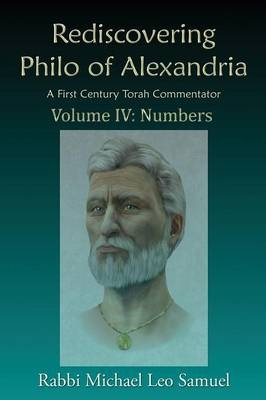
Rediscovering Philo of Alexandria (eBook)
100 Seiten
First Edition Design Publishing (Verlag)
9781506902654 (ISBN)
Philo of Alexandria (20 BCE.--50 CE.) stood at the crossroads of ancient history. Philo was the first pioneer to integrate Judaic thought with the Stoic, Platonic, and Pythagorean philosophical traditions. This Alexandrian Jewish philosopher assembled the very first philosophical, ethical, psychological, exegetical, and theological commentary on the Torah. As his community's most prestigious Jewish leader, he defended Alexandrian Jews from the attacks of anti-Semites, and met with the capricious Roman Emperor Caligula, calling upon him to respect the ethical monotheistic beliefs of the Jewish people. As with Josephus, Philo bears witness to the world's first protomodern and intellectual Jewish community of Alexandria, the cultural center of Late Antiquity. Reclaiming Philo as a Jewish exegete puts him in company with other great luminaries of Jewish history. Rabbi Michael Leo Samuel has meticulously culled from all of Philo's exegetical remarks, arranging them according to the biblical verses. He provides extensive parallels from the corpus of rabbinical literature, Greek philosophy, and Christian theology in presenting how Philo impacted the great minds of Late Antiquity and beyond.
Introduction to Philo’s Exposition of Numbers
Although Philo never wrote a commentary on the Book of Numbers, much less, an introduction to it, Rediscovering Philo of Alexandria is a modest attempt to reconstruct most of Philo’s ideas concerning the fourth book of the Torah from the thoughts and reflections scattered throughout his vast writings. As a scholar, philosopher, teacher, and Jewish community leader, there can be no doubt that Philo expounded the themes of Numbers, as well as other books of the Pentateuch during the Sabbath services and on numerous other occasions.
As with the other books of the new Rediscovering Philo of Alexandria series, many fragments of Philo’s scriptural insights resemble the pieces of a jigsaw puzzle strewn about. By themselves, the segments are disjointed and unclear to the eye. However, when creatively assembled, the patterns and organization of Philo’s thoughts and ideas emerge and form a coherent message of 1st century Judaism that is nothing less than spectacular.
Different kinds of audiences gravitated to Philo in Alexandria; some of his students had a strong philosophical training in schools of Plato and Aristotle; others were people who loved listening to an intellectual presentation of the weekly Torah reading at the local synagogues. Philo’s ethical teachings appealed to those who love the study of ethics in Socrates, Plato, Aristotle and the Stoic thinkers. Philo’s associates delighted in the study of law, and his students had a fascination with the mysteries of the Torah, where Philo taught his allegorical interpretations of Scriptures.
A number of early rabbinic scholars also frequented Alexandria, which had one of the oldest and largest Jewish communities of the ancient Near East, numbering close to two hundred and seventy-thousand Jews.[1] Alexandria also had a rich cosmopolitan atmosphere, made famous by the Light Tower of Pharos, the world’s first university, and the Alexandrian Library. As a prominent city, Alexandria often rivaled the Athens as the intellectual capital of the ancient world.
Why is Philo so Important?
You can ask: Why is Philo’s thoughts on the Pentateuch so important? Here is a brief answer to this important question. For one thing, Philo is arguably one of the very first expounders of the Pentateuch. His writings antedate the early rabbinical and medieval Judaic commentaries by many centuries.
Secondly, Philo was a major player of Jewish history in what was one of the largest Jewish communities of the ancient world, perhaps the largest of the Diaspora. His leadership in the Alexandrian gives us a profound insight in one of the most turbulent periods of Jewish history—of 1st century Judaism. His insights preserve the values of the once great Alexandrian community, which produced the first proto-modern Jewish community of Jewish history.
Thirdly, Philo anticipates much of the kind of midrashic insights that would crystalize in the form of Midrash. Little did Don Isaac Abarbanel (1437-1508) realize that his style of question and answering format used in his Torah commentary derived directly from Philo. In the future volumes of this series, we will examine Philo’s hermeneutical principles that he used when he interpreted the Torah and we will see how they compare with the rabbinical methodology that the early Sages used in Judea.
Fourthly, Philo’s view of the biblical laws have great relevance for how the Oral Law of Judaism developed. His novel interpretations inspired scholars over history. In the 20th century alone, scholars such as Bernard Ritter, Samuel Belkin, Gedaliah Allon (and others!) show how Philo’s ethical hermeneutic of Torah corresponds to many of the laws and other midrashic/Aggadic texts found in the Talmud and in other rabbinical sources.
Fifthly, Philo’s attitude about proselytes and welcoming Jews by choice helps explain how Judaism became a very popular religion in the ancient world.
Sixthly, Philo became Judaism’s first prominent theologian who presented his ideas on Judaic thought that was relatively systematic and cohesive, as is attested in Henry Wolfson’s landmark work on Philo of Alexandria.[2]
In the new series Rediscovering Philo of Alexandria, we will expand some of the points illustrating Philo’s relationship with the Oral Law of rabbinic tradition, with sources and comparisons made with the various Halachic, midrashic texts of the past. The ultimate goal of this project is to help re-vision Philo’s position within normative Judaism. Although scholars often view Philo as a religious allegorical thinker, Philo was also one of the first Judaic exegetes who sought to explain the biblical text in the idiom of his time. Although several of his works were lost over time, his Questions and Answers on Genesis and Exodus resembled a medieval styled rabbinical commentary. Philo consistently looked for the ethical lessons the Torah could teach us. As a humble servant, sage, and leader of the Alexandrian Jewish community, Philo’s contributions can enrich our lives with his brilliant ethical insights, which are still relevant even today in the 21st century.
Philo’s Exegetical Style
A substantial amount of material used in this book comes from the two volumes Philo wrote on Moses’ biography, entitled, “Moses.” Philo was an excellent storyteller and creates at times a marvelous midrashic depiction of the biblical actors, making them seem real and alive to his readers (as seen in the stories of Balaam, and Phinehas); his interpretations are clear, lucid and always insightful. Philo’s examination of the various laws found in Numbers that are used in this book derive from his philosophical work, “The Special Laws.” Philo offers plenty of practical explanations that anyone who is interested in the study of 1st century Judaism or early rabbinic Judaism could benefit from reading.
In light of this, the reader may want to carefully peruse through the Philo material on Numbers and focus only on the themes that seem relevant and perhaps even surprisingly practical. Philo has the distinction of being the best-known Judaic philosopher of Late Antiquity. He created the first successful synthesis of Judaism and Greek philosophy—well over a thousand years before Maimonides and eight hundred years before Saadia Gaon. For the students of theology, philosophy, and ethics, Philo’s insights will invite comparison to some of the greatest Jewish minds of Jewish history—ancient, medieval and modern.
To make the material more user-friendly, I added subtitles throughout the work and this should make navigating Philo’s ideas somewhat more accessible. Philo used a multi-dimensional approach in disseminating ideas of Torah that reflected his diversity and skill as a pedagogue to his people and community. Sometimes Philo writes like a medieval exegete who focuses on the simplest and contextual meaning of a text, better known to us as peshat.
Philo’s love of allusion appears whenever he explains some of the mathematical patterns embedded in the Torah (see Philo’s comments on Numbers 7:13). This approach of Philo comes remarkably close to the expounders of remez in medieval Jewish tradition. At other times, Philo focusses on the deeper philosophical meaning of a section that is comparable to what medieval rabbinic scholars identified as derash. Anticipating a view later expressed in the Zohar, Philo viewed the allegory as the “soul” of the text—in contrast to the text’s more “bodily” feature.[3] Only those who have a more mature capacity can readily grasp the text’s deeper meaning.[4] Philo’s allegorical approach is remarkably similar to the great mystics of the Kabbalah and especially Hassidut who expounded the method of esoteric exegesis known as sod.
Philo of Alexandria has the unique distinction of writing the very first philosophical commentary on the Torah. Philo has the unique distinction in Jewish history having written the world’s first philosophical exposition of the Torah.[5] In this new series, we will also be making serious comparisons between Philo and the nascent rabbinical tradition of the 1st century and beyond. By showing the parallels in these sources, a reader will be able to appreciate Philo’s thoughts in relation to many of Judaism and Christianity’s greatest thinkers. Talmudic students and scholars will likewise appreciate the antiquity and the antecedents of key discussions in the literature of Halacha, thus proving the seeds of the Oral tradition are evident in the first century, if not considerably later.
Translating Philo’s ideas is challenging and his penchant for verbosity and his never-ending rhetoric even strains the patience of Philo scholars. Unfortunately, it often takes philosophers scores of pages to convey one simple idea that would take a normal person to express in just a few words. Most philosophers—ancient and modern have...
| Erscheint lt. Verlag | 1.10.2016 |
|---|---|
| Sprache | englisch |
| Themenwelt | Geschichte ► Teilgebiete der Geschichte ► Kulturgeschichte |
| Religion / Theologie ► Christentum ► Kirchengeschichte | |
| Geisteswissenschaften ► Religion / Theologie ► Judentum | |
| Geisteswissenschaften ► Sprach- / Literaturwissenschaft ► Anglistik / Amerikanistik | |
| Geisteswissenschaften ► Sprach- / Literaturwissenschaft ► Literaturwissenschaft | |
| Sozialwissenschaften ► Soziologie ► Spezielle Soziologien | |
| ISBN-13 | 9781506902654 / 9781506902654 |
| Informationen gemäß Produktsicherheitsverordnung (GPSR) | |
| Haben Sie eine Frage zum Produkt? |
 EPUB (Wasserzeichen)
Größe: 293 KB
DRM: Digitales Wasserzeichen
Dieses eBook enthält ein digitales Wasserzeichen und ist damit für Sie personalisiert. Bei einer missbräuchlichen Weitergabe des eBooks an Dritte ist eine Rückverfolgung an die Quelle möglich.
Dateiformat: EPUB (Electronic Publication)
EPUB ist ein offener Standard für eBooks und eignet sich besonders zur Darstellung von Belletristik und Sachbüchern. Der Fließtext wird dynamisch an die Display- und Schriftgröße angepasst. Auch für mobile Lesegeräte ist EPUB daher gut geeignet.
Systemvoraussetzungen:
PC/Mac: Mit einem PC oder Mac können Sie dieses eBook lesen. Sie benötigen dafür die kostenlose Software Adobe Digital Editions.
eReader: Dieses eBook kann mit (fast) allen eBook-Readern gelesen werden. Mit dem amazon-Kindle ist es aber nicht kompatibel.
Smartphone/Tablet: Egal ob Apple oder Android, dieses eBook können Sie lesen. Sie benötigen dafür eine kostenlose App.
Geräteliste und zusätzliche Hinweise
Buying eBooks from abroad
For tax law reasons we can sell eBooks just within Germany and Switzerland. Regrettably we cannot fulfill eBook-orders from other countries.
aus dem Bereich