


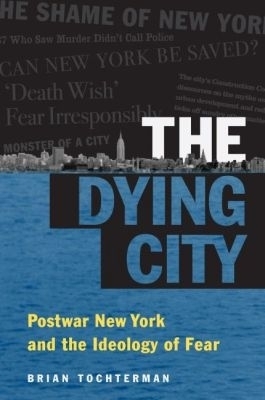
The Dying City
Postwar New York and the Ideology of Fear
Seiten
2017
The University of North Carolina Press (Verlag)
978-1-4696-3306-0 (ISBN)
The University of North Carolina Press (Verlag)
978-1-4696-3306-0 (ISBN)
In this eye-opening cultural history, Brian Tochterman examines competing narratives that shaped post-World War II New York City. Tochterman reveals how elite culture producers, planners and theorists, and elected officials drew on and perpetuated the fear of death to press for a new urban vision.
In this eye-opening cultural history, Brian Tochterman examines competing narratives that shaped post–World War II New York City. As a sense of crisis rose in American cities during the 1960s and 1970s, a period defined by suburban growth and deindustrialization, no city was viewed as in its death throes more than New York. Feeding this narrative of the dying city was a wide range of representations in film, literature, and the popular press--representations that ironically would not have been produced if not for a city full of productive possibilities as well as challenges. Tochterman reveals how elite culture producers, planners and theorists, and elected officials drew on and perpetuated the fear of death to press for a new urban vision.
It was this narrative of New York as the dying city, Tochterman argues, that contributed to a burgeoning and broad anti-urban political culture hostile to state intervention on behalf of cities and citizens. Ultimately, the author shows that New York's decline--and the decline of American cities in general--was in part a self-fulfilling prophecy bolstered by urban fear and the new political culture nourished by it.
In this eye-opening cultural history, Brian Tochterman examines competing narratives that shaped post–World War II New York City. As a sense of crisis rose in American cities during the 1960s and 1970s, a period defined by suburban growth and deindustrialization, no city was viewed as in its death throes more than New York. Feeding this narrative of the dying city was a wide range of representations in film, literature, and the popular press--representations that ironically would not have been produced if not for a city full of productive possibilities as well as challenges. Tochterman reveals how elite culture producers, planners and theorists, and elected officials drew on and perpetuated the fear of death to press for a new urban vision.
It was this narrative of New York as the dying city, Tochterman argues, that contributed to a burgeoning and broad anti-urban political culture hostile to state intervention on behalf of cities and citizens. Ultimately, the author shows that New York's decline--and the decline of American cities in general--was in part a self-fulfilling prophecy bolstered by urban fear and the new political culture nourished by it.
Brian Tochterman is assistant professor of sustainable community development at Northland College.
| Erscheinungsdatum | 10.06.2017 |
|---|---|
| Reihe/Serie | Studies in United States Culture |
| Zusatzinfo | 15 halftones |
| Verlagsort | Chapel Hill |
| Sprache | englisch |
| Maße | 155 x 233 mm |
| Gewicht | 440 g |
| Themenwelt | Sachbuch/Ratgeber ► Geschichte / Politik ► Allgemeines / Lexika |
| Geisteswissenschaften ► Geschichte ► Allgemeine Geschichte | |
| Geisteswissenschaften ► Geschichte ► Regional- / Ländergeschichte | |
| Geschichte ► Teilgebiete der Geschichte ► Kulturgeschichte | |
| Sozialwissenschaften ► Soziologie | |
| ISBN-10 | 1-4696-3306-X / 146963306X |
| ISBN-13 | 978-1-4696-3306-0 / 9781469633060 |
| Zustand | Neuware |
| Informationen gemäß Produktsicherheitsverordnung (GPSR) | |
| Haben Sie eine Frage zum Produkt? |
Mehr entdecken
aus dem Bereich

aus dem Bereich
Die Revolution des Gemeinen Mannes
Buch | Softcover (2024)
C.H.Beck (Verlag)
CHF 16,80
Eine Geschichte des Geschmacks
Buch | Hardcover (2025)
C.H.Beck (Verlag)
CHF 49,95
vom Mittelalter bis zur Gegenwart
Buch | Softcover (2024)
C.H.Beck (Verlag)
CHF 16,80


