


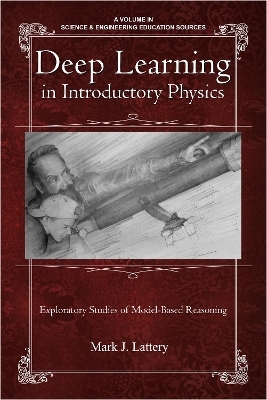
Deep Learning in Introductory Physics
Exploratory Studies of Model Based Reasoning
Seiten
2016
Information Age Publishing (Verlag)
978-1-68123-628-5 (ISBN)
Information Age Publishing (Verlag)
978-1-68123-628-5 (ISBN)
Deep Learning in Introductory Physics explores how students learn physics in a model-centered classroom. It addresses the coherence vs. fragmentation debate and suggests that deep science learning is regressive and revolutionary.
Deep Learning in Introductory Physics: Exploratory Studies of Model-Based Reasoning is concerned with the broad question of how students learn physics in a model-centered classroom. The diverse, creative, and sometimes unexpected ways students construct models, and deal with intellectual conflict, provide valuable insights into student learning and cast a new vision for physics teaching. This book is the first publication in several years to thoroughly address the 'coherence versus fragmentation' debate in science education, and the first to advance and explore the hypothesis that deep science learning is regressive and revolutionary. Deep Learning in Introductory Physics also contributes to a growing literature on the use of history and philosophy of science to confront difficult theoretical and practical issues in science teaching, and addresses current international concern over the state of science education and appropriate standards for science teaching and learning.
The book is divided into three parts. Part I introduces the framework, agenda, and educational context of the book. An initial study of student modeling raises a number of questions about the nature and goals of physics education. Part II presents the results of four exploratory case studies. These studies reproduce the results of Part I with a more diverse sample of students; under new conditions (a public debate, peer discussions, and group interviews); and with new research prompts (model-building software, bridging tasks, and elicitation strategies). Part III significantly advances the emergent themes of Parts I and II through historical analysis and a review of physics education research.
Deep Learning in Introductory Physics: Exploratory Studies of Model-Based Reasoning is concerned with the broad question of how students learn physics in a model-centered classroom. The diverse, creative, and sometimes unexpected ways students construct models, and deal with intellectual conflict, provide valuable insights into student learning and cast a new vision for physics teaching. This book is the first publication in several years to thoroughly address the 'coherence versus fragmentation' debate in science education, and the first to advance and explore the hypothesis that deep science learning is regressive and revolutionary. Deep Learning in Introductory Physics also contributes to a growing literature on the use of history and philosophy of science to confront difficult theoretical and practical issues in science teaching, and addresses current international concern over the state of science education and appropriate standards for science teaching and learning.
The book is divided into three parts. Part I introduces the framework, agenda, and educational context of the book. An initial study of student modeling raises a number of questions about the nature and goals of physics education. Part II presents the results of four exploratory case studies. These studies reproduce the results of Part I with a more diverse sample of students; under new conditions (a public debate, peer discussions, and group interviews); and with new research prompts (model-building software, bridging tasks, and elicitation strategies). Part III significantly advances the emergent themes of Parts I and II through historical analysis and a review of physics education research.
Mark J. Lattery, University of Wisconsin Oshkosh
Preface.
Acknowledgments.
Part I. Research Framework.
Chapter 1. Scientific Models.
Chapter 2. Modeling in the Classroom.
Chapter 3. An Unsolved Puzzle.
Part II. Research on Student Model Formation and Development in Mechanics.
Chapter 4. Case Study I. Anda and Rick.
Chapter 5. Case Study II. Juan.
Chapter 6. Case Study III. Chris and Laura.
Chapter 7. Case Study IV. Kristy and Mia.
Chapter 8. Model-Based Reasoning.
Part III. Research Extensions.
Chapter 9. A Search for Cardinal Models.
Chapter 10. Student Conceptions of Free Fall.
Chapter 11. Pathways to Formal Knowledge.
Chapter 12. Perspectives.
References.
About the Author.
Index.
| Erscheinungsdatum | 19.11.2016 |
|---|---|
| Reihe/Serie | Science & Engineering Education Sources |
| Sprache | englisch |
| Maße | 156 x 234 mm |
| Gewicht | 430 g |
| Themenwelt | Schulbuch / Wörterbuch ► Unterrichtsvorbereitung ► Unterrichts-Handreichungen |
| Sozialwissenschaften ► Pädagogik | |
| ISBN-10 | 1-68123-628-1 / 1681236281 |
| ISBN-13 | 978-1-68123-628-5 / 9781681236285 |
| Zustand | Neuware |
| Informationen gemäß Produktsicherheitsverordnung (GPSR) | |
| Haben Sie eine Frage zum Produkt? |
Mehr entdecken
aus dem Bereich



aus dem Bereich
praxiserprobte Arbeitshilfen für Mentorinnen und Mentoren
Buch (2025)
Raabe (Verlag)
CHF 48,85
Flugsimulation mit Microsoft Flight Simulator, X-Plane, AeroflyFS und …
Buch | Softcover (2024)
Springer Fachmedien Wiesbaden (Verlag)
CHF 41,95


