


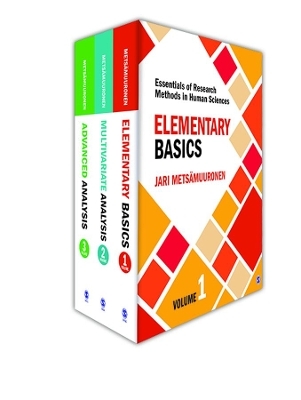
Essentials of Research Methods in Human Sciences
Sage Publications India Pvt Ltd
978-93-86042-96-5 (ISBN)
- Keine Verlagsinformationen verfügbar
- Artikel merken
Watch Jari Metsamuuronen talk about Essentials of Research Methods in Human Sciences
These books, as a whole, serve as a "one-stop-shop" or "all-in-one guide" in introducing those at the very beginning of research, beginner university students, distance education students and students in vocational higher education (polytechnics), to the world of basic research methodology – to both the basic qualitative and quantitative methodology. At the same time, the books suits for non-mathematician and non-statistician professional researchers, professors, and lecturers of varied disciplines by providing a practical understanding of tens of possibilities of analysing the dataset. These provide a step-by-step guidance on running of statistical analyses with SPSS dialogue boxes, interpretation of results.
The set is divided into three volumes:
Volume 1: Elementary Basics leads the beginners into the basics – of research as a process, test construction, qualitative research, statistical description and – inference as well as into the basics of futures studies.
Volume 2: Multivariate Analysis teaches analyzing the quantitative dataset with the classical multivariate methods, such as Regression analysis, Factor analysis, Analysis of Variance, and Discrimination – and Classification analysis. The practical part is illustrated by using SPSS software.
Volume 3: Advanced Analysis teaches advanced methods in analyzing a quantitative dataset, with Non-parametric statistics, Experimental studies, Multi-level modeling, Structural Equation Modeling (SEM) and Path Modeling as well as Survival analysis.
These are the FIRST English language editions of the original Finnish handbook (4th edition of which was published in 2011), which is used as a textbook in almost all universities in Finland and in 26 different domains including Education, Special Education, Psychology, Sociology, Nursing, Marketing, Statistics, Military, and Sports. It has served the Finnish readers as a "one-stop shop" guide for scholars at UG level, distance education and in vocational higher education; faculty and professional researchers of varied disciplines; and also to those seeking a practical understanding of analyzing the dataset.
Jari Metsämuuronen is Adjunct Professor and Special Evaluation Expert at Finnish Education Evaluation Centre, Helsinki, Finland. He worked for 10 years as a nurse, primarily in emergency rooms. In 1990, he graduated with a PhM of education (classroom teacher). After gaining a degree in statistics, he made his doctoral dissertation in the area of education. His thesis, Interests and Intentional Learning, concerned the structures of commitment in intentional learning. The second monograph, Intentional Learning and Motive Structures, concerned the structures of motives in intentional learning. In 1999, he was named as an Adjunct Professor of Education at the University of Helsinki. During 1997–1998 and 2005–2007, he worked as a futurologist in areas of social welfare and health care and education. He was also the editor of FUTURA, a scientific journal of the Finnish Future Studies Society during 1998–2000. On the basis of his studies and several scientific articles, he wrote two futurological books: World Is Changing—How About Social Welfare and Health Care? (1998, reprinted in 2000) and Finding the Future of Social Welfare and Health Care (2001). From 1998 onwards, he has been a senior methodologist in the student assessment unit on the Finnish National Board of Education and, since 2014, at Finnish Education Evaluation Centre. He has also served as an international consultant in Sri Lanka (2002), Kenya (2005), Ethiopia (2005), Palestine (2008, 2009), Chile (2013), and Nepal (2010, 2011?2014). From 1996 onwards, he has been a lecturer of research methodology in several universities and polytechnics in Finland. He has popularized research methodology in 10 volumes of the Methodology series (2000–2009) and 11 volumes of e-books of the same series (2002). His largest book, Handbook of Basics of Research Methods in Human Sciences was first published in 2002. The fourth edition of the handbook was published in 2009 and its e-book version in 2011 (both in Finnish and English). This book was given the Grant of Finnish State for Public Information in 2007. The Handbook of Practical Qualitative Research (in Finnish) was published in 2006. The author cordially encourages the readers to send feedback of the book to his e-mail: Jari.Metsamuuronen@methelp.com
Volume 1: Elementary Basis
Preface and Acknowledgments
Introduction
SECTION I: BASICS OF METHODOLOGY IN HUMAN SCIENCES
Introduction and Objectives
Topic of the Study
Finding the Literature
Concepts
Research Problems and Hypothesis
Research Design and Sampling
Measurement Instrument and Its Trustworthiness
Results and Selection of the Method
Discussion and Implications for Practice
SECTION II: BASICS OF TEST THEORY AND TEST CONSTRUCTION
Introduction and a Brief History of Test Theory
Principles of Writing Items
The Process of Creating a Measurement Instrument
Validity of the Measurement
Classical Test Theory
Latent Ability and Item Response Theory
Principles of Item Banking and Adaptive Testing
Two Practical Examples of Test Construction
SECTION III: BASICS OF QUALITATIVE RESEARCH
Introduction to the Qualitative Research
Concepts of Qualitative Research
Strategies to Acquire Qualitative Knowledge
Methods to Acquire the Qualitative Data
Analysis and Interpretation of Qualitative Data
Qualitative Report
Combining Qualitative and Quantitative Approaches
SECTION IV: BASICS OF FUTURES STUDIES
Introduction to Futures Studies
Futures Studies and Scientific Knowledge
Weak Signals and Decision Making
Methods for the Futures Studies
SECTION V: BASICS OF STATISTICAL DESCRIPTION
Introduction to Statistical Analysis
Data
Condensing the Data: Basic Statistics
Cross-tabulation
Scales and Correlation
Testing the Difference of Means
SECTION VI: BASICS OF STATISTICAL INFERENCE
Introduction to Statistical Inference
Probability
Population, Sampling, and Probability Distributions and Their Use
Principles of Hypothesis Testing
Examples of Significance Testing
Confidence Interval
Effect Size and Principles of Meta-analysis
References
Index
Volume 2: Multivariate Analysis
Preface and Acknowledgments
SECTION I: BASICS OF SPSS SOFTWARE
Introduction to SPSS
Basic Matters and Data Entry
Composite Variables and Scale Reliability
Analyzing the Dependence and Correlation between Variables
Comparing Two Means
Illustrating the Results, Using the Graphical Possibilities of SPSS
SECTION II: BASICS OF MULTIVARIATE ANALYSIS
A Glossary for a Beginner Researcher
Multivariate Analysis in Human Sciences
Family of Factor Analysis
Family of Regression Analysis
Family of Analysis of Variance
Family of Cluster and Classification Analysis
References
Index
Volume 3: Advanced Analysis
Preface and Acknowledgments
SECTION I: BASICS OF NONPARAMETRIC STATISTICS
Brief Glossary for a Beginner Researcher
Introduction
Introduction to Nonparametric Methods
Tests for One Sample
Tests for Related Samples
Tests for Independent Samples
Nonparametric Measures of Association
Views on Nonparametric Multivariate Methods
SECTION II: BASICS OF EXPERIMENTAL RESEARCH IN HUMAN SCIENCES
Introduction to Experimental Research
Experimental Designs
Analyzing Experimental Designs
SECTION III: BASICS OF MULTILEVEL MODELING
Introduction to Multilevel Modeling
Traditional Linear Regression Analysis
Special Characteristics of Multilevel Modeling
Multilevel Modeling Using HLM
Multilevel Modeling Using MLwiN
Multilevel Modeling Using SPSS
Diagnostic Examination of the Models
General Comparison of the Software Packages
SECTION IV: BASICS OF SEM AND PATH MODELING IN AMOS ENVIRONMENT
Background and History of SEM
Research Questions and Assumptions in SEM
Briefly on Theory and Concepts
Technical Execution with AMOS
SECTION V: BASICS OF SURVIVAL ANALYSIS
Introduction to Survival Analysis
Life Tables
Survival Analysis
References
Index
| Verlagsort | New Delhi |
|---|---|
| Sprache | englisch |
| Maße | 184 x 241 mm |
| Gewicht | 4170 g |
| Themenwelt | Sozialwissenschaften ► Soziologie ► Empirische Sozialforschung |
| ISBN-10 | 93-86042-96-7 / 9386042967 |
| ISBN-13 | 978-93-86042-96-5 / 9789386042965 |
| Zustand | Neuware |
| Informationen gemäß Produktsicherheitsverordnung (GPSR) | |
| Haben Sie eine Frage zum Produkt? |


