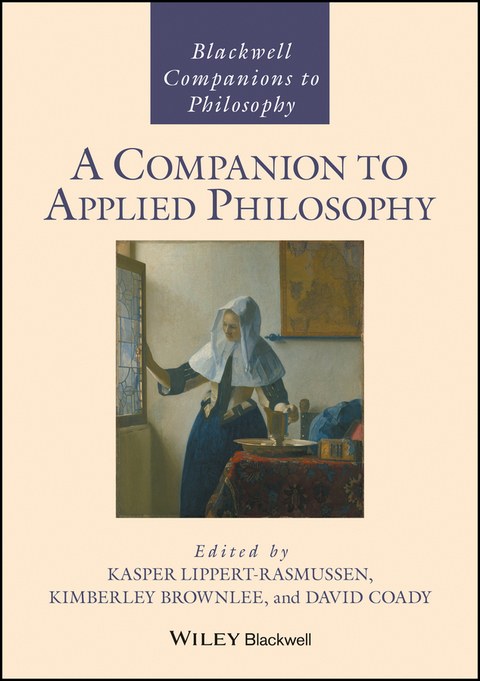
A Companion to Applied Philosophy (eBook)
John Wiley & Sons (Verlag)
978-1-118-86912-3 (ISBN)
Applied philosophy has been a growing area of research for the last 40 years. Until now, however, almost all of this research has been centered around the field of ethics. A Companion to Applied Philosophy breaks new ground, demonstrating that all areasof philosophy, including epistemology, metaphysics, philosophy of science, and philosophy of mind, can be applied, and are relevant to questions of everyday life.
This perennial topic in philosophy provides an overview of these various applied philosophy developments, highlighting similarities and differences between various areas of applied philosophy, and examining the very nature of this topic. It is an area to which many of the towering figures in the history of philosophy have contributed, and this timely Companion demonstrates how various historical contributions are actually contributions within applied philosophy, even if they are not traditionally seen as such.The Companion contains 42 essays covering major areas of philosophy; the articles themselves are all original contributions to the literature and represent the state of the art on this topic, as well as offering a map to the current debates.
Kasper Lippert-Rasmussen is Professor of Political Theory at the University of Aarhus and Professor II in Philosophy at the University of Tromsø. Recent publications include Born Free and Equal? (2013) and Luck Egalitarianism (2015). He is an associate editor of Ethics and was Chair of the Society for Applied Philosophy from 2012 to 2014.
David Coady is a senior lecturer in philosophy at the University of Tasmania, Australia. He has published on many topics in applied epistemology, including expertise, conspiracy theory, rumor, and the blogosphere. He is the editor of Conspiracy Theories: The Philosophical Debate (2006), the author of What To Believe Now: Applying Epistemology to Contemporary Issues (2012), and the co?-author of The Climate Change Debate: An Epistemic and Ethical Enquiry (2013). He has also published on metaphysics, philosophyof law, police ethics, the ethics of horror films, and the ethics of cricket.
Kimberley Brownlee is Professor of Philosophy at the University of Warwick. Her research focuses on the ethics of sociability, social rights, social virtues, and freedom of association. She is the author of Conscience and Conviction: The Case for Civil Disobedience (2012) and co-editor of Disability and Disadvantage (2009).
Applied philosophy has been a growing area of research for the last 40 years. Until now, however, almost all of this research has been centered around the field of ethics. A Companion to Applied Philosophy breaks new ground, demonstrating that all areasof philosophy, including epistemology, metaphysics, philosophy of science, and philosophy of mind, can be applied, and are relevant to questions of everyday life. This perennial topic in philosophy provides an overview of these various applied philosophy developments, highlighting similarities and differences between various areas of applied philosophy, and examining the very nature of this topic. It is an area to which many of the towering figures in the history of philosophy have contributed, and this timely Companion demonstrates how various historical contributions are actually contributions within applied philosophy, even if they are not traditionally seen as such. The Companion contains 42 essays covering major areas of philosophy; the articles themselves are all original contributions to the literature and represent the state of the art on this topic, as well as offering a map to the current debates.
Kasper Lippert-Rasmussen is Professor of Political Theory at the University of Aarhus and Professor II in Philosophy at the University of Tromsø. Recent publications include Born Free and Equal? (2013) and Luck Egalitarianism (2015). He is an associate editor of Ethics and was Chair of the Society for Applied Philosophy from 2012 to 2014. David Coady is a senior lecturer in philosophy at the University of Tasmania, Australia. He has published on many topics in applied epistemology, including expertise, conspiracy theory, rumor, and the blogosphere. He is the editor of Conspiracy Theories: The Philosophical Debate (2006), the author of What To Believe Now: Applying Epistemology to Contemporary Issues (2012), and the co?-author of The Climate Change Debate: An Epistemic and Ethical Enquiry (2013). He has also published on metaphysics, philosophyof law, police ethics, the ethics of horror films, and the ethics of cricket. Kimberley Brownlee is Professor of Philosophy at the University of Warwick. Her research focuses on the ethics of sociability, social rights, social virtues, and freedom of association. She is the author of Conscience and Conviction: The Case for Civil Disobedience (2012) and co-editor of Disability and Disadvantage (2009).
Notes on Contributors ix
Foreword xvi
Acknowledgments xix
Part I Introductory Articles 1
1 The Nature of Applied Philosophy 3
Kasper Lippert?]Rasmussen
2 The Methodology of Applied Philosophy 18
David Archard
3 The Value of Applied Philosophy 34
Suzanne Uniacke
Part II Epistemology 49
4 Applied Epistemology 51
David Coady
5 Gender and Feminist Epistemology 61
Nancy Daukas
6 The Epistemology of Deliberative Democracy 76
Fabienne Peter
7 Information Markets 89
Kristoffer Ahlstrom?]Vij
8 Epistemology for (Real) People 103
Michael Bishop and J.D. Trout
9 Are Conspiracy Theorists Epistemically Vicious? 120
Charles R. Pigden
10 Experts in the Climate Change Debate 133
Ben Almassi
11 Freedom of Expression, Diversity, and Truth 147
Klemens Kappel, Bjørn Hallsson, and Emil F.L. Møller
Part III Metaphysics and Philosophy of Language 163
12 Applied Metaphysics 165
Katherine Hawley
13 Applied Philosophy of Language 180
Emma Borg
14 Social Ontology and War 196
Seumas Miller
15 The Metaphysics of Gender 211
Natalie Stoljar
16 The Existence of the Dead 224
Steven Luper
17 Freedom of Expression and Derogatory Words 236
Caroline West
Part IV Ethics 253
18 Applied Moral Philosophy 255
Richard Arneson
19 Neuroethics and Responsibility 270
Neil Levy
20 Non?]ideal Theory 284
Zofia Stemplowska
21 Death: Badness and Prudential Reasons 297
Jens Johansson
Part V Political Philosophy and Philosophy of Law 311
22 Applied Political and Legal Philosophy 313
Michelle Madden Dempsey and Matthew Lister
23 Legal Human Rights Theory 328
Samantha Besson
24 Collectivism and Reductivism in the Ethics of War 342
Helen Frowe
25 Freedom of Association 356
Kimberley Brownlee
26 Neuroethics and Criminal Justice 370
Jesper Ryberg and Thomas Søbirk Petersen
27 Deliberative Democracy 383
Thomas Christiano and Sameer Bajaj
28 Tax Ethics: Political and Individual 397
Geoffrey Brennan and George Tsai
29 Benefiting from Wrongdoing 411
Avia Pasternak
30 Freedom of Religion and Expression 424
Larry Alexander
Part VI Philosophy of Science 439
31 Applied Philosophy of Social Science: The Case of the Social Construction of Race 441
Isaac Wiegman and Ron Mallon
32 Social Constructivism in Social Science and Science Wars 455
Finn Collin
33 Did Climate Change Cause That? 469
Richard Corry
Part VII Aesthetics 485
34 Applied Aesthetics 487
David Davies
35 Thought Experiments in Aesthetics 501
Paisley Livingston and Mikael Pettersson
36 Aesthetic Value, Artistic Value, and Morality 514
Andrea Sauchelli
37 The Applied Philosophy of Humor 527
Noël Carroll
Part VIII Philosophy of Religion 539
38 Applied Philosophy of Religion 541
C.A.J. Coady
39 Thinking about Reported Miracles 555
Timothy Mcgrew
40 Religion and Neuroscience 567
Monima Chadha
Part IX History of Applied Philosophy 583
41 Ancient Applied Philosophy 585
Chris Megone
42 Modern Applied Philosophy: Kant on Theory and Practice 599
Allen Wood
Index 612
Notes on Contributors
Kristoffer Ahlstrom‐Vij is a former Fulbright and Templeton Foundation Fellow, and currently senior lecturer in philosophy at the University of Kent, Canterbury. His research focuses on social epistemology and epistemic normativity, and has been published in, among other places, Noûs, Philosophy and Phenomenological Research, Episteme, Philosophical Quarterly, and Philosophical Studies.
Larry Alexander is the Warren Distinguished Professor of Law at the University of San Diego. He is the author or co‐author of several books, the editor of several anthologies, and the author or co‐author of over 220 published articles, essays, and book chapters on legal and moral philosophy, criminal law theory, and constitutional theory.
Ben Almassi is an assistant professor in the Division of Humanities and Social Sciences at Governors State University, Illinois, where he teaches practical and professional ethics, philosophy of science, and political philosophy. His recent publications in applied philosophy include “Medical Ghostwriting and Informed Consent” (2014) and “Climate Change, Epistemic Trust, and Expert Trustworthiness” (2012). He thanks the organizers of the 2011 Workshop on Climate Justice at the University of Alaska‐Anchorage and 2012 Summer Symposium on Science Communication at Iowa State University, where several aspects of his contribution to this volume were first developed.
David Archard is professor of philosophy at Queen’s University Belfast, having previously taught at the Universities of Ulster, St Andrews, and Lancaster. He is a past Honorary Chair of the Society for Applied Philosophy. His publications have addressed the philosophical issues of the child, family, and state, sexual consent, education, moral expertise, and the application of philosophy to public policy.
Richard Arneson has been a professor in the Department of Philosophy at the University of California, San Diego since 1973. He has published extensively on a wide number of topics in ethics, political philosophy, and applied ethics. His current research interests include the relation between distributive justice and responsibility and forms of consequentialist morality that are responsive to standard objections.
Sameer Bajaj is a doctoral candidate in philosophy at the University of Arizona. He works primarily in political philosophy, metaethics, and the philosophy of law. His current research develops an account of democratic justice that gives a central role to both the ideal of public reason – which requires that political activity is mutually acceptable – and epistemic considerations – which concern democracy’s ability to produce decisions that correspond to or track the procedure‐independent truth about justice.
Samantha Besson is professor of public international law and European law at the University of Fribourg (Switzerland). Her research focus and publications interests lie in the philosophy of international law and human rights. She is the co‐editor of The Philosophy of International Law (2010) and The Oxford Handbook on the Sources of International Law (forthcoming). She is currently completing a monograph entitled Human Rights as Law.
Michael Bishop is professor of philosophy at Florida State University. He has authored or co‐authored articles on a wide range of issues in philosophy of science, ethics and epistemology. He is co‐author, with J.D. Trout, of Epistemology and the Psychology of Human Judgment (2005). His most recent book, The Good Life: Unifying the Philosophy and Psychology of Well‐Being (2015), builds an empirically grounded and philosophically reflective theory of wellbeing.
Emma Borg is a professor of philosophy at the University of Reading, UK. Her main research interests lie in philosophy of language (where she defends a position known as “minimal semantics”) and philosophy of mind (where she is interested in issues around modularity, embodied/enactive cognition, mirror neurons, and animal cognition). She has published widely in these areas, including two monographs, Minimal Semantics (2004) and Pursuing Meaning (2012), and has held numerous research grants, including a Philip Leverhulme Prize award. Emma is currently Director of the Reading Centre for Cognition Research and an Associate Investigator at the Australian Research Council Centre of Excellence in Cognition and Its Disorders.
Geoffrey Brennan is an economist by training who works increasingly at the interface between economics and political and moral philosophy. He is author of six books and over 250 articles and book chapters. He was a collaborator on two books, The Power to Tax and The Reason of Rules, with Nobel Laureate James Buchanan. His most recent book is co‐authored with Nicholas Southwood, Lina Eriksson, and Bob Goodin, entitled Explaining Norms.
Kimberley Brownlee is Professor of Philosophy at the University of Warwick. Her research focuses on the ethics of sociability, social rights, social virtues, and freedom of association. She is the author of Conscience and Conviction: The Case for Civil Disobedience (2012) and co‐editor of Disability and Disadvantage (2009).
Noël Carroll is distinguished professor of philosophy at City University of New York. He specializes in philosophy of art and aesthetics in the United States.
Monima Chadha is senior lecturer in philosophy at Monash University Australia. Her main research interests are in Buddhist philosophy of mind and Indian philosophy more generally. She has published extensively in journals such as Philosophy East and West, Phenomenology and Cognitive Sciences, and Asian Philosophy.
Thomas Christiano is professor of philosophy and law at the University of Arizona. He has written The Rule of the Many (1996) and The Constitution of Equality: Democratic Authority and Its Limits (2008). He has edited a number of books on political philosophy and written articles on the theory of democratic deliberation in large societies and on distributive justice and international institutions. He is co‐editor of Politics, Philosophy and Economics.
C.A.J. (Tony) Coady is a prominent Australian philosopher well known for his writings on epistemology and on issues concerning political morality. He is Emeritus Professor of Philosophy, and was Boyce Gibson Professor of Philosophy at the University of Melbourne. His publications include Testimony: A Philosophical Study (1992), Morality and Political Violence (2008), and Messy Morality: The Challenge of Politics (2008). A current research project concerns the role of religion in politics.
David Coady is a senior lecturer in philosophy at the University of Tasmania, Australia. He has published on many topics in applied epistemology, including expertise, conspiracy theory, rumor, and the blogosphere. He is the editor of Conspiracy Theories: The Philosophical Debate (2006), the author of What To Believe Now: Applying Epistemology to Contemporary Issues (2012), and the co‐author of The Climate Change Debate: An Epistemic and Ethical Enquiry (2013). He has also published on metaphysics, philosophy of law, police ethics, the ethics of horror films, and the ethics of cricket.
Finn Collin holds a PhD degree from University of California Berkeley (1978) and a DPhil degree from the University of Copenhagen (1985), where he is currently a professor of philosophy. His writings are mainly in the philosophy of science, focusing upon the social sciences and the humanities. Chief titles in English are Theory and Understanding (1985), Social Reality (1993), and Science Studies as Naturalized Philosophy (2011).
Richard Corry is a lecturer in philosophy at the University of Tasmania, Australia. He has published on numerous topics in the metaphysics of science and causation. He is author, with David Coady, of The Climate Change Debate: An Epistemic and Ethical Enquiry (2013), and editor, with Huw Price, of Causation, Physics, and the Constitution of Reality (2007). He has also published on ethics and on the philosophy of ESP.
Nancy Daukas is a professor of philosophy and contributing faculty in Women’s, Gender, and Sexuality Studies at Guilford College in Greensboro, North Carolina, USA. Publications include Epistemic Trust and Social Location (2006) and Altogether Now: A Virtue‐Theoretic Approach to Pluralism in Feminist Epistemology (2011).
David Davies is professor of philosophy at McGill University. He is the author of Art as Performance (2004), Aesthetics and Literature (2007), and Philosophy of the Performing Arts (2011); editor of The Thin Red Line (2008); and co‐editor of Blade Runner (2015). He has published widely on philosophical issues relating to film, photography, performance, music, literature, and visual art, and on issues in metaphysics, philosophy of mind, and philosophy of language.
Michelle Madden Dempsey (JD, LLM, DPhil) is a professor of law at Villanova University School of Law in Pennsylvania, USA, and was tutorial fellow and CUF lecturer in law at the University of Oxford (2006–2009). She is an associate editor of Criminal Law and Philosophy, member of the American Law Institute, former Chair of...
| Erscheint lt. Verlag | 19.9.2016 |
|---|---|
| Reihe/Serie | Blackwell Companions to Philosophy |
| Blackwell Companions to Philosophy | Blackwell Companions to Philosophy |
| Sprache | englisch |
| Themenwelt | Geisteswissenschaften ► Philosophie ► Allgemeines / Lexika |
| Geisteswissenschaften ► Philosophie ► Ethik | |
| Sozialwissenschaften ► Soziologie | |
| Schlagworte | Aesthetics • ancient applied philosophy • Angewandte Ethik • Angewandte Philosophie • Applied Epistemology • Applied Ethics • applied metaphysics • Applied Philosophy • applied philosophy of language • applied political philosophy • Epistemic Virtues • Epistemology • ethics • ethics of war • Ethik • feminist epistemology • freedom of expression • global warming • History of Philosophy • Individualism • legal • medieval applied philosophy • Metaphysics • miracles • Neuroethics • Philosophie • Philosophy • Philosophy of Language • Philosophy of Law • Philosophy of Religion • philosophy of science • Political Philosophy • Problem of evil • Social Ontology |
| ISBN-10 | 1-118-86912-5 / 1118869125 |
| ISBN-13 | 978-1-118-86912-3 / 9781118869123 |
| Informationen gemäß Produktsicherheitsverordnung (GPSR) | |
| Haben Sie eine Frage zum Produkt? |
 EPUB (Adobe DRM)
Kopierschutz: Adobe-DRM
Adobe-DRM ist ein Kopierschutz, der das eBook vor Mißbrauch schützen soll. Dabei wird das eBook bereits beim Download auf Ihre persönliche Adobe-ID autorisiert. Lesen können Sie das eBook dann nur auf den Geräten, welche ebenfalls auf Ihre Adobe-ID registriert sind.
Details zum Adobe-DRM
Dateiformat: EPUB (Electronic Publication)
EPUB ist ein offener Standard für eBooks und eignet sich besonders zur Darstellung von Belletristik und Sachbüchern. Der Fließtext wird dynamisch an die Display- und Schriftgröße angepasst. Auch für mobile Lesegeräte ist EPUB daher gut geeignet.
Systemvoraussetzungen:
PC/Mac: Mit einem PC oder Mac können Sie dieses eBook lesen. Sie benötigen eine
eReader: Dieses eBook kann mit (fast) allen eBook-Readern gelesen werden. Mit dem amazon-Kindle ist es aber nicht kompatibel.
Smartphone/Tablet: Egal ob Apple oder Android, dieses eBook können Sie lesen. Sie benötigen eine
Geräteliste und zusätzliche Hinweise
Buying eBooks from abroad
For tax law reasons we can sell eBooks just within Germany and Switzerland. Regrettably we cannot fulfill eBook-orders from other countries.
aus dem Bereich