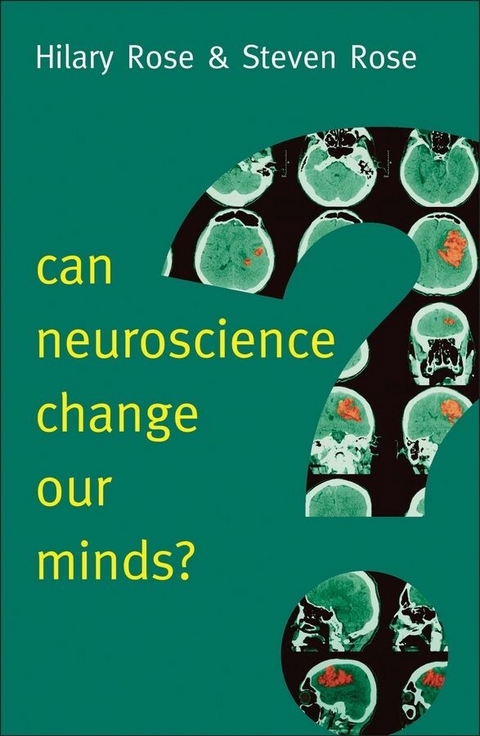
Can Neuroscience Change Our Minds? (eBook)
John Wiley & Sons (Verlag)
978-0-7456-8935-7 (ISBN)
Leading critic of such neuropretensions, neuroscientist Steven Rose and sociologist of science Hilary Rose take a sceptical look at these claims and the science underlying them, sifting out the sensible from the snake oil. Examining the ways in which science is shaped by and shapes the political economy of neoliberalism, they argue that neuroscience on its own is not able to bear the weight of these hopes.
Hilary Rose is Emerita Professor of Social Policy at the University of Bradford. Together with Steven Rose, she is author of 'Genes, Cells and Brains' and 'Alas, Poor Darwin'.
Steven Rose is Emeritus Professor of Neuroscience at The Open University. He was co-founder of the British Neuroscience Association, and has won numerous prestigious awards, including the Biochemical Society medal for communication in science and the British Neuroscience Association's lifetime award for 'Outstanding contributions to neuroscience'.
Neuroscience, with its astounding new technologies, is uncovering the workings of the brain and with this perhaps the mind. The 'neuro' prefix spills out into every area of life, from neuroaesthetics to neuroeconomics, neurogastronomy and neuroeducation. With its promise to cure physical and social ills, government sees neuroscience as a tool to increase the 'mental capital' of the children of the deprived and workless. It sets aside intensifying poverty and inequality, instead claiming that basing children's rearing and education on brain science will transform both the child's and the nation's health and wealth. Leading critic of such neuropretensions, neuroscientist Steven Rose and sociologist of science Hilary Rose take a sceptical look at these claims and the science underlying them, sifting out the sensible from the snake oil. Examining the ways in which science is shaped by and shapes the political economy of neoliberalism, they argue that neuroscience on its own is not able to bear the weight of these hopes.
Hilary Rose is Emerita Professor of Social Policy at the University of Bradford. Together with Steven Rose, she is author of "Genes, Cells and Brains" and "Alas, Poor Darwin". Steven Rose is Emeritus Professor of Neuroscience at The Open University. He was co-founder of the British Neuroscience Association, and has won numerous prestigious awards, including the Biochemical Society medal for communication in science and the British Neuroscience Association's lifetime award for "Outstanding contributions to neuroscience".
Introduction
1 The Rise and Rise of the Neurosciences
2 The Neurosciences Go Mega
3 Early Intervention: Making the Most of Ourselves in the Twenty-First Century
4 Neuroscience Goes to School
Conclusion
"This book is a bold, forthright and courageous commentary on looming cultural trends?a true tour de force."
Scientific American
?An important corrective to the rise of neuroscientific ideas, and to the neoliberal ideology that spawned them.?
Counterfire
introduction
The proliferating prefix
How to understand the ever-proliferating neuro-prefix, attached to everything from new academic disciplines – neuroeconomics, neuromarketing, neuroethics, neuroaesthetics, neuropsychoanalysis – to the marketing of neuro-eticals such as the soda drinks NeuroBliss, NeuroPassion etc.? Neuro occupies more and more space within mainstream science; neuro research papers dominate the leading journals, Science and Nature. Specialist journals proliferate. Neuro books, from the academic to the popular, stream from the presses. One publishing house alone, the venerable Oxford University Press, has no less than 1,200 neuro titles in its list. They range from handbooks on the wiring patterns of the brain through philosophical reflections on the relations between brain, mind and consciousness, to self-help texts on brain optimization. Unsurprisingly, the press has not been left out of this neuro-feeding frenzy; one research study mapped the steady rise of newspaper articles on the brain in the UK's top three broadsheets and the top three tabloids between 2000 and 2010.1 The flow only slackened in 2008, when that year's near-cataclysmic banking crash briefly drove neuro from the pages. Brain optimization and brain pathologies, ranging from eating disorders to dementia, drew most of the journalists' interest. Neuro has gone into orbit and neuromania is all too often the order of the day.
Can neuroscience really change our minds? As a neuroscientist and a sociologist who share the view that neuroscience is dramatically increasing our understanding of the brain and also that science and society shape each other – that is, they are co-produced2 – we have written this book together to unpick the hope from the hype of these neuro-prefixes, arising, as they do, as part of today's neoliberal political economy. The hopes that the neurosciences offer equal, even surpass, those of genomics at the time of the launch of the Human Genome Project in 1990, but with one crucial difference. Then one of the world's leading molecular biologists, James Watson, claimed that ‘our fate lay in our genes’, thus only geneticists could offer hope through their molecular biology, their genetic manipulation and their bespoke drugs, and could save us from our destiny.3 The imaginary that they depicted left those outside the community of molecular biology as passive, waiting rescue. Despite the ideology of reductionism they share, the neurosciences' imaginary is radically different, claiming that their knowledge can empower us to remake our brains, and hence our minds and our very selves. Personal effort, guided by the neurosciences, can overcome the injuries of poverty and inequality. Plasticity, a property of the brain central to neuroscientific thinking for half a century, has become a quasi-magical term within public-policy discourse, offering an entirely new solution to problems of child development and poor educational performance, and heralded as the new elixir by the self-help manuals.
So is the answer to the question in the title of this book a simple ‘yes’? As we will show in the chapters that follow, things aren't quite that simple.
For neuroscientists, the brain is the last biological frontier. It is seen as the repository of learning, thinking, deciding, acting, feeling angry, afraid, loving, remembering, forgetting, even consciousness4 itself. Well funded, with €6 billion for just two Euro-American mega-projects, bolstered by an astonishing array of new technologies from the atomic to the systemic, and with research papers tumbling out in a seemingly inexhaustible torrent, it was almost inevitable that for most neuroscientists all doubts would vanish: the mind is the brain, the brain the mind. With this, the philosophical debate of centuries is simply bypassed.
Not everyone goes along with this, although an increasing corporatism in universities is hostile to dissent, and controversial ideas that might stir thought are unwelcome. With research money in short supply, only a handful of neuroscientists are willing to stick their heads above the parapet. More audible are the grumbles from psychiatry, although individuals who have vigorously entered public debate have encountered problems. British psychiatrist David Healy found his appointment to a senior position in a Canadian university blocked, following pressure from a pharmaceutical company, the efficacy of whose drug he had questioned.5 Philosophers are freer from the constraints of needing substantial research grants, and many, John Searle, Raymond Tallis and Mary Midgley among them, have mounted a vigorous public defence of the mind.
The co-production of neuroscience, society and the self
Scholars working in science and technology studies – for the most part sociologists, anthropologists, philosophers and historians – have observed the fusion of science and technology in genomics, informatics and the neurosciences, and renamed them technosciences. Genomics would be impossible without high-throughput sequencers, and neuroscience without its imagers, and neither without mega-powerful computers.6 The technosciences and today's neoliberal political economy are not separate entities: they are co-produced; the demands of the political economy shape the development of the technosciences, while in turn genomics and the neurosciences are powerful sources of innovation and hence provide the economic growth on which capitalism depends. What this structural account leaves out, however, is the agency of humans, both the technoscientists studying and manipulating life itself – from plants to animals, including the human animal – and the audiences and users of these new knowledges and technologies. The neuroscientists offer compelling imaginaries of how this new knowledge will help midwife new and hitherto undreamed of societies, while more mundanely their new understanding offers possibilities of manipulating the brain – from therapeutic interventions to new military neurotechnologies.
As so often with new technologies, humans modify their use for purposes other than were intended; as, for example, with the telephone, intended to make business more efficient but hijacked to facilitate social communication, call the family or speak to friends. The neurosciences offer similar possibilities. Anthropologist Rayna Rapp's ethnographic study7 describes the experience of children and young adults going through hi-tech procedures to diagnose neurological problems, such as those of dyslexia or Asperger's syndrome. She observed that some, particularly young adults with a common diagnosis, came together as biosocial groups, not in opposition to neuroscience but seizing it as a resource to support their claim to a different, not deficit, brain identity. Their emphasis on diversity not deficit has found support from among the neuroscientific and clinical communities, and together they are building a new concept of neurodiversity. No longer are normal and abnormal brains set against each other; instead neurodiversity locates the neurotypical as one (albeit the most numerous) among many different brains.
This biosocial concept of neurodiversity offers more open ways to think about identity. By contrast, others, such as the philosophers Fernando Ortega and Francisco Vidal, argue that we live in a neuroculture, and thus conceptualize the brain as the centre of the self, as ‘brainhood’.8 Such theories of individual self-making exclude biosociality and hence the possibility of a shared construction of neuro-identity – a philosophical move which tends to reinforce the reductionist ideology of neuroscience, so clearly expressed in the titles of Jean-Pierre Changeux's book Neuronal Man or Joseph LeDoux's Synaptic Self. Such titles ignore Rapp's reminder that ‘A child surrounds this brain.’ Can brainhood make space for an identity of resistance?
The technosciences in neoliberalism
Since the mid-1970s the social rights embedded in the welfare states of Western Europe have been steadily eroded, a process dramatically accelerated by the near meltdown of the banking system. (The US trajectory has been rather different, never having had a welfare state on the European model – think of Obama's ongoing battle to secure access to health care for the poor.) Europe now follows the US and welfare is increasingly targeted towards the poorest by means-testing, even though research has long demonstrated that it is expensive to administer, humiliating to the recipients, and often misses those in greatest need. In Britain, even the right of free access to the treasured NHS is under systematic attack, beginning with the denial of health care to refugees.
In economics, it's been goodbye Keynesianism and hello to Chicagoan, or neo-classical, economics, with its reliance on complex algorithms and huge computing power. This latter, beginning as a distinctly marginal approach, rapidly increased its influence as cracks began to appear in the long post-1945 boom, with confidence in the welfare state fast fading. Today, despite the 2008 crash, which triggered a brief turn to Keynesianism, Chicagoan economics rises like the phoenix from what has unquestionably been ashes for most. The market remains fetishized as the guarantor of efficiency, innovation, economic growth and wealth creation, despite the challenge of the Occupy movement with its attack on the banking system and...
| Erscheint lt. Verlag | 6.9.2016 |
|---|---|
| Reihe/Serie | New Human Frontiers |
| New Human Frontiers - Polity | New Human Frontiers - Polity |
| Sprache | englisch |
| Themenwelt | Geisteswissenschaften ► Philosophie ► Erkenntnistheorie / Wissenschaftstheorie |
| Geisteswissenschaften ► Psychologie ► Biopsychologie / Neurowissenschaften | |
| Medizin / Pharmazie ► Medizinische Fachgebiete ► Neurologie | |
| Naturwissenschaften ► Biologie ► Humanbiologie | |
| Naturwissenschaften ► Biologie ► Zoologie | |
| Sozialwissenschaften ► Soziologie | |
| Schlagworte | Bildungswesen • Biowissenschaften • brain • Brain Mapping • Brain science • darpa • Education • Lehrpläne / Naturwissenschaften • Lehrpläne / Naturwissenschaften • Life Sciences • neuroeducation • Neurological • Neuroscience • Neurowissenschaften • Science • Scientism • Sociology • Sociology of Science • Sociology of Science & Technology • Soziologie • Soziologie d. Naturwissenschaft u. Technik • STS |
| ISBN-10 | 0-7456-8935-3 / 0745689353 |
| ISBN-13 | 978-0-7456-8935-7 / 9780745689357 |
| Informationen gemäß Produktsicherheitsverordnung (GPSR) | |
| Haben Sie eine Frage zum Produkt? |
 EPUB (Adobe DRM)
Kopierschutz: Adobe-DRM
Adobe-DRM ist ein Kopierschutz, der das eBook vor Mißbrauch schützen soll. Dabei wird das eBook bereits beim Download auf Ihre persönliche Adobe-ID autorisiert. Lesen können Sie das eBook dann nur auf den Geräten, welche ebenfalls auf Ihre Adobe-ID registriert sind.
Details zum Adobe-DRM
Dateiformat: EPUB (Electronic Publication)
EPUB ist ein offener Standard für eBooks und eignet sich besonders zur Darstellung von Belletristik und Sachbüchern. Der Fließtext wird dynamisch an die Display- und Schriftgröße angepasst. Auch für mobile Lesegeräte ist EPUB daher gut geeignet.
Systemvoraussetzungen:
PC/Mac: Mit einem PC oder Mac können Sie dieses eBook lesen. Sie benötigen eine
eReader: Dieses eBook kann mit (fast) allen eBook-Readern gelesen werden. Mit dem amazon-Kindle ist es aber nicht kompatibel.
Smartphone/Tablet: Egal ob Apple oder Android, dieses eBook können Sie lesen. Sie benötigen eine
Geräteliste und zusätzliche Hinweise
Buying eBooks from abroad
For tax law reasons we can sell eBooks just within Germany and Switzerland. Regrettably we cannot fulfill eBook-orders from other countries.
aus dem Bereich