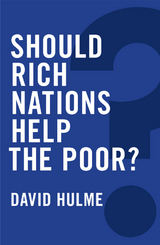
Should Rich Nations Help the Poor? (eBook)
John Wiley & Sons (Verlag)
978-0-7456-8609-7 (ISBN)
But should rich nations continue to help the poor? In this short book, leading global poverty analyst David Hulme explains why helping the world's neediest communities is both the right thing to do and the wise thing to do Ð if rich nations want to take care of their own citizens' future welfare.
The real question is how best to provide this help. The way forward, Hulme argues, is not conventional foreign aid but trade, finance and environmental policy reform. But this must happen alongside a change in international social norms so that we all recognise the collective benefits of a poverty-free world.
David Hulme is Professor of Development Studies at The University of Manchester where he is Director of the Brooks World Poverty Institute and CEO of the Effective States and Inclusive Development Research Centre
In the past decade, the developed world has spent almost US$ 2 trillion on foreign aid for poorer countries. Yet 1.2 billion people still live in extreme poverty and around 2.9 billion cannot meet their basic human needs. But should rich nations continue to help the poor? In this short book, leading global poverty analyst David Hulme explains why helping the world s neediest communities is both the right thing to do and the wise thing to do if rich nations want to take care of their own citizens future welfare. The real question is how best to provide this help. The way forward, Hulme argues, is not conventional foreign aid but trade, finance and environmental policy reform. But this must happen alongside a change in international social norms so that we all recognise the collective benefits of a poverty-free world.
David Hulme is Professor of Development Studies at The University of Manchester where he is Director of the Brooks World Poverty Institute and CEO of the Effective States and Inclusive Development Research Centre
Acknowledgements
1 Why Worry About the Distant Poor?
2 The Limits of Foreign Aid
3 What Can Be Done?
4 Climate Change and Inequality
5 From Broken Promises to Global Partnership
Further Reading
'David Hulme's is a passionate and personal yet professional plea for attacking poverty rather than trying to stop bodies washing ashore in the Mediterranean. We can still argue about definitions of poverty and the value of charity, but it is no longer possible in our interconnected planet to deny the self-interests of the wealthy West in addressing pandemics, narco-trafficking, climate deterioration, and terrorism. Read why things have to change.'
Thomas G. Weiss, The Graduate Center, CUNY
"The impulse to assist poor people in poorer countries appears weaker than it has at any time in the recent past. In this slim volume, David Hulme presents the case in support of global connectedness (albeit with some reforms and course corrections) and reinforcing foreign aid (but with significant modifications). This persuasive polemic, smoothly flowing and accessibly presented, is well worth a read. The essential humanity that permeates the narrative is uplifting."
Anirudh Krishna, Duke University
"Hulme addresses this complex topic with clarity and provides a platform for further discussion about future development initiatives. The book is therefore a good resource for development practitioners, planners and policymakers."
Environment and Urbanization
1
Why Worry About the Distant Poor?
Rich nations, and their citizens, are increasingly experiencing the consequences of living in a very unequal world. Much of this is to their advantage: cheap garden furniture from China, fashionable, low-cost clothing from Bangladesh and affordable petrol. But there is also a downside. Holidaymakers from Northern Europe are keeping away from some Mediterranean beaches as it spoils your fun when the bodies of refugees wash up. There are deep tensions in mainland Europe about the growing flows of migrants and refugees. These stretch from the west, where Britain and France have been at loggerheads about migrant camps around Calais, to the east, where EU and non-EU countries are erecting new iron curtains. Meanwhile, the last time I travelled from Mexico to the US, the queue to pass through the Tijuana border control snaked back more than a mile. Having so much poverty and inequality in an affluent world means that rich nations and their citizens have no choice but to think through how they relate to the distant poor.
Extreme poverty has reduced greatly in recent years, but poverty is a long way from eradication. Almost 3 billion people are deprived of at least one basic human need: lack of access to food, drinking water, shelter, basic health services, not to mention education – and dignity. Some 800 million people went to sleep hungry last night, and one billion experienced the indignity of having to defecate in the open. Even more shocking, 19,000 children will die today of easily preventable causes: one unnecessary child death every five seconds all day every day.
Our grandparents, and perhaps our parents, could accept such conditions. They believed that there were just not enough resources (and technology and organization) to provide for every human being. But we cannot use this excuse today – we live in an affluent world. Our agricultural systems produce enough food to feed all 7 billion of us. Low-cost medicines, basic health services and simple health practices (washing hands after using the toilet and sleeping under a mosquito net) would save millions of human lives every year. A reallocation of a mere 1% of global income to the poorest would entirely eradicate US$1.90-a-day income poverty.1
How is it that avoidable human suffering and preventable deaths occur on such a vast scale after 25 years of unprecedented global economic wealth creation? Newspaper headlines and media coverage create the impression that extreme poverty and destitution are caused by emergencies and disasters. These are both man-made and natural, ranging from violent conflict in Syria to hurricanes in the Caribbean, floods in Africa and earthquakes in Asia. But these humanitarian crises are only a part of the story. More thoughtful analyses find that the main causes are grounded in less dramatic, more mundane processes: low wages; lack of access to productivity-enhancing agricultural technologies; indebtedness to moneylenders; the profit margins and business models that corporations pursue; the investment decisions (and bonuses) that bankers take; poor-quality basic services; and the public policies that governments select and implement – or fail to implement.
From an early age I understood that there were very different ideas about how rich nations and better-off people could try to help poor people in faraway places. In the mid-1960s, from the relative comfort of a council house near Liverpool, my parents had very different responses when the BBC reported that India ‘faced famine’. My mother thought the UK government ‘should send them food’: if people were starving, then others with food should spare them some. By contrast, my father thought ‘they should all be sterilized’. The Indian government should do this, and should not be over-concerned about whether sterilization was voluntary. The UK government could assist the Indian authorities with finance and medical expertise. ‘Over-population’, not access to food, was the underlying problem.
Fifty years later, such contrasting positions are still argued out – not by my parents, but in the media. Charity fundraising advertisements on television encourage donations for poor children in poor countries. The BBC’s Children in Need programme goes beyond this focus on charity. It also reports on successful UK government aid projects that help girls complete primary and secondary schooling across Asia and avoid female genital mutilation in Africa. The message is clear: relatively small amounts of money can make a big difference at household and community levels. Less clear, but implicitly: isn’t it your moral duty (and your government’s) to help those who are poor? A contrasting position comes from the right-wing news media like Fox News in the US and the Daily Mail in the UK. These present aid programmes as inefficient and highlight that corruption in recipient countries means that aid money is ‘wasted’. Explicitly, they argue there is next to nothing that better-off outsiders can do to help poor people in poor countries beyond humanitarian work. Implicitly, they suggest that it is ‘not our job’ to provide help. Poor countries and poor people need to sort themselves out.
In this book I explore these contrasting viewpoints and ask: ‘Should rich nations help the poor?’ I argue that rich nations should help the governments and people of poor countries to achieve prosperity and human development. But the argument goes further: those of us who are ‘better-off’ would be stupid not to help the poor. Not only is this the morally right thing to do, but the pursuit of self-interest, indeed the future well-being of rich world citizens (our children and grandchildren), requires that we help poor people in faraway lands.
Migration, the focus of the opening paragraph, is not the only issue that makes global poverty and inequality topical in rich countries. The Ebola virus illustrates this vividly. In 2014, Ebola caused devastation across parts of West Africa, and health authorities across Europe, North America, China and Japan made detailed plans about how they would respond to the arrival of the disease – especially if the nightmare scenario occurred and it mutated into airborne transmission. But the rich world’s response to West Africa’s problem was tardy. This disease has been known about for decades, but research on medicines to prevent or treat it has been very limited: it only kills poor Africans, so who would pay for research? A similarly sluggish response to an emerging health problem in Africa 30 years ago permitted HIV/AIDS to become a global pandemic, killing millions in Europe, the US and other rich countries. And now we have the Zika virus.
Have we learned nothing? On a small, densely populated, highly connected planet a problem in a faraway place can soon become a problem anywhere. Unexpected population movements and health are not the only examples of our interconnectedness. Desperately poor people in Latin America opt to grow and/or transport cocaine to the US as the economic opportunities they have offer few alternatives. As a result, large parts of Central America have been destabilized and the chains of narco-violence spill over into US cities. In the Middle East, religious ideologies take root that legitimate violence and terrorism at home and abroad. The question we need to ask is not simply ‘Should rich nations help the poor?’ but ‘What are the best ways for rich nations to help the poor?’
Why things have to change
There are three main reasons why rich country support for the distant poor cannot go on the way it is today. First, it is not working: the underpinning idea that a set of developed countries can help a set of developing countries to ‘catch up’ is now untenable. Countries that were once classed as developing – Chile, Mexico and South Korea – are now members of the OECD, the club of rich nations. A whole set of others are holding talks about joining the OECD (Colombia, Costa Rica, Malaysia and Peru). Brazil, China and India are all recognized as emerging powers and have been running their own aid programmes (being donors) at the same time as they have been recipients of aid. The world is a complex multi-polar mosaic and not a Global North that needs to help a Global South.
Second, the idea that development can be achieved largely through foreign aid (government-to-government financial transfers) has been discredited. Countries that have experienced significant improvements in the well-being of their population in recent years have achieved this through engaging with markets/international trade and selectively participating in a set of processes commonly described as ‘globalization’. Interactions between the civil societies of different countries (the women’s movement, the environment movement, development and human rights NGOs, faith-based organizations, diaspora communities, etc.) have been an important part of these processes. Nation states remain crucial, but their role is at least as much about enabling development as about delivering development. By contrast, countries that have made little development progress often have high levels of political instability and/or violent conflict. These are commonly referred to as ‘fragile states’. In such circumstances the role of rich countries is about working out how to support domestic...
| Erscheint lt. Verlag | 7.9.2016 |
|---|---|
| Reihe/Serie | Global Futures |
| Global Futures | Global Futures |
| Sprache | englisch |
| Themenwelt | Kunst / Musik / Theater ► Kunstgeschichte / Kunststile |
| Geisteswissenschaften ► Philosophie ► Allgemeines / Lexika | |
| Geisteswissenschaften ► Philosophie ► Ethik | |
| Sozialwissenschaften ► Politik / Verwaltung ► Politische Theorie | |
| Wirtschaft ► Volkswirtschaftslehre | |
| Schlagworte | Art & Applied Arts • Design-Geschichte u. -Theorie • Design History & Theory • Development • Development Policy • Development Studies • Entwicklungsforschung • Entwicklungspolitik • Entwicklungspolitische Strategien • Foreign Aid • growth • Humanitarian aid • Hunger • international aid • International Development • International Trade • Kunst u. Angewandte Kunst • mgd • Millennium Development Goals • Philosophie • Philosophie i. d. Technik • Philosophy • Philosophy of Technology • Politics • Poverty • Third World Debt • World Poverty |
| ISBN-10 | 0-7456-8609-5 / 0745686095 |
| ISBN-13 | 978-0-7456-8609-7 / 9780745686097 |
| Informationen gemäß Produktsicherheitsverordnung (GPSR) | |
| Haben Sie eine Frage zum Produkt? |
 EPUB (Adobe DRM)
Kopierschutz: Adobe-DRM
Adobe-DRM ist ein Kopierschutz, der das eBook vor Mißbrauch schützen soll. Dabei wird das eBook bereits beim Download auf Ihre persönliche Adobe-ID autorisiert. Lesen können Sie das eBook dann nur auf den Geräten, welche ebenfalls auf Ihre Adobe-ID registriert sind.
Details zum Adobe-DRM
Dateiformat: EPUB (Electronic Publication)
EPUB ist ein offener Standard für eBooks und eignet sich besonders zur Darstellung von Belletristik und Sachbüchern. Der Fließtext wird dynamisch an die Display- und Schriftgröße angepasst. Auch für mobile Lesegeräte ist EPUB daher gut geeignet.
Systemvoraussetzungen:
PC/Mac: Mit einem PC oder Mac können Sie dieses eBook lesen. Sie benötigen eine
eReader: Dieses eBook kann mit (fast) allen eBook-Readern gelesen werden. Mit dem amazon-Kindle ist es aber nicht kompatibel.
Smartphone/Tablet: Egal ob Apple oder Android, dieses eBook können Sie lesen. Sie benötigen eine
Geräteliste und zusätzliche Hinweise
Buying eBooks from abroad
For tax law reasons we can sell eBooks just within Germany and Switzerland. Regrettably we cannot fulfill eBook-orders from other countries.
aus dem Bereich