


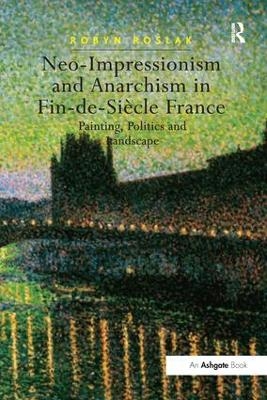
Neo-Impressionism and Anarchism in Fin-de-Siècle France
Painting, Politics and Landscape
Seiten
2016
Routledge (Verlag)
978-1-138-24839-7 (ISBN)
Routledge (Verlag)
978-1-138-24839-7 (ISBN)
In Neo-Impressionism and Anarchism in Fin-de-Siècle France, Robyn Roslak examines for the first time the close relationship between neo-impressionist landscapes and cityscapes and the anarchist sympathies of the movement's artists. She focuses in particular on paintings produced between 1886 and 1905 by Paul Signac and Maximilien Luce, the neo-impressionists whose fidelity to anarchism, to the art of landscape and to a belief in the social potential of art was strongest. Although the neo-impressionists are best known for their rational and scientific technique, they also heeded the era's call for art surpassing the mundane realities of everyday life. By tempering their modern subjects with a decorative style, they hoped to lead their viewers toward moral and social improvement. Roslak's ground-breaking analysis shows how the anarchist theories of Elisée Reclus, Pierre Kropotkin and Jean Grave both inspired and coincided with these ideals. Anarchism attracted the neo-impressionists because its standards for social justice were grounded, like neo-impressionism itself, in scientific exactitude and aesthetic idealism. Anarchists claimed humanity would reach its highest level of social and moral development only in the presence of a decorative variety of nature, and called upon progressive thinkers to help create and maintain such environments. The neo-impressionists, who primarily painted decorative landscapes, therefore discovered in anarchism a political theory consistent with their belief that decorative harmony should be the basis for socially responsible art.
Robyn Roslak is Associate Professor of Art History at the University of Minnesota, Duluth, USA.
Contents: Introduction; Neo-impressionism, anarchism and the 'republic of science and reason'; Anarchists, artists and artisans; Representing Paris: streets, bridges and petits boulevards; Anarchist geography and the idea of landscape; 'Dirty and radiant, depressing and cheerful:' the neo-impressionist suburbs; Anarchists and tourists in Provence; Conclusion: looking forward, looking back: neo-impressionism around 1900; Bibliography; Index.
| Erscheinungsdatum | 07.09.2016 |
|---|---|
| Verlagsort | London |
| Sprache | englisch |
| Maße | 156 x 234 mm |
| Gewicht | 430 g |
| Themenwelt | Kunst / Musik / Theater ► Kunstgeschichte / Kunststile |
| Kunst / Musik / Theater ► Malerei / Plastik | |
| Schulbuch / Wörterbuch ► Wörterbuch / Fremdsprachen | |
| Geschichte ► Allgemeine Geschichte ► Neuzeit (bis 1918) | |
| Geschichte ► Teilgebiete der Geschichte ► Kulturgeschichte | |
| Geisteswissenschaften ► Philosophie | |
| Sozialwissenschaften ► Politik / Verwaltung ► Politische Systeme | |
| ISBN-10 | 1-138-24839-8 / 1138248398 |
| ISBN-13 | 978-1-138-24839-7 / 9781138248397 |
| Zustand | Neuware |
| Informationen gemäß Produktsicherheitsverordnung (GPSR) | |
| Haben Sie eine Frage zum Produkt? |
Mehr entdecken
aus dem Bereich

aus dem Bereich
Geschichte einer wilden Handlung
Buch | Hardcover (2024)
C.H.Beck (Verlag)
CHF 47,60


