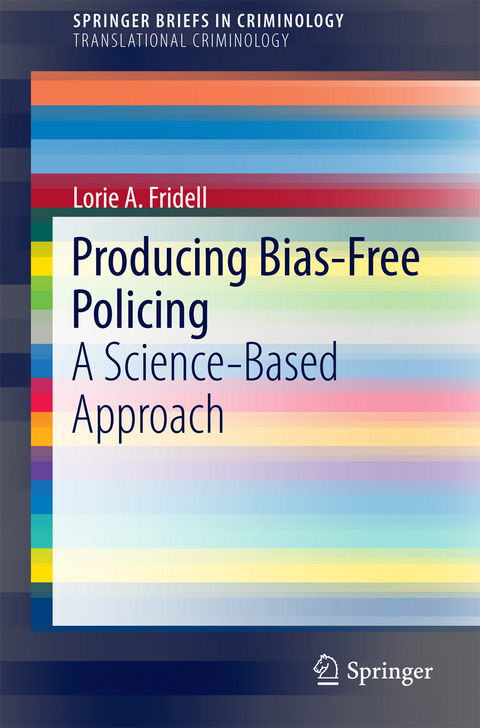
Producing Bias-Free Policing (eBook)
117 Seiten
Springer International Publishing (Verlag)
978-3-319-33175-1 (ISBN)
Dr. Lorie Fridell is an Associate Professor and Graduate Director in the Department of Criminology at the University of South Florida (USF) in Tampa. Prior to joining USF in August of 2005, she served for six years as the Director of Research at the Police Executive Research Forum (PERF) in Washington, D.C. Dr. Fridell has over 25 years of experience conducting research on law enforcement. Her primary research areas are police use of force and violence against police. Dr. Fridell is a national expert on biased policing. She speaks nationally on this topic and provides consultation and training to law enforcement agencies. Publications on this topic include two books: Racially Biased Policing: A Principled Response and By the Numbers: A Guide for Analyzing Race Data From Vehicle Stop (and the companion guide, Understanding Race Data From Vehicle Stops: A Stakeholder’s Guide.) A recent chapter is and “Racially Biased Policing: The Law Enforcement Response to the Implicit Black-Crime Association.” Dr. Fridell developed the science-based “Fair and Impartial Policing perspective.” With national experts on the psychology of bias and funding from the US Department of Justice, she has developed five Fair and Impartial Policing training programs for police personnel.
Acknowledgements 6
Contents 7
About the Author 9
1 Introduction 10
2 The Science of Implicit Bias and Implications for Policing 15
The Science of Bias 15
The Characteristics of Implicit Bias 15
Research on Implicit Biases Related to Crime and Aggressiveness 18
Does Neighborhood Context Matter? 22
Evidence of Implicit Biases in Police Subjects 22
Implicit Bias and the Police Profession 24
Reducing and Managing Biases 30
Reducing Biases 31
Contact Theory 31
Exposure to Counterstereotypes 32
Stereotype-Disconfirming Information and Cultural Sensitivity Training 33
Blurring the Lines and Perspective Taking 34
Managing Biases Through Self-regulation 35
Conclusion 37
3 A Comprehensive Program to Produce Fair and Impartial Policing 39
The Leadership Message 40
Agency Policy 41
Policy Models Defining Biased Policing 42
Other Policy Considerations 48
Title 48
List of Demographics 49
Behaviors/Actions Encompassed 49
Enforcement Provisions 50
Staying Focused 51
Personnel Knowledge of Policy Content 52
Recruitment, Hiring, and Promotions 53
Recruiting/Hiring Individuals Who Represent the Diversity of the Community 53
Hire People Who Can Police in an Unbiased Fashion 57
Guard Against Implicit Biases in Managerial Decisions 59
Problems 59
Solutions 61
Training 62
Use-of-Force Training 64
Supervision 67
Accountability Measures to Promote Bias-Free Policing 70
Measurement 73
The History and Role of Measurement 73
Vehicle Stop Data Collection: Assessing Who Is Stopped 75
Geographic Units of Analysis to Assess Police Bias 76
Searches 77
Making Decisions About Measurement 78
Outreach to Diverse Communities 80
Programs and Practices Directed at Youths 84
Contact Theory Revisited 86
Measuring Community Outreach 87
Operations to Promote Bias-Free Policing and the Perceptions of it 88
Take Seriously Community Complaints of Operational Bias 89
Reduce the Risk of Bias in High-Discretion, Crime-Control-Focused Activities 91
Adopt Policing Models that Promote Bias-Free Policing and the Perceptions of it 93
Procedural Justice 94
“Guardian Versus Warrior” Mentality in Policing 95
Abusive Policing 96
Avoid Profiling by Proxy 98
Transforming the Richmond (CA) Police Department 101
4 The Way Ahead 103
Next Steps for Agency Leaders 104
Next Steps for Researchers 107
Concluding Remarks 109
References 111
Index 125
| Erscheint lt. Verlag | 3.8.2016 |
|---|---|
| Reihe/Serie | SpringerBriefs in Criminology |
| SpringerBriefs in Criminology | |
| SpringerBriefs in Translational Criminology | SpringerBriefs in Translational Criminology |
| Zusatzinfo | IX, 117 p. 1 illus. |
| Verlagsort | Cham |
| Sprache | englisch |
| Themenwelt | Recht / Steuern ► Strafrecht |
| Sozialwissenschaften ► Politik / Verwaltung | |
| Schlagworte | Biased Policing • Community Policing • Implicit Bias • Police Ethics • Police Studies • racial profiling |
| ISBN-10 | 3-319-33175-2 / 3319331752 |
| ISBN-13 | 978-3-319-33175-1 / 9783319331751 |
| Informationen gemäß Produktsicherheitsverordnung (GPSR) | |
| Haben Sie eine Frage zum Produkt? |
 PDF (Wasserzeichen)
DRM: Digitales Wasserzeichen
Dieses eBook enthält ein digitales Wasserzeichen und ist damit für Sie personalisiert. Bei einer missbräuchlichen Weitergabe des eBooks an Dritte ist eine Rückverfolgung an die Quelle möglich.
Dateiformat: PDF (Portable Document Format)
Mit einem festen Seitenlayout eignet sich die PDF besonders für Fachbücher mit Spalten, Tabellen und Abbildungen. Eine PDF kann auf fast allen Geräten angezeigt werden, ist aber für kleine Displays (Smartphone, eReader) nur eingeschränkt geeignet.
Systemvoraussetzungen:
PC/Mac: Mit einem PC oder Mac können Sie dieses eBook lesen. Sie benötigen dafür einen PDF-Viewer - z.B. den Adobe Reader oder Adobe Digital Editions.
eReader: Dieses eBook kann mit (fast) allen eBook-Readern gelesen werden. Mit dem amazon-Kindle ist es aber nicht kompatibel.
Smartphone/Tablet: Egal ob Apple oder Android, dieses eBook können Sie lesen. Sie benötigen dafür einen PDF-Viewer - z.B. die kostenlose Adobe Digital Editions-App.
Buying eBooks from abroad
For tax law reasons we can sell eBooks just within Germany and Switzerland. Regrettably we cannot fulfill eBook-orders from other countries.
aus dem Bereich