


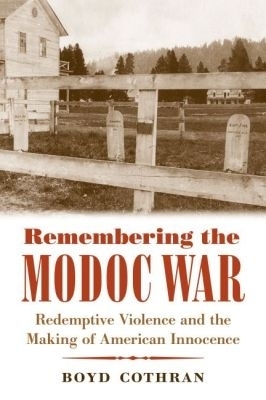
Remembering the Modoc War
Redemptive Violence and the Making of American Innocence
Seiten
2017
The University of North Carolina Press (Verlag)
978-1-4696-3334-3 (ISBN)
The University of North Carolina Press (Verlag)
978-1-4696-3334-3 (ISBN)
On October 3, 1873, the US Army hanged four Modoc headmen at Oregon's Fort Klamath. The condemned had supposedly murdered the only US Army general to die during the Indian wars of the nineteenth century. Their execution marked the end of the Modoc War of 1872-73. But as Boyd Cothran demonstrates, the conflict's close marked the beginning of a new struggle over the memory of the war.
On October 3, 1873, the U.S. Army hanged four Modoc headmen at Oregon's Fort Klamath. The condemned had supposedly murdered the only U.S. Army general to die during the Indian wars of the nineteenth century. Their much-anticipated execution marked the end of the Modoc War of 1872–73. But as Boyd Cothran demonstrates, the conflict's close marked the beginning of a new struggle over the memory of the war. Examining representations of the Modoc War in the context of rapidly expanding cultural and commercial marketplaces, Cothran shows how settlers created and sold narratives of the conflict that blamed the Modocs. These stories portrayed Indigenous people as the instigators of violence and white Americans as innocent victims.
Cothran examines the production and circulation of these narratives, from sensationalized published histories and staged lectures featuring Modoc survivors of the war to commemorations and promotional efforts to sell newly opened Indian lands to settlers. As Cothran argues, these narratives of American innocence justified not only violence against Indians in the settlement of the West but also the broader process of U.S. territorial and imperial expansion.
On October 3, 1873, the U.S. Army hanged four Modoc headmen at Oregon's Fort Klamath. The condemned had supposedly murdered the only U.S. Army general to die during the Indian wars of the nineteenth century. Their much-anticipated execution marked the end of the Modoc War of 1872–73. But as Boyd Cothran demonstrates, the conflict's close marked the beginning of a new struggle over the memory of the war. Examining representations of the Modoc War in the context of rapidly expanding cultural and commercial marketplaces, Cothran shows how settlers created and sold narratives of the conflict that blamed the Modocs. These stories portrayed Indigenous people as the instigators of violence and white Americans as innocent victims.
Cothran examines the production and circulation of these narratives, from sensationalized published histories and staged lectures featuring Modoc survivors of the war to commemorations and promotional efforts to sell newly opened Indian lands to settlers. As Cothran argues, these narratives of American innocence justified not only violence against Indians in the settlement of the West but also the broader process of U.S. territorial and imperial expansion.
Boyd Cothran is assistant professor of history at York University.
| Erscheinungsdatum | 18.01.2017 |
|---|---|
| Zusatzinfo | 20 - 20 halftones, 2 maps |
| Verlagsort | Chapel Hill |
| Sprache | englisch |
| Maße | 165 x 236 mm |
| Gewicht | 380 g |
| Themenwelt | Sachbuch/Ratgeber ► Geschichte / Politik ► Allgemeines / Lexika |
| Geschichte ► Allgemeine Geschichte ► Neuzeit (bis 1918) | |
| Geisteswissenschaften ► Geschichte ► Regional- / Ländergeschichte | |
| Geschichte ► Teilgebiete der Geschichte ► Kulturgeschichte | |
| Geschichte ► Teilgebiete der Geschichte ► Militärgeschichte | |
| Sozialwissenschaften ► Soziologie | |
| ISBN-10 | 1-4696-3334-5 / 1469633345 |
| ISBN-13 | 978-1-4696-3334-3 / 9781469633343 |
| Zustand | Neuware |
| Informationen gemäß Produktsicherheitsverordnung (GPSR) | |
| Haben Sie eine Frage zum Produkt? |
Mehr entdecken
aus dem Bereich
aus dem Bereich
Geschichte einer wilden Handlung
Buch | Hardcover (2024)
C.H.Beck (Verlag)
CHF 47,60


