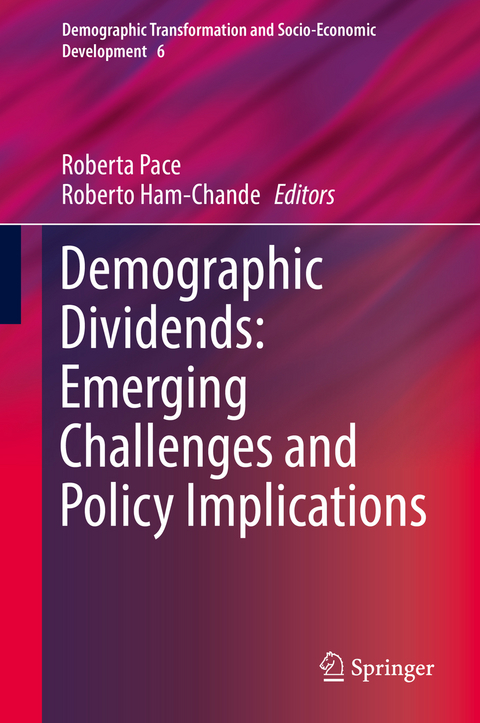
Demographic Dividends: Emerging Challenges and Policy Implications (eBook)
XI, 184 Seiten
Springer International Publishing (Verlag)
978-3-319-32709-9 (ISBN)
Introduction : Roberto Roberta Pace and Ham-Chande.- The Common Link between Policies Conducive to both Demographic Dividend and Fertility Transition: Anrudh K. Jain.- Population Ageing, Demographic Dividend and Gender Dividend: Assessing the Long Term Impact of Gender Equality on Economic Growth and Development in Latin America: Tim Miller, Paulo Saad and Ciro Martínez.- Demographic Dividends and Household Saving in Mexico: Isalia Nava-Bolaños and Roberto Ham-Chande.- Demographic Transition in Sub-Saharan Africa: Implications for Demographic Dividend: Yoonjoung Choi.- Age-Structural Transition and Demographic Windows around the Mediterranean: Maria Carella and Alain Parant.- The Potential Collateral Demographic Dividend: Natalie Jackson.- Beyond the Demographic Dividend: Demographic Transitions and Empirical Evidence in Italy: Roberta Pace and Nadia Mignolli.
| Erscheint lt. Verlag | 29.7.2016 |
|---|---|
| Reihe/Serie | Demographic Transformation and Socio-Economic Development | Demographic Transformation and Socio-Economic Development |
| Zusatzinfo | XI, 184 p. 77 illus. |
| Verlagsort | Cham |
| Sprache | englisch |
| Themenwelt | Sozialwissenschaften ► Politik / Verwaltung |
| Sozialwissenschaften ► Soziologie ► Spezielle Soziologien | |
| Schlagworte | Active population -workforce • Demographic dividend analysis • Different territorial contexts • Families well-being • Investment in economic development • Typologies of demographic dividend |
| ISBN-10 | 3-319-32709-7 / 3319327097 |
| ISBN-13 | 978-3-319-32709-9 / 9783319327099 |
| Informationen gemäß Produktsicherheitsverordnung (GPSR) | |
| Haben Sie eine Frage zum Produkt? |
 PDF (Wasserzeichen)
DRM: Digitales Wasserzeichen
Dieses eBook enthält ein digitales Wasserzeichen und ist damit für Sie personalisiert. Bei einer missbräuchlichen Weitergabe des eBooks an Dritte ist eine Rückverfolgung an die Quelle möglich.
Dateiformat: PDF (Portable Document Format)
Mit einem festen Seitenlayout eignet sich die PDF besonders für Fachbücher mit Spalten, Tabellen und Abbildungen. Eine PDF kann auf fast allen Geräten angezeigt werden, ist aber für kleine Displays (Smartphone, eReader) nur eingeschränkt geeignet.
Systemvoraussetzungen:
PC/Mac: Mit einem PC oder Mac können Sie dieses eBook lesen. Sie benötigen dafür einen PDF-Viewer - z.B. den Adobe Reader oder Adobe Digital Editions.
eReader: Dieses eBook kann mit (fast) allen eBook-Readern gelesen werden. Mit dem amazon-Kindle ist es aber nicht kompatibel.
Smartphone/Tablet: Egal ob Apple oder Android, dieses eBook können Sie lesen. Sie benötigen dafür einen PDF-Viewer - z.B. die kostenlose Adobe Digital Editions-App.
Buying eBooks from abroad
For tax law reasons we can sell eBooks just within Germany and Switzerland. Regrettably we cannot fulfill eBook-orders from other countries.
aus dem Bereich