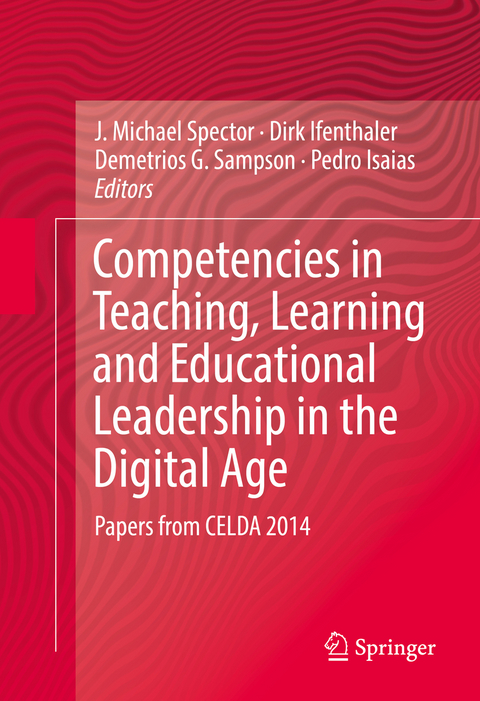
Competencies in Teaching, Learning and Educational Leadership in the Digital Age (eBook)
363 Seiten
Springer International Publishing (Verlag)
978-3-319-30295-9 (ISBN)
J. Michael Spector is Professor of Learning Technologies in the College of Information at the University of North Texas, and is editor of Educational Technology Research & Development. Dr. Spector served on the International Board of Standards for Training, Performance and Instruction (IBSTPI) as Executive Vice President; he is on the Executive Committee of the IEEE Learning Technology Technical Committee and is Past-President of the Association for Educational and Communications Technology (AECT).
J. Michael Spector is Professor of Learning Technologies in the College of Information at the University of North Texas, and is editor of Educational Technology Research & Development. Dr. Spector served on the International Board of Standards for Training, Performance and Instruction (IBSTPI) as Executive Vice President; he is on the Executive Committee of the IEEE Learning Technology Technical Committee and is Past-President of the Association for Educational and Communications Technology (AECT).Dirk Ifenthaler is Chair and Professor for Learning, Design and Technology at University of Mannheim, Germany, Adjunct Professor at Deakin University, Australia and Affiliate Research Scholar at the University of Oklahoma, USA. Dirk Ifenthaler’s research focuses on the intersection of cognitive psychology, educational technology, learning science, data analytics, and computer science. His research outcomes include numerous co-authored books, book series, book chapters, journal articles, and international conference papers, as well as successful grant funding in Australia, Germany, and USA – see Dirk’s website for a full list of scholarly outcomes at www.ifenthaler.info. He is the Editor-in-Chief of the Springer journal Technology, Knowledge and Learning (www.springer.com/10758).Demetrios G. Sampson is a Research Professor of Learning Technologies at the School of Education, Curtin University, Perth, Australia. He is also affiliated with the Information Technologies Institute, Centre of Research and Technology - Hellas Greece, European Union. Previously, he has been a Professor of Digital Systems for Learning and Education at the Department of Digital Systems, University of Piraeus, Greece (2003-2015) and a Senior Researcher at the Informatics and Telematics Institute, Centre of Research and Technology - Hellas Greece (2000-2003). He is the Editor-in-Chief of the Educational Technology and Society Journal, a Senior Member of IEEE and a Golden Core Member of IEEE Computer Society.Pedro Isaias is an associate professor at the Universidade Aberta (Portuguese Open University) in Lisbon, Portugal, responsible for several courses and director of the master degree program in Management / MBA. Was director of master degree program in Electronic Commerce and Internet since its start in 2003 until July 2014. He is co-founder and president of IADIS – International Association for Development of the Information Society (http://iadisportal.org/ ), a scientific non-profit association. He holds a PhD in Information Management (in the specialty of information and decision systems) from the New University of Lisbon. He is leading editor of Interactive Technologies and Smart Education (ITSE) Journal (http://www.emeraldgrouppublishing.com/products/journals/journals.htm?id=itse ) from Emerald. Pedro Isaias is an Adjunct Professor at School of Information Systems – Curtin University, Australia.
Preface.- 1. Reflections on the Future of Instructional Design Research.- Part I. A Global Conversation about Competencies and Challenges for 21st Century.- 2. Competencies Challenges, and Changes: A U.S. Perspective on Preparing 21st Century Teachers and Leaders.- 3. Initiation and Implementation: Changes to Teacher Education in Ireland.- 4. Digital Learnings and Digital Teachers: Challenges, Changes and Competencies.- 5. Pre-service Teachers’ Perceptions of School Development.- Part II. Changing Learning and Instructional Paradigms.- 6. School Analytics: A Framework for Supporting School Complexity Leadership.- 7. Improving Content Area Reading Comprehension with 4-6th Grade Spanish ELLs Using Web-based Structure Strategy Instruction.- 8. Teachers’ Readiness, Understanding and Workload in Implementing School Based Assessment.- 9. Digital Storytelling: Emotions in Higher Education.- Part III. Assessments and Analytics for Teachers and Decision Makers.- 10. Addressing Standardized Testing Through a Novel Assessment Model.- 11. An EVS Clicker-based Assessment for Radical Transparency in Marking Criteria.- 12. Assessing the Level of Collaborative Writing in a Wiki-based Environment: A Case Study in Teacher Education.- 13. Student-centered Analytics for Postsecondary Education.- 14. Computational Thinking: Toward a Unifying Definition.- Part IV. Changing Tools and Learning Environments.- 15. Designing the Flipped Classroom in Higher Education.- 16. Design4Practice: Scenario for Improving Management Education.- 17. Informal Learning for Possible Science Selves.- 18. Project ‘Flappy Crab’: An Edugame for Music Learning.- 19. Educational App Creation for the Cathedral in Freiburg.- 20. An Approach to Designing and Implementing Intelligent Tutors in Immersive Virtual Environments.- 21. A Synthesizing Look Forward in Teaching, Learning and Educational Leadership in the Digital Age.- Index.
| Erscheint lt. Verlag | 26.7.2016 |
|---|---|
| Zusatzinfo | XXII, 363 p. 42 illus., 27 illus. in color. |
| Verlagsort | Cham |
| Sprache | englisch |
| Themenwelt | Geisteswissenschaften |
| Sozialwissenschaften ► Pädagogik ► Schulpädagogik / Grundschule | |
| Schlagworte | Educational technology • e-Learning Systems • E-Learning Systems and Environments • information and communications technologies • Learning and Instruction • Teachers and Technology • technology in the classroom |
| ISBN-10 | 3-319-30295-7 / 3319302957 |
| ISBN-13 | 978-3-319-30295-9 / 9783319302959 |
| Informationen gemäß Produktsicherheitsverordnung (GPSR) | |
| Haben Sie eine Frage zum Produkt? |
 PDF (Wasserzeichen)
DRM: Digitales Wasserzeichen
Dieses eBook enthält ein digitales Wasserzeichen und ist damit für Sie personalisiert. Bei einer missbräuchlichen Weitergabe des eBooks an Dritte ist eine Rückverfolgung an die Quelle möglich.
Dateiformat: PDF (Portable Document Format)
Mit einem festen Seitenlayout eignet sich die PDF besonders für Fachbücher mit Spalten, Tabellen und Abbildungen. Eine PDF kann auf fast allen Geräten angezeigt werden, ist aber für kleine Displays (Smartphone, eReader) nur eingeschränkt geeignet.
Systemvoraussetzungen:
PC/Mac: Mit einem PC oder Mac können Sie dieses eBook lesen. Sie benötigen dafür einen PDF-Viewer - z.B. den Adobe Reader oder Adobe Digital Editions.
eReader: Dieses eBook kann mit (fast) allen eBook-Readern gelesen werden. Mit dem amazon-Kindle ist es aber nicht kompatibel.
Smartphone/Tablet: Egal ob Apple oder Android, dieses eBook können Sie lesen. Sie benötigen dafür einen PDF-Viewer - z.B. die kostenlose Adobe Digital Editions-App.
Buying eBooks from abroad
For tax law reasons we can sell eBooks just within Germany and Switzerland. Regrettably we cannot fulfill eBook-orders from other countries.
aus dem Bereich