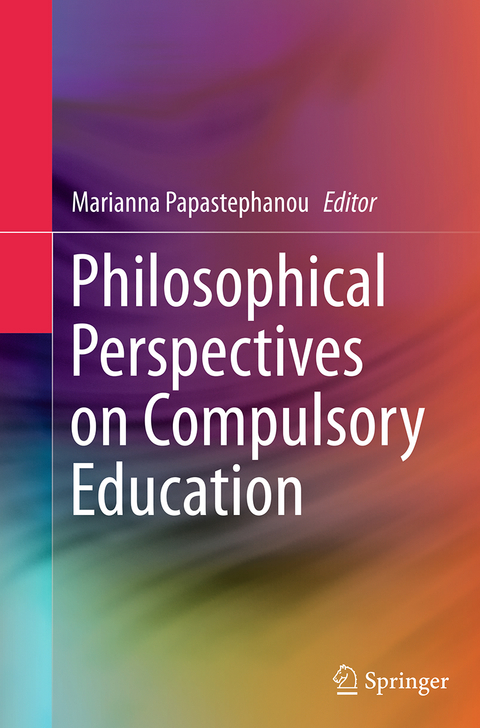
Philosophical Perspectives on Compulsory Education
Springer (Verlag)
978-94-024-0620-7 (ISBN)
From Luther down to John Stuart Mill and John Dewey, compulsory education has been heralded either as a vehicle of social coordination and individual well-being, or as a vehicle of democratization and progress, or as a means for protecting the rights of the young and of society, and so on and so forth. But there have also been periods of challenge and denaturalization of compulsory education, producing a range of interesting and spirited debates not only on matters of educational legality but also on matters that boil down to broader philosophical questions about the self and the world. Without neglecting the lasting significance of older debates, argumentation over schooling, its character and its scope can be recast in the light of current philosophical educational debates. Given the fact that failure adequately to mine such connections leads to a lack in philosophical-educational engagement with one of the most central pedagogical practices of the contemporary world, namely, the school, the book aspires to remedy this lack and to put together work that addresses those connections through the highly original and innovative work of its contributors. The subtext in all contributions is a vision of educational transformation in one way or other. All chapters (from the most theoretical to the most practice-related) promote a version of a recast or redirected compulsory schooling.
Marianna Papastephanou has studied and taught at the University of Cardiff, UK. She has also studied and researched in Berlin, Germany. She is currently teaching Philosophy of Education in the Department of Education at the University of Cyprus. Her research interests include political philosophy, the 'modern vs postmodern' divide, utopia, the Frankfurt School and epistemological, linguistic and ethical issues in education. She has written articles on the above topics, she is the editor of K-O Apel: From a Transcendental-Semiotic Point of View (Manchester: MUP, 1997), and the author of: Educated Fear and Educated Hope (Rotterdam, Sense Publishers, 2009); and Eccentric Cosmopolitanism and a Globalized World (Boulder, Paradigm, 2012).
Acknowledgements.- Editor’s Introduction.- Part One: The General, Theoretical Challenges.- Chapter One: Volker Kraft, ‘Constants of Education’.- Chapter Two: Robin Barrow, ‘Compulsory Common Schooling and Individual Difference’.- Chapter Three: Geoffrey Hinchliffe, ‘Education, Liberty and Authority: justifying compulsory education’.- Chapter Four: Kevin Williams, ‘Compulsion and Education as a Conversation: Are they compatible?’.- Chapter Five: Naoko Saito, ‘Compulsion without Coercion: liberal education through uncommon schooling’.- Chapter Six: Anders Schinkel, ‘On the justification of compulsory schooling’.- Part Two: The Many Faces of Challenges Confronting the Compulsory.- Chapter Seven: David Blacker, ‘Compulsory Education Cycles Down’.- Chapter Eight: Roni Aviram, ‘Is there hope for modern education systems in postmodern democracies?’.- Chapter Nine: Kevin Williams, ‘Conscripts or volunteers? The status of learners in faith schools’.- Chapter Ten: Helen Lees, ‘Is the idea ofcompulsory schooling ridiculous?’.- Chapter Eleven: Andrew Davis, ‘Homework: chronicles of wasted time?’.- Chapter Twelve: Amrita Zahir, ‘Understanding Transformation’.- Coda: Paul Gibbs, ‘Happiness and Education: Recognizing a fundamental attunement’.
| Erscheinungsdatum | 10.09.2016 |
|---|---|
| Zusatzinfo | 7 Illustrations, black and white; XII, 191 p. 7 illus. |
| Verlagsort | Dordrecht |
| Sprache | englisch |
| Maße | 155 x 235 mm |
| Themenwelt | Sozialwissenschaften ► Pädagogik ► Allgemeines / Lexika |
| Sozialwissenschaften ► Pädagogik ► Bildungstheorie | |
| ISBN-10 | 94-024-0620-4 / 9402406204 |
| ISBN-13 | 978-94-024-0620-7 / 9789402406207 |
| Zustand | Neuware |
| Informationen gemäß Produktsicherheitsverordnung (GPSR) | |
| Haben Sie eine Frage zum Produkt? |
aus dem Bereich