


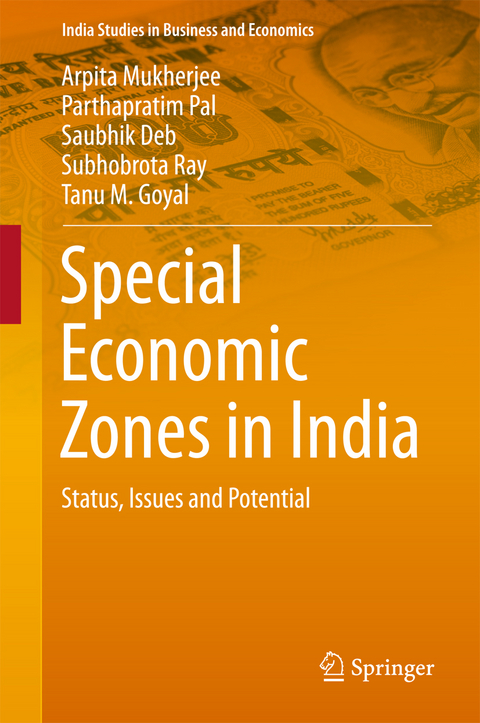
Special Economic Zones in India (eBook)
XXIX, 254 Seiten
Springer India (Verlag)
978-81-322-2806-6 (ISBN)
This book examines India's ten years of experience developing Special Economic Zones (SEZs) and the performance of SEZs in the context of India's growing international engagement, its endeavours to attract domestic and foreign investment in manufacturing and services and its aim to increase and diversify exports of goods and services. SEZs are industrial enclaves/clusters within a country that receive certain incentives and business facilitation benefits that are not generally available to the rest of the country. To facilitate private and foreign investment in SEZs, India introduced the SEZ policy in 2000, which was followed by the SEZ Act in 2005. After ten years under the Act, India now has one of the largest number of approved SEZs in the world and its SEZ policy remains heatedly debated, with a number of studies arguing both for and against it. Given this background, the book also identifies the challenges faced by SEZs in India and offers policy recommendations on how to make the SEZs an engine for India's economic growth and development that can more effectively link the country's manufacturing and services sectors to global value chains.
Dr. Arpita Mukherjee is a Professor at the Indian Council for Research on International Economic Relations (ICRIER). She has several years of experience in policy-oriented research, working closely with the government in India and policymakers in the EU, US, ASEAN and East Asian countries. She has conducted studies for various international organizations and Indian industrial associations. Her research is a key contributor to India’s negotiating strategies in the WTO and bilateral agreements. She has authored chapters in joint study group reports set up by the Indian government and has led research teams contributing to India’s domestic policy reforms in areas such as logistics, retail and special economic zones. Her research interests include trade and domestic reforms; the WTO; bilateral/regional agreements; retail; infrastructure; FDI; special economic zones; economic corridors and production networks; and migration. Dr Mukherjee has a PhD in Economics from the University of Portsmouth, UK. She has published widely and presented her research in various international and national forums.Dr. Parthapratim Pal is a Professor at the Indian Institute of Management (IIM) Calcutta. He has a Masters, MPhil and Ph.D. in Economics from the Center for Economic Studies and Planning of Jawaharlal Nehru University, New Delhi. Before joining the IIM, he worked with the Indian Council for Research in International Economic Relations (ICRIER), Economic Research Foundation (ERF) and the Indian Institute of Foreign Trade (IIFT). He has engaged in numerous consultancy and research projects for the Ministry of Commerce, Ministry of Agriculture, United Nations Development Programme (UNDP), WTO, UNCTAD and British High Commission. His recent areas of interest include international trade, regional trade agreements, WTO related issues and international capital flows. He has produced a number of publications in nationally and internationally reputed journals and books.Dr. Saubhik Deb is an economist and independent consultant, specialized in the evaluation of public sector programs and randomized controlled trials. He was an economist with the World Bank at Washington DC and worked on evaluations of various World Bank projects, country assistance programs and thematic evaluations in the areas of aid effectiveness, gender and development, global food crisis etc. He has also worked as external consultant for the ADB and ICRIER. He is currently working in the areas of development economics and open-economy macroeconomics and has published his work in various forums. Dr. Deb has a Ph.D. in Economics from Rutgers University, USA and M.A. and M.Phil. from Jawaharlal Nehru University, New Delhi.Subhobrota Ray is an economist and an independent consultant. Currently she is working on projects with ICRIER and CII. She has several years of research and project management experience with premier chambers of commerce (CII and Indian Chamber of Commerce) and economic research institutes (ICRIER). She has been involved in industry related research spanning a wide spectrum of sectors. She is a university rank holder with a post-graduate degree in Economics from Presidency College, Calcutta University, and has been awarded a First Prize - Presidential Award (1996) for a paper on “Vision of South Asia and How That Vision Should Be Realised” among participants from SAARC countries.Tanu M. Goyal is a Consultant at ICRIER. Her research interests include trade in services, foreign direct investment issues and retail. She has several years of research experience and has worked on projects for the Government of India, Asian Development Bank (ADB), and the European Commission (EC), among others. She has conducted an evaluation study for a cluster development scheme of the Indian Government and has extensive field experience and knowledge of Government’s policies on the topic. She has published several international and national journal articles, book chapters, reports and other popular media articles on policy and trade issues. She has a Masters degree in Economics with specialisation in the world economy from the Centre of Trade and Development (CITD), Jawaharlal Nehru University, New Delhi.
Introduction.- SEZs in Select Countries: A Comparison with India.- SEZs in India: Evolution, Policy Framework and Current Status.- Performance of SEZs.- Quality of the Business Environment: SEZs vs. DTAs.- Special SEZs for Services: India’s Experiences and the Way Forward.- SEZs and other Industrial Clusters: Why Incentives have not been Successful in Developing Manufacturing in India?.- SEZs in the Multilateral Trading System.- Special Economic Zones and Regional Trade Agreements.- Challenges Faced by SEZs in India and the Way Forward.
| Erscheint lt. Verlag | 14.7.2016 |
|---|---|
| Reihe/Serie | India Studies in Business and Economics | India Studies in Business and Economics |
| Zusatzinfo | XXIX, 254 p. 23 illus., 22 illus. in color. |
| Verlagsort | New Delhi |
| Sprache | englisch |
| Themenwelt | Sozialwissenschaften ► Politik / Verwaltung |
| Wirtschaft ► Betriebswirtschaft / Management ► Marketing / Vertrieb | |
| Wirtschaft ► Volkswirtschaftslehre ► Wirtschaftspolitik | |
| Schlagworte | Business environment • Economic Policy • India • SEZs • special economic zones • Trade • Trade and investment • Trade Policy |
| ISBN-10 | 81-322-2806-5 / 8132228065 |
| ISBN-13 | 978-81-322-2806-6 / 9788132228066 |
| Informationen gemäß Produktsicherheitsverordnung (GPSR) | |
| Haben Sie eine Frage zum Produkt? |
 PDF (Wasserzeichen)
DRM: Digitales Wasserzeichen
Dieses eBook enthält ein digitales Wasserzeichen und ist damit für Sie personalisiert. Bei einer missbräuchlichen Weitergabe des eBooks an Dritte ist eine Rückverfolgung an die Quelle möglich.
Dateiformat: PDF (Portable Document Format)
Mit einem festen Seitenlayout eignet sich die PDF besonders für Fachbücher mit Spalten, Tabellen und Abbildungen. Eine PDF kann auf fast allen Geräten angezeigt werden, ist aber für kleine Displays (Smartphone, eReader) nur eingeschränkt geeignet.
Systemvoraussetzungen:
PC/Mac: Mit einem PC oder Mac können Sie dieses eBook lesen. Sie benötigen dafür einen PDF-Viewer - z.B. den Adobe Reader oder Adobe Digital Editions.
eReader: Dieses eBook kann mit (fast) allen eBook-Readern gelesen werden. Mit dem amazon-Kindle ist es aber nicht kompatibel.
Smartphone/Tablet: Egal ob Apple oder Android, dieses eBook können Sie lesen. Sie benötigen dafür einen PDF-Viewer - z.B. die kostenlose Adobe Digital Editions-App.
Buying eBooks from abroad
For tax law reasons we can sell eBooks just within Germany and Switzerland. Regrettably we cannot fulfill eBook-orders from other countries.
aus dem Bereich


