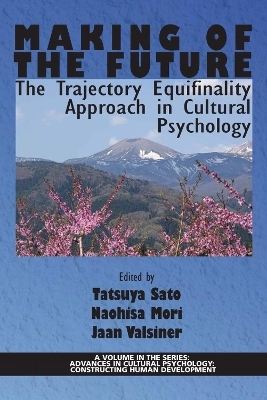
Making of the Future
Information Age Publishing (Verlag)
9781681235462 (ISBN)
Making of the Future is the first English-language coverage of the new methodological perspective in cultural psychology—TEA (Trajectory Equifinality Approach) that was established in 2004 as a collaboration of Japanese and American cultural psychologists. In the decade that follows it has become a guiding approach for cultural psychology all over the World. Its central feature is the reliance on irreversible time as the basis for understanding of cultural phenomena and the consideration of real and imaginary options in human life course as relevant for the construction of personal futures.
The book is expected to be of interest in researchers and practitioners in education, developmental and social psychology, developmental sociology and history. It has extensions for research methodology in the focus on different sampling strategies.
Tatsuya Sato, Ritsumeikan University. Naohisa Mori, Sapporo Gakuin University. Jaan Valsiner, Aalborg University
Introduction: From TEM to TEA: The Making of a New Approach; Tatsuya Sato.
Part I. Theoretical Roots and History of the Concept.
Chapter 1. Imagining the Past and Remembering the Future: How the Unreal Defines the Real; Tania Zittoun and Jaan Valsiner.
Chapter 2. The Trajectory Equifinality Model (TEM) as a General Tool for Understanding Human Life Course Within Irreversible Time; Tatsuya Sato and Hitomi Tanimura.
Chapter 3. Mapping Trajectories of Becoming a Psychologist; Katrin Kullasepp.
Part II. The Dynamics of Human Lives.
Chapter 4. How Can the Diversity of Human Lives Be Expressed Using TEM? Depicting the Experiences and Choices of Infertile Women Unable to Conceive After Infertility Treatment; Yuko Yasuda.
Chapter 5. Exploring the Transgenerational Transmission of Trauma in a Cultural Life Course Perspective; Nina Dalgaard and Pernille Hviid.
Chapter 6. Meaning Construction and Its Transformation in Narratives About Music With a Personal Meaning: Music Therapy in Group Counseling for Juvenile Delinquents; Kakuko Matsumoto.
Part III. TEM and Dialogical Self.
Chapter 7. TEM and Dialogical Self Theory: How to Understand a Marriage Problem? Hubert Hermans.
Chapter 8. Composition Work and TEM: Studying the Self in Irreversible Time; Agnieszka Konopka and Wim van Beers.
Chapter 9. A Dialogical Self: Trajectory Equifinality Model for Higher Education Persistence/Abandoning of Study; Mauricio Cortés.
Part IV. Life, Tea, and Research.
Chapter 10. Contribution of TEM to Lifespan Development Psychology From Life Story; Masakuni Tagaki.
Chapter 11. From the As If to the As Is: The Emergence of a Research Project; Eugenia Gouvedari.
Chapter 12. TEM Model and Brazilian Research on Developmental Transitions; Ana Cecília Bastos.
Chapter 13. Extending the Trajectory Equifinality Model's Conceptual and Methodological Toolkit to Account for Continuous Development; Eric Jensen and Brady Wagoner.
| Erscheinungsdatum | 02.09.2016 |
|---|---|
| Reihe/Serie | Advances in Cultural Psychology: Constructing Human Development |
| Sprache | englisch |
| Maße | 156 x 234 mm |
| Gewicht | 316 g |
| Themenwelt | Geisteswissenschaften ► Psychologie ► Pädagogische Psychologie |
| Sozialwissenschaften ► Soziologie | |
| ISBN-13 | 9781681235462 / 9781681235462 |
| Zustand | Neuware |
| Informationen gemäß Produktsicherheitsverordnung (GPSR) | |
| Haben Sie eine Frage zum Produkt? |
aus dem Bereich