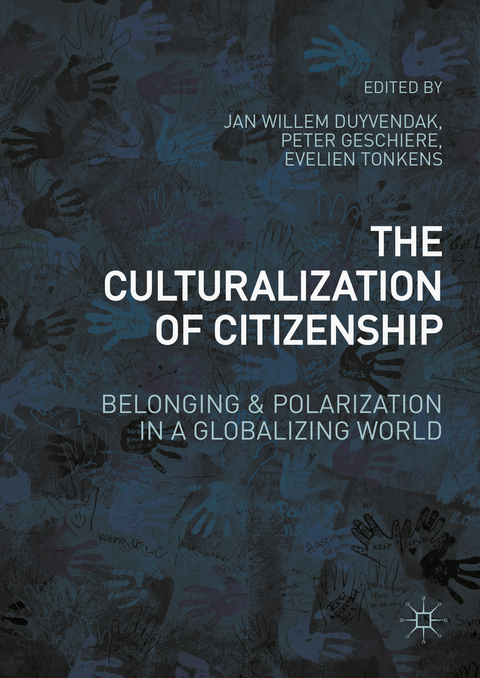
The Culturalization of Citizenship (eBook)
231 Seiten
Palgrave Macmillan UK (Verlag)
978-1-137-53410-1 (ISBN)
The notion of citizenship has gradually evolved from being simply a legal status or practice to a deep sentiment. Belonging, or feeling at home, has become a requirement. This groundbreaking book analyzes how 'feeling rules' are developed and applied to migrants, who are increasingly expected to express feelings of attachment, belonging, connectedness and loyalty to their new country. More than this, however, it demonstrates how this culturalization of citizenship is a global trend with local variations, which develop in relation to each other. The authors pay particular attention to the intersection between sexuality, race and ethnicity, spurred on by their awareness of the dialectical construction of homosexuality, held up as representative of liberal Western values by both those in the West and by African leaders, who use such claims as proof that homosexuality is un-African.
Jan Willem Duyvendak is Distinguished Research Professor of Sociology at the University of Amsterdam, the Netherlands. His current research interests span the welfare state, social movements, nativism, belonging and 'feeling at home'. His most recent books include The Politics of Home: Nostalgia and Belonging in Western Europe and the United States (Palgrave, 2011); European States and their Muslim Citizens: The Impact of Institutions on Perceptions and Boundaries (2014, co-edited with John Bowen, Christophe Bertossi and Mona Lena Krook); and Players and Arenas: The Interactive Dynamics of Protest (2015, co-edited with James M. Jasper). He is co-editor of Ethnography.
Peter Geschiere is Emeritus Professor of African Anthropology at Leiden University and the University of Amsterdam, the Netherlands, and co-editor of Ethnography. He has been pursuing historical-anthropological fieldwork in Cameroon and elsewhere in West Africa since 1971. His publications include The Modernity of Witchcraft: Politics and the Occult in Post-Colonial Africa (1997), Perils of Belonging: Autochthony, Citizenship and Exclusion in Africa and Europe (2009), and Witchcraft, Intimacy and Trust: Africa in Comparison (2013).
Evelien Tonkens is a sociologist and Professor of Citizenship and Humanisation of the Public Sector at the University for Humanistic Studies, the Netherlands. She was previously Professor of Active Citizenship at the University of Amsterdam, a member of the Dutch parliament for the Green Left, and weekly columnist for the Dutch daily newspaper Volkskrant. Her research centres on ideals of citizenship and social change. Her recent books include Summoning the Active Citizen: Responsibility, Participation and Choice (2011, with Janet Newman) and Crafting Citizenship: Negotiating Tensions in Modern Society (Palgrave, 2012, with Menno Hurenkamp and Jan Willem Duyvendak).
The notion of citizenship has gradually evolved from being simply a legal status or practice to a deep sentiment. Belonging, or feeling at home, hasbecome a requirement. This groundbreaking book analyzes how 'feeling rules' are developed and applied to migrants, who are increasingly expected to express feelings of attachment, belonging, connectedness and loyalty to their new country. More than this, however, it demonstrates how this culturalization of citizenship is a global trend with local variations, which develop in relation to each other. The authors pay particular attention to the intersection between sexuality, race and ethnicity, spurred on by their awareness of the dialectical construction of homosexuality, held up as representative of liberal Western values by both those in the West and by African leaders, who use such claims as proof that homosexuality is un-African.
Jan Willem Duyvendak is Distinguished Research Professor of Sociology at the University of Amsterdam, the Netherlands. His current research interests span the welfare state, social movements, nativism, belonging and ‘feeling at home’. His most recent books include The Politics of Home: Nostalgia and Belonging in Western Europe and the United States (Palgrave, 2011); European States and their Muslim Citizens: The Impact of Institutions on Perceptions and Boundaries (2014, co-edited with John Bowen, Christophe Bertossi and Mona Lena Krook); and Players and Arenas: The Interactive Dynamics of Protest (2015, co-edited with James M. Jasper). He is co-editor of Ethnography.Peter Geschiere is Emeritus Professor of African Anthropology at Leiden University and the University of Amsterdam, the Netherlands, and co-editor of Ethnography. He has been pursuing historical-anthropological fieldwork in Cameroon and elsewhere in West Africa since 1971. His publications include The Modernity of Witchcraft: Politics and the Occult in Post-Colonial Africa (1997), Perils of Belonging: Autochthony, Citizenship and Exclusion in Africa and Europe (2009), and Witchcraft, Intimacy and Trust: Africa in Comparison (2013).Evelien Tonkens is a sociologist and Professor of Citizenship and Humanisation of the Public Sector at the University for Humanistic Studies, the Netherlands. She was previously Professor of Active Citizenship at the University of Amsterdam, a member of the Dutch parliament for the Green Left, and weekly columnist for the Dutch daily newspaper Volkskrant. Her research centres on ideals of citizenship and social change. Her recent books include Summoning the Active Citizen: Responsibility, Participation and Choice (2011, with Janet Newman) and Crafting Citizenship: Negotiating Tensions in Modern Society (Palgrave, 2012, with Menno Hurenkamp and Jan Willem Duyvendak).
The notion of citizenship has gradually evolved from being simply a legal status or practice to a deep sentiment. Belonging, or feeling at home, has become a requirement. This groundbreaking book analyzes how 'feeling rules' are developed and applied to migrants, who are increasingly expected to express feelings of attachment, belonging, connectedness and loyalty to their new country. More than this, however, it demonstrates how this culturalization of citizenship is a global trend with local variations, which develop in relation to each other. The authors pay particular attention to the intersection between sexuality, race and ethnicity, spurred on by their awareness of the dialectical construction of homosexuality, held up as representative of liberal Western values by both those in the West and by African leaders, who use such claims as proof that homosexuality is un-African. Jan Willem Duyvendak is Distinguished Research Professor of Sociology at the University of Amsterdam, the Netherlands.Peter Geschiere is Emeritus Professor of African Anthropology at Leiden University and the University of Amsterdam, the Netherlands.Evelien Tonkens is a sociologist and Professor of Citizenship and Humanisation of the Public Sector at the University for Humanistic Studies, the Netherlands.
| Erscheint lt. Verlag | 30.6.2016 |
|---|---|
| Zusatzinfo | XII, 231 p. |
| Verlagsort | London |
| Sprache | englisch |
| Themenwelt | Sozialwissenschaften ► Ethnologie |
| Sozialwissenschaften ► Politik / Verwaltung | |
| Sozialwissenschaften ► Soziologie ► Gender Studies | |
| Sozialwissenschaften ► Soziologie ► Makrosoziologie | |
| Sozialwissenschaften ► Soziologie ► Spezielle Soziologien | |
| Schlagworte | Area Studies • belonging • culturalization, • global north • global South • polarization • Populism • Race • Sexuality • Sub-Sahara Africa |
| ISBN-10 | 1-137-53410-9 / 1137534109 |
| ISBN-13 | 978-1-137-53410-1 / 9781137534101 |
| Informationen gemäß Produktsicherheitsverordnung (GPSR) | |
| Haben Sie eine Frage zum Produkt? |
 PDF (Wasserzeichen)
DRM: Digitales Wasserzeichen
Dieses eBook enthält ein digitales Wasserzeichen und ist damit für Sie personalisiert. Bei einer missbräuchlichen Weitergabe des eBooks an Dritte ist eine Rückverfolgung an die Quelle möglich.
Dateiformat: PDF (Portable Document Format)
Mit einem festen Seitenlayout eignet sich die PDF besonders für Fachbücher mit Spalten, Tabellen und Abbildungen. Eine PDF kann auf fast allen Geräten angezeigt werden, ist aber für kleine Displays (Smartphone, eReader) nur eingeschränkt geeignet.
Systemvoraussetzungen:
PC/Mac: Mit einem PC oder Mac können Sie dieses eBook lesen. Sie benötigen dafür einen PDF-Viewer - z.B. den Adobe Reader oder Adobe Digital Editions.
eReader: Dieses eBook kann mit (fast) allen eBook-Readern gelesen werden. Mit dem amazon-Kindle ist es aber nicht kompatibel.
Smartphone/Tablet: Egal ob Apple oder Android, dieses eBook können Sie lesen. Sie benötigen dafür einen PDF-Viewer - z.B. die kostenlose Adobe Digital Editions-App.
Buying eBooks from abroad
For tax law reasons we can sell eBooks just within Germany and Switzerland. Regrettably we cannot fulfill eBook-orders from other countries.
aus dem Bereich